Thunder eggs are nodules that form in rhyolite volcanic ash and lava flows. Each has a rough rhyolite shell around a core filled with agate, chalcedony, jasper, opal or quartz, usually in a star or angular shape.
Prices checked . Page updated .
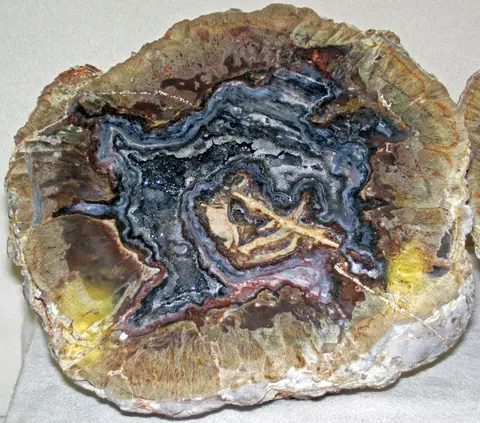
Agate-quartz nodule (Buchanan Ranch, Harney County, east of Burns, Oregon, USA) 1 (34762399356). Photo: James St. John, CC BY 2.0, via Wikimedia Commons.
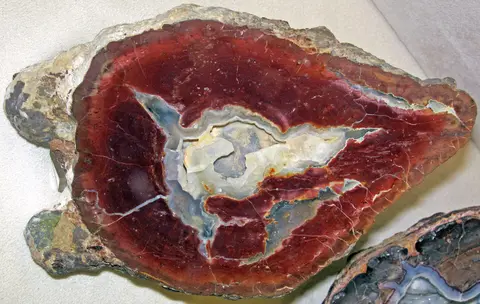
Agate nodule (Succor Creek Claim, Harney County, Oregon, USA) (34670752811). Photo: James St. John, CC BY 2.0, via Wikimedia Commons.
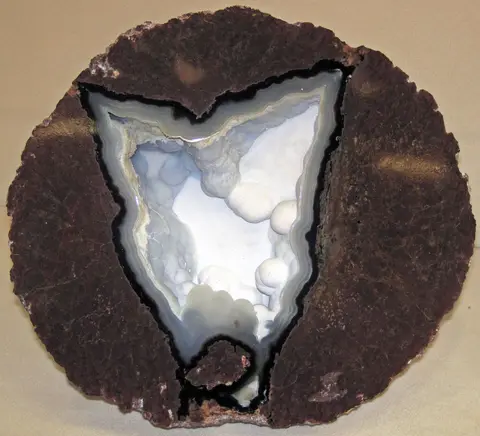
Agate-lined geode (Black Rock Desert, Gerlach, Nevada, USA) (33974978773). Photo: James St. John, CC BY 2.0, via Wikimedia Commons.
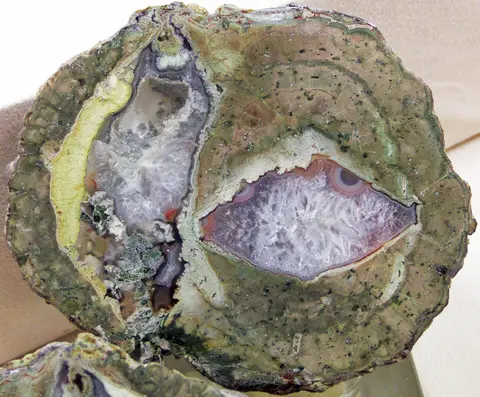
Quartz-agate nodule (Killer Green Claim, Ochoco Mountains, Prineville, Oregon, USA) (33993292453). Photo: James St. John, CC BY 2.0, via Wikimedia Commons.
What thunder eggs is worth
Not enough data. We have not yet seen 5 or more current dealer listings for thunder eggs in any one form, so we show no range rather than guess.
These are dealer asking prices: what shops list thunder eggs for, not what it sells for and not an appraisal. Selling to a dealer usually brings well below retail, because the dealer has to resell it at a margin.
How to identify thunder eggs
Round to egg-shaped nodule with a rough, knobby, brown or gray rock skin, often with ridges
When cut, a star-shaped or angular center of agate, chalcedony, jasper or opal
Usually solid or nearly solid, so it feels heavy for its size
Shell is fine-grained rhyolite, sometimes showing radial lines toward the center
Found weathering out of volcanic ash beds, often in groups
Sizes from marble to basketball, most between golf ball and softball
Thunder eggs from Australia, best known from Mount Hay in Queensland. The same kind of rhyolite nodule; Mount Hay eggs typically show blue-gray to white agate and brown jasper in star-shaped centers.
Richardson ranch thunder egg
Thunder eggs from Richardson's Ranch, near Madras in Jefferson County, Oregon, including the historic Priday beds. Oregon thunder eggs from one well-known ranch, known for blue agate, plume and fortification centers.
Where thunder eggs comes from
Central and eastern Oregon, USA
The classic source, including Richardson's Ranch near Madras, Succor Creek and the Lucky Strike area near Mitchell.
Mount Hay, Queensland, Australia
Well known Australian thunder eggs with blue-gray and brown agate cores.
Chihuahua, Mexico
Agate-filled nodules from rhyolite such as Las Choyas, often sold as geodes.
Star or angular filled center with agate or chalcedony and a rhyolite rim.
Fake or lookalike
Geodes show hollow crystal-lined cavities; septarians show a crack network.
Acetone swab for dye
Rub a cotton swab dampened with acetone on the cut face.
Real
Swab stays clean.
Fake or lookalike
Dyed cores may tint the swab.
Vinegar drop
Put a drop of household vinegar on the shell and core.
Real
No fizzing.
Fake or lookalike
Septarian nodules and limestone geodes fizz.
A stone that passes these tests is consistent with natural thunder eggs, not proven. For valuable pieces, a gem lab report settles treatment and origin.
Treatments
Dyeing (occasional)
Adds bright colors to porous agate cores; dyed eggs sell as decor and are worth less to collectors. Unnatural colors and an acetone swab test.
Stabilizing or sealing (occasional)
Fills cracks or adds shine to cut faces; lowers collector value. Loupe for surface film or filled pits.
What moves the price of thunder eggs
Core quality. Colorful, well-defined agate, plume or opal centers bring the most.
Core size relative to shell. A large filled center outsells a mostly rock egg.
Locality. Named Oregon beds and other known localities carry premiums.
Cut and polish. Matched polished halves sell better than uncut eggs.
Size. Large intact eggs and matched pairs are scarcer.
Uncut status. Uncut eggs sell as a gamble and are usually worth less than proven good pairs.