What agatized coral is worth
Not enough data. We have not yet seen 5 or more current dealer listings for agatized coral in any one form, so we show no range rather than guess.
Show 4 of the listings behind these numbers
These are dealer asking prices: what shops list agatized coral for, not what it sells for and not an appraisal. Selling to a dealer usually brings well below retail, because the dealer has to resell it at a margin.
How to identify agatized coral
- Flower-like or honeycomb pattern of small rounded or star-shaped cells (corallites), each a former coral polyp
- Waxy, translucent chalcedony that glows when a flashlight is held behind it
- Hardness about 7: scratches glass and resists a steel knife
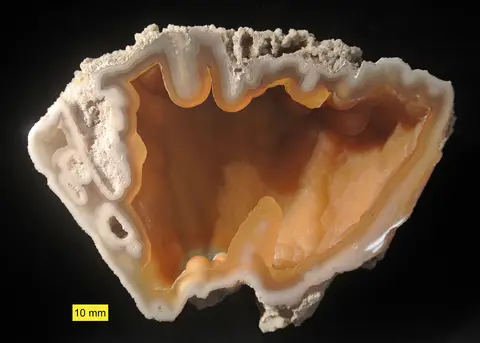
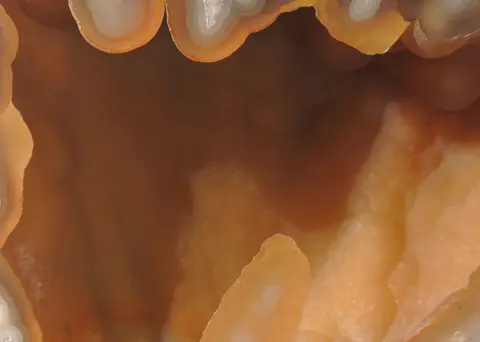
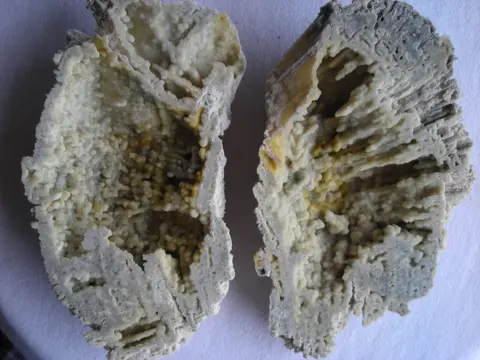
- Hollow Florida coral heads may be lined with banded chalcedony or tiny quartz crystals, like small geodes
- Colors from white, grey and tan to pink, red, brown, yellow and black
- No fizzing with vinegar, unlike unreplaced calcite coral
Where agatized coral comes from
- Tampa Bay and west central Florida, USA
- Oligocene coral heads replaced by chalcedony, found around Tampa Bay and in the Withlacoochee and Suwannee rivers; hollow geodized heads are prized.
- Indonesia
- Source of colorful polished agatized coral slabs and cabochons sold as Indonesian coral; color is sometimes enhanced.
- Morocco
- Fossil coral, some of it silicified, sold as polished pieces; check whether it is agatized or calcite.
Agatized coral lookalikes
Petoskey stone is calcite fossil coral that a knife scratches easily and that fizzes with vinegar.
- Hardness 3 to 4
- Opaque grey to brown with hexagonal cells
Charlevoix stone is calcite Favosites coral with small cells; soft and reacts to vinegar.
Chrysanthemum stone shows radiating flower shapes of celestite or calcite in dark rock, not packed coral cells.
- Soft, does not scratch glass
Agate shows bands but lacks the repeating corallite cell pattern.
A hollow coral head has coral cell patterns on its outer surface; ordinary geodes have a plain rind.
- Both may have crystal-lined hollows
Also mistaken for agatized coral: palm wood, dinosaur bone.
Fake, dyed and treated agatized coral
Dyed agatized coral
Occasional
- Bright unnatural reds, blues or greens
- Color concentrated in cracks and porous cells
- Color on an acetone swab in cheap pieces
Calcite fossil coral sold as agatized coral
Common
- Knife scratches it
- Fizzes with vinegar
- Opaque dull look
Resin stabilized or filled pieces
Occasional
- Glossy plastic-like fill in hollow cells
- Bubbles in filled areas
Is my agatized coral real? Tests you can do at home
-
Knife scratch
Try to scratch a hidden spot with a steel knife.
- Real
- Agatized coral resists the knife.
- Fake or lookalike
- Calcite coral scratches easily.
Can leave a small mark.
-
Vinegar drop
Place a drop of household vinegar on an unpolished spot and watch with a loupe for a minute.
- Real
- No reaction.
- Fake or lookalike
- Calcite coral fizzes with tiny bubbles.
Can leave a small mark.
-
Flashlight translucency
Shine a flashlight through a thin edge in a dark room.
- Real
- Chalcedony glows and shows cell outlines.
- Fake or lookalike
- Calcite coral and most opaque rocks stay dark.
-
Acetone swab
Rub a hidden area with a swab dampened with acetone.
- Real
- Swab stays clean.
- Fake or lookalike
- Some dyed pieces transfer color; a clean swab does not prove natural color.
A stone that passes these tests is consistent with natural agatized coral, not proven. For valuable pieces, a gem lab report settles treatment and origin.
Treatments
- Dyeing (occasional)
- Strengthens or adds color, mostly in imported material; dyed pieces are worth less. Unnatural color and dye pooling in cells and cracks.
- Resin stabilization (occasional)
- Fills porous or hollow areas so slabs can be polished; lowers collector value. Glossy fill and bubbles under a loupe.
What moves the price of agatized coral
- Pattern definition. Crisp, clearly defined corallites across the face are the main driver.
- Color. Natural pinks, reds, yellows and contrasting colors add value; undisclosed dye reduces it.
- Form. Hollow Florida coral heads lined with chalcedony or crystals are sought as specimens.
- Locality. Documented Florida material is popular with American collectors.
- Solidity and size. Large, crack-free, fully silicified pieces cut the best slabs and cabochons.
Questions collectors ask about agatized coral
- How much is agatized coral worth?
- Value depends on how sharp and colorful the coral pattern is, whether the piece is a whole geodized coral head or a cut stone, and whether the color is natural. See the price table above for current figures.
Sources
Prices: 4 current listings from Kingsley North, Trade Roots, seen 2026-11-20 to 2026-11-20. How we collect prices.