What chrysanthemum stone is worth
Not enough data. We have not yet seen 5 or more current dealer listings for chrysanthemum stone in any one form, so we show no range rather than guess.
These are dealer asking prices: what shops list chrysanthemum stone for, not what it sells for and not an appraisal. Selling to a dealer usually brings well below retail, because the dealer has to resell it at a margin.
How to identify chrysanthemum stone
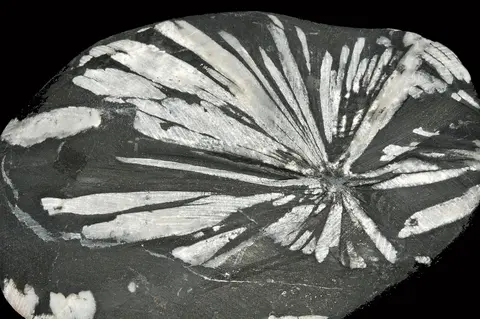
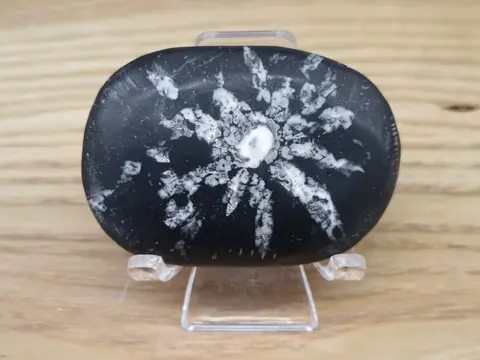
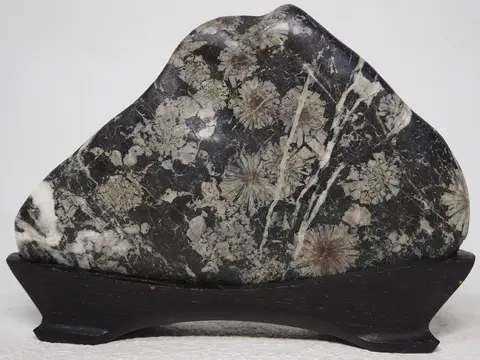
- White to cream radiating 'petals' spreading from a center, set in dark gray to black rock.
- Petals are made of elongated crystal blades that you can see under a loupe, not brushed or flat lines.
- Flowers vary in size and shape across a piece and are cut through at different angles.
- Most pieces are polished on one face and left natural or rough on the back.
- Soft: a steel knife scratches both the dark matrix and the flowers.
- Matrix may fizz slowly with household vinegar if it is calcareous.
Where chrysanthemum stone comes from
- Liuyang, Hunan, China
- The main source; Permian limestone with celestine flowers, carved locally into display pieces.
- Vancouver Island and Texada Island, British Columbia, Canada
- Local 'flower stone' is a different rock: dark volcanic porphyry with radiating feldspar crystals.
Chrysanthemum stone lookalikes
British Columbia flower stone
BC flower stone is a hard volcanic porphyry with feldspar flowers that do not scratch with steel; Chinese chrysanthemum stone scratches easily.
- Feldspar hardness 6
- Darker green-black matrix
Chiastolite shows a dark cross inside square crystal sections, not a radiating flower.
Dalmatian stone is white with black spots, the reverse of chrysanthemum stone.
Also mistaken for chrysanthemum stone: agatized coral.
Fake, dyed and treated chrysanthemum stone
Painted or enhanced flowers on black stone
Common
- Flowers that look brushed, flat and too perfect
- No crystal blades visible under a loupe
- White color rubs off with acetone
Carved or inlaid flowers set into dark stone or resin
Occasional
- Sharp, cut outlines around petals
- Glue lines or resin fill at petal edges
Matrix blackened with dye or heavy oil to increase contrast
Common
- Black transfers to a cotton swab with acetone
- Greasy surface
Is my chrysanthemum stone real? Tests you can do at home
-
Loupe on the petals
Look at the flowers with a 10x loupe.
- Real
- Bladed crystals with natural edges, sometimes slightly raised or recessed after polishing.
- Fake or lookalike
- Smooth paint, brush marks, or cut inlay outlines.
-
Acetone swab
Rub acetone on a cotton swab across a small area of a flower and the matrix on the back.
- Real
- No color transfer.
- Fake or lookalike
- White paint or black dye comes off.
Can leave a small mark.
-
Steel knife scratch
Scratch the unpolished back lightly with a steel knife.
- Real
- Scratches easily.
- Fake or lookalike
- BC feldspar flower stone resists steel.
Can leave a small mark.
A stone that passes these tests is consistent with natural chrysanthemum stone, not proven. For valuable pieces, a gem lab report settles treatment and origin.
Treatments
- Waxing and oiling (almost always)
- Darkens the matrix and boosts contrast; routine for display pieces. Waxy surface; contrast fades over time.
- Dyeing the matrix (occasional)
- Increases contrast artificially; lowers value. Acetone swab.
What moves the price of chrysanthemum stone
- Flower quality. Large, complete, symmetrical flowers with crisp white petals are the main factor.
- Composition. Well-placed flowers on a pleasing shape, especially for display stones, add value.
- Natural vs enhanced. Natural flowers with no paint or inlay are what collectors pay for.
- Carving. Skilled carving that works around the flowers raises value.
- Size. Large pieces with several fine flowers are scarcer.
Care and safety
Soft and calcareous: avoid acids, harsh cleaners and scratching; dust gently and re-wax if the surface dulls.