RockValues

Chiastolite value and identification

Chiastolite is andalusite whose crystals trapped dark carbon-rich material along specific growth zones, so a cross section shows a black cross or X on a gray, brown or pink background.

A variety of andalusite. Prices checked .
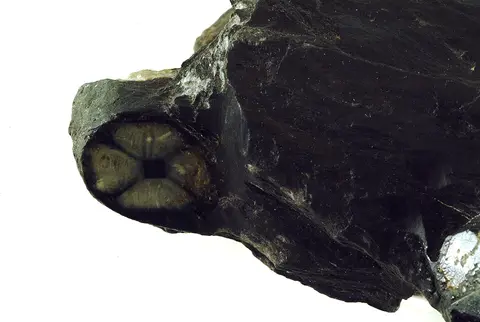
Chiastolite: Andalusite (chiastolite) (GeoDIL number - 388)
Andalusite (chiastolite) (GeoDIL number - 388). Photo: Shannon Heinle, CC0, via Wikimedia Commons.
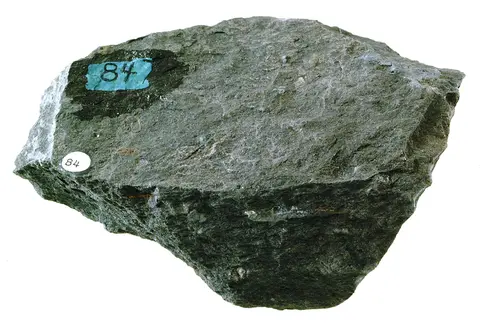
Chiastolite: Andalusite (chiastolite) Slate (GeoDIL number - 335)
Andalusite (chiastolite) Slate (GeoDIL number - 335). Photo: Mike Davis, CC0, via Wikimedia Commons.

What chiastolite is worth

Not enough data. We have not yet seen 5 or more current dealer listings for chiastolite in any one form, so we show no range rather than guess.

Show 1 of the listings behind these numbers
Sample dealer listings for Chiastolite
ListingSizeLocalityAskingSeen
Andalusite var. chiastolite #65467
Dakota Matrix Minerals
1.2 cmLancaster, Worcester Co., Massachusetts, United States$20

These are dealer asking prices: what shops list chiastolite for, not what it sells for and not an appraisal. Selling to a dealer usually brings well below retail, because the dealer has to resell it at a margin.

How to identify chiastolite

It is opaque and sold as slices, tumbled stones and pendants for its cross pattern rather than faceted for pleochroism. See andalusite value for the species as a whole.

  • Square cross section with a dark cross running corner to corner or a dark central square.
  • Gray, tan, brown or pinkish body color around the dark pattern.
  • Often in long prismatic crystals embedded in dark slate or schist.
  • Surface may be partly altered to soft mica, so polished pieces can feel softer than gem andalusite.

Where chiastolite comes from

Bimbowrie, South Australia
Large crystals with clear crosses.
Lancaster, Massachusetts, USA
Historic locality in schist.
China
Supplies much of the polished chiastolite sold in shops today.
Spain
Metamorphic slates with chiastolite crystals.

Chiastolite lookalikes

Staurolite

Staurolite crosses are two whole crystals grown through each other; chiastolite's cross is inside one crystal and seen on a cut face.

  • Staurolite is dark brown and heavier
  • Both are sold as 'fairy cross'

Also mistaken for chiastolite: chrysanthemum stone.

Fake, dyed and treated chiastolite

  • Staurolite and chiastolite mixed up in 'fairy cross' sales

    Common

    • Check whether the cross is a twin shape or a pattern on a slice

Is my chiastolite real? Tests you can do at home

  1. Look at both ends

    Compare the pattern on the two cut ends of a slice or crystal.

    Real
    The cross shape shows on both ends, varying slightly along the crystal.
    Fake or lookalike
    A painted or printed pattern appears on one face only.
  2. Steel scratch on the base

    Try to scratch an unpolished spot with a steel knife.

    Real
    Fresh andalusite resists the knife; altered surfaces may mark.
    Fake or lookalike
    Resin or painted imitations scratch easily.

    Can leave a small mark.

A stone that passes these tests is consistent with natural chiastolite, not proven. For valuable pieces, a gem lab report settles treatment and origin.

Treatments

Waxing or resin coating (occasional)
Improves the shine on polished slices; little effect on value. Plastic feel and film in pits.

What moves the price of chiastolite

  1. Pattern sharpness. A crisp, symmetrical cross is the main value point.
  2. Contrast. Black cross on a pale body color is preferred.
  3. Size and form. Large whole crystals in matrix sell as specimens.
  4. Locality. Classic localities like Bimbowrie appeal to specimen collectors.

Sources

Prices: 1 current listings from Dakota Matrix Minerals, seen 2026-11-20 to 2026-11-20. How we collect prices.