RockValues

Staurolite value and identification

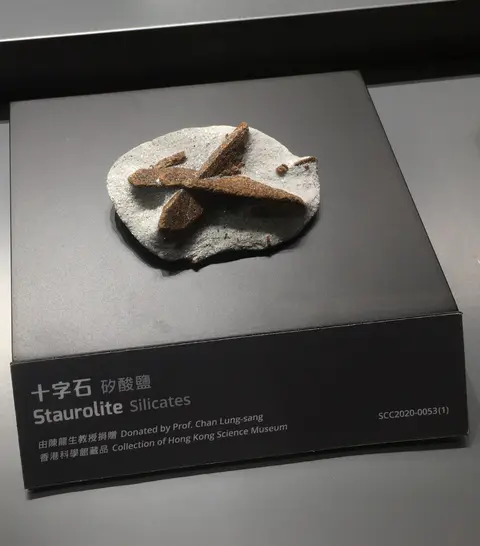
Staurolite is an iron aluminum silicate hydroxide that grows in medium-grade metamorphic rocks such as mica schist. Its twinned crystals that cross at 90 or 60 degrees are sold as fairy crosses.

Prices checked . Page updated .
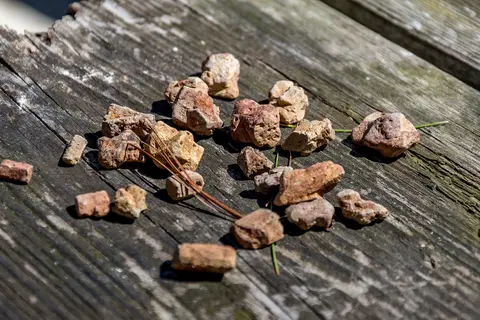
Staurolite: Raw Fairy Stones - staurolite crystallizes into the shape of crosses 60 and 90 degrees (26224799371)
Raw Fairy Stones - staurolite crystallizes into the shape of crosses 60 and 90 degrees (26224799371). Photo: Virginia State Parks, CC BY 2.0, via Wikimedia Commons.
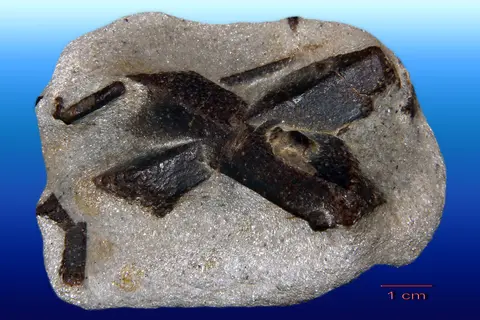
Staurolite: Staurolite specimen
Staurolite specimen. Photo: 384, CC BY-SA 4.0, via Wikimedia Commons.
Staurolite: Staurolite (Staurolit) - Pestsovye Keivy, Keivy Mountains, Kola Peninsula, Murmanskaja Oblast', Northern Region, Russia
Staurolite (Staurolit) - Pestsovye Keivy, Keivy Mountains, Kola Peninsula, Murmanskaja Oblast', Northern Region, Russia. Photo: Lech Darski, CC BY-SA 4.0, via Wikimedia Commons.
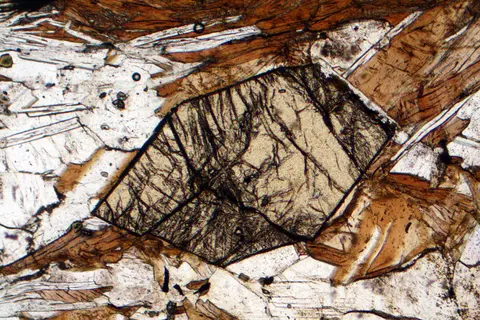
Staurolite: Staurolite sardinia
Staurolite sardinia. Photo: Strekeisen, CC BY-SA 4.0, via Wikimedia Commons.

What staurolite is worth

Not enough data. We have not yet seen 5 or more current dealer listings for staurolite in any one form, so we show no range rather than guess.

Show 6 of the listings behind these numbers
Sample dealer listings for Staurolite
ListingSizeLocalityAskingSeen
.8" Twinned Staurolite Cross In Glittering Mica-Schist - Russia
FossilEra
Russia$12
1" Twinned Staurolite Cross In Glittering Mica-Schist - Russia
FossilEra
2.5 cmRussia$29
1.4" Twinned Staurolite Cross In Glittering Mica-Schist - Russia
FossilEra
3.6 cmRussia$29
1.3" Twinned Staurolite Cross In Glittering Mica-Schist - Russia
FossilEra
3.3 cmRussia$29
1.3" Twinned Staurolite Cross In Glittering Mica-Schist - Russia
FossilEra
3.3 cmRussia$29
1.2" Twinned Staurolite Cross In Glittering Mica-Schist - Russia
FossilEra
3.1 cmRussia$29

These are dealer asking prices: what shops list staurolite for, not what it sells for and not an appraisal. Selling to a dealer usually brings well below retail, because the dealer has to resell it at a margin.

How to identify staurolite

  • Brown to reddish-brown or nearly black prismatic crystals, often six-sided in cross section
  • Penetration twins forming a cross at about 90 degrees or an X at about 60 degrees
  • Usually embedded in or weathered out of shiny mica schist
  • Hard: scratches glass easily (hardness 7 to 7.5)
  • Surface often rough or dull, with mica flakes stuck to it
  • Heavier than quartz of similar size

Where staurolite comes from

Fairy Stone State Park, Patrick County, Virginia, USA
The best known source of fairy crosses; collecting is allowed in a designated area of the park.
Blue Ridge and Fannin County, Georgia, USA
Twins weathered out of schist, collected for generations.
Taos County, New Mexico, USA
Twinned crystals in schist near Taos.
Keivy, Kola Peninsula, Russia
Large, sharp twins and single crystals.
Coray, Brittany, France
Classic European crosses.
Pizzo Forno, Ticino, Switzerland
Sharp crystals with blue kyanite in white paragonite schist, a classic display combination.

Staurolite lookalikes

Chiastolite

Chiastolite shows a dark cross inside a cut cross section; staurolite is shaped like a cross from the outside.

  • Chiastolite is andalusite with carbon inclusions
  • Chiastolite SG about 3.1 to 3.2
  • Usually gray or tan, not brown

Garnet in schist

Garnet forms round, many-faced crystals, not long prisms or crosses.

  • Garnet has no cleavage
  • Red to brownish red
  • Both occur in the same schists

Kyanite

Kyanite is blue, bladed and much softer along its length.

  • Kyanite hardness 4.5 to 7 depending on direction
  • Flat blades, not stubby prisms

Tourmaline (schorl)

Schorl is black with lengthwise striations and a triangular cross section.

  • SG about 3.1 to 3.2
  • No twinned crosses

Also mistaken for staurolite: andalusite.

Fake, dyed and treated staurolite

  • Carved or molded fairy crosses

    Common

    • Perfectly symmetrical crosses that look identical
    • Mold seams or tool marks
    • Soft enough to be scratched by a knife
    • Smooth, uniform surface with no schist or mica attached
  • Cross-shaped rocks and chiastolite sold as fairy crosses

    Occasional

    • Cross pattern only visible on a cut face
    • Wrong color or softness

Is my staurolite real? Tests you can do at home

  1. Scratch test against glass

    Press a sharp edge of the crystal across a glass bottle.

    Real
    Scratches glass easily.
    Fake or lookalike
    Carved soft stone and molded clay or resin do not.

    Can leave a small mark.

  2. Loupe for natural surface

    Examine the arms and the joint between them with a 10x loupe.

    Real
    Natural crystal faces, slight irregularities, often mica flakes or schist stuck on.
    Fake or lookalike
    Tool marks, mold seams, perfectly uniform shape.
  3. Specific gravity with a kitchen scale

    Weigh the piece dry, then suspended in water; divide dry weight by the loss in weight.

    Real
    About 3.7 to 3.8.
    Fake or lookalike
    Carved soft stones and resin are much lower, usually under 3.

A stone that passes these tests is consistent with natural staurolite, not proven. For valuable pieces, a gem lab report settles treatment and origin.

Treatments

Cleaning and oiling (occasional)
Removing schist and oiling darkens and brightens crosses; it does not add value. Oily feel or uniform sheen.

What moves the price of staurolite

  1. Twin quality. Clean, symmetrical 90 degree crosses are the most wanted; 60 degree X twins are more common.
  2. Crystal sharpness. Sharp faces and complete arms beat weathered or broken twins.
  3. Matrix. Crystals in schist, especially with kyanite, are valued as display pieces.
  4. Size. Larger complete twins are scarcer.
  5. Locality. Pizzo Forno and Keivy pieces bring more than common tourist crosses.

Sources

Prices: 6 current listings from FossilEra, seen 2026-11-20 to 2026-11-20. How we collect prices.