What dalmatian stone is worth
Not enough data. We have not yet seen 5 or more current dealer listings for dalmatian stone in any one form, so we show no range rather than guess.
These are dealer asking prices: what shops list dalmatian stone for, not what it sells for and not an appraisal. Selling to a dealer usually brings well below retail, because the dealer has to resell it at a margin.
How to identify dalmatian stone
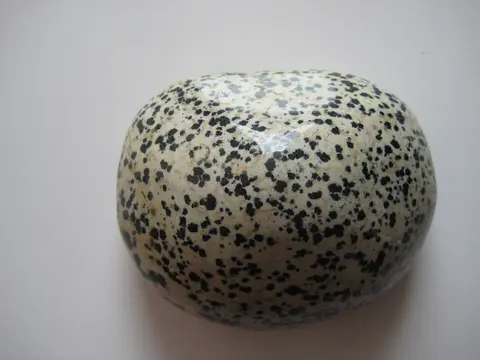
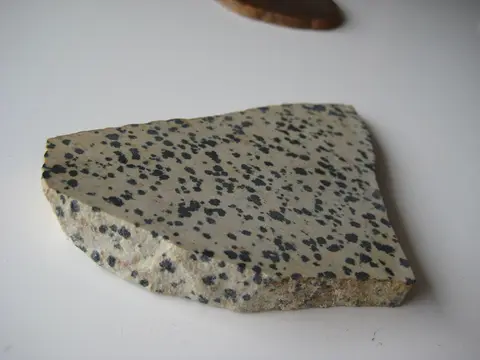
- Cream, off-white or light tan background with irregular black to dark grey spots, like a dalmatian dog's coat
- Some pieces show rusty orange or brown patches from iron oxide staining
- Granular, crystalline texture visible under a loupe, with flat feldspar cleavage glints
- Opaque with a waxy to dull polish
- Scratches glass (feldspar and quartz, hardness about 6 to 7)
- Common as tumbled stones, beads and small carvings
Where dalmatian stone comes from
- Chihuahua, Mexico
- The commercial source of dalmatian stone; nearly all material on the market comes from here.
Dalmatian stone lookalikes
This is the same rock under a misleading trade name; it is not jasper, which is microcrystalline quartz.
- Sold interchangeably
- No difference in properties
Howlite has grey or black web-like veins, not separate spots, and a knife scratches it easily (hardness 3 to 3.5).
- Howlite SG about 2.5
- Chalky white
Snowflake obsidian is the reverse: a black glassy background with white spots.
- Volcanic glass, conchoidal fracture
- Hardness about 5.5
Leopard skin jasper has ring-like or blotchy tan, pink and brown spots, not crisp black dots on cream.
- Rhyolite based
- More color variety
Also mistaken for dalmatian stone: chrysanthemum stone, llanite.
Fake, dyed and treated dalmatian stone
Dyed dalmatian stone in pink, blue, purple, green or red
Common
- Bright colors that do not occur naturally
- Color concentrated in cracks and pores
- Color on an acetone swab in some cases
Ceramic or glass beads with printed or fired black dots
Occasional
- Perfectly round, uniform dots
- Smooth, glassy body with no crystal grains
- Bubbles under a loupe in glass
Dyed howlite or magnesite with spots
Rare
- Knife scratches it
- Vein pattern instead of spots
Is my dalmatian stone real? Tests you can do at home
-
Loupe check for crystal grains
Examine the surface and a black spot at 10x.
- Real
- Interlocking grains of feldspar and quartz and irregular black mineral clusters.
- Fake or lookalike
- Ceramic or glass shows a smooth uniform body and painted or perfectly round dots.
-
Knife scratch
Try to scratch a hidden spot with a steel knife.
- Real
- Dalmatian stone resists the knife.
- Fake or lookalike
- Howlite and magnesite scratch easily.
Can leave a small mark.
-
Acetone swab for dye
Rub a colored piece with a cotton swab dampened with acetone.
- Real
- Natural cream and black stones leave the swab clean.
- Fake or lookalike
- Some dyed stones color the swab; any bright pink, blue or purple stone is dyed regardless.
A stone that passes these tests is consistent with natural dalmatian stone, not proven. For valuable pieces, a gem lab report settles treatment and origin.
Treatments
- Dyeing (common)
- Produces colored versions for beads and jewelry; these sell as decorative material. Unnatural color and dye in cracks.
- Waxing (occasional)
- Improves the polish on porous beads. Slightly greasy feel.
What moves the price of dalmatian stone
- Contrast and spot pattern. Clean cream background with crisp, evenly scattered black spots is preferred.
- Absence of staining. Heavy orange iron staining lowers appeal for many buyers.
- Form. Carvings, spheres and large polished pieces sell above tumbles and beads.
- Treatment. Natural colored stone is generally preferred over dyed versions.
- Size. Larger solid pieces without fractures.