RockValues

Petoskey stone value and identification

A Petoskey stone is a fossil of the colonial coral Hexagonaria percarinata, preserved in limestone from the Devonian period, found mainly along the northern Lake Michigan shore. It is Michigan's state stone.

Prices checked . Page updated .
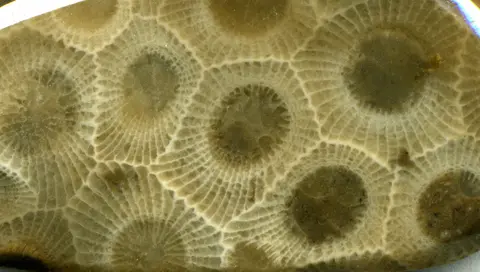
Petoskey stone: Hexagonaria percarinata (fossil coral) (Petoskey Stone) (Traverse Group, Middle Devonian; Michigan, USA) 10
Hexagonaria percarinata (fossil coral) (Petoskey Stone) (Traverse Group, Middle Devonian; Michigan, USA) 10. Photo: James St. John, CC BY 2.0, via Wikimedia Commons.
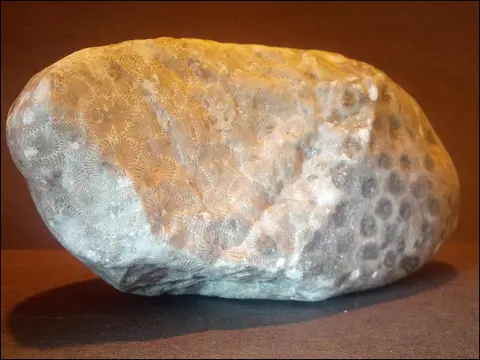
Petoskey stone: Hexagonaria percarinata fossil coral (Petoskey Stone) (Traverse Group, Middle Devonian; Michigan, USA) 1 (15018363137)
Hexagonaria percarinata fossil coral (Petoskey Stone) (Traverse Group, Middle Devonian; Michigan, USA) 1 (15018363137). Photo: James St. John, CC BY 2.0, via Wikimedia Commons.
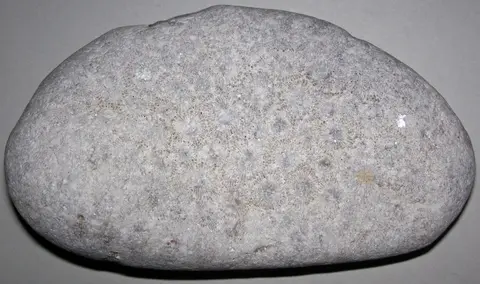
Petoskey stone: Unpolished Petoskey Stone (Photo by John Mortimore)
Unpolished Petoskey Stone (Photo by John Mortimore). Photo: John Mortimore, CC BY-SA 3.0, via Wikimedia Commons.

What petoskey stone is worth

Not enough data. We have not yet seen 5 or more current dealer listings for petoskey stone in any one form, so we show no range rather than guess.

Show 4 of the listings behind these numbers

These are dealer asking prices: what shops list petoskey stone for, not what it sells for and not an appraisal. Selling to a dealer usually brings well below retail, because the dealer has to resell it at a margin.

How to identify petoskey stone

  • Pattern of tightly packed six-sided cells, each with a dark center 'eye' and radiating lines (septa).
  • Pattern is faint when dry and shows clearly when the stone is wet or polished.
  • Gray to tan or light brown color; beach pebbles are rounded and smooth.
  • Soft: a steel knife scratches it easily (calcite, hardness about 3).
  • Fizzes slowly with a drop of household vinegar because it is calcite.

Where petoskey stone comes from

Petoskey and Little Traverse Bay, Michigan
The classic area, along Lake Michigan beaches and in gravel pits.
Charlevoix and Grand Traverse Bay, Michigan
Beaches with Petoskey stones and Charlevoix stones.
Leelanau Peninsula and Northport, Michigan
Beach collecting where permitted.
Inland gravel pits of the northern Lower Peninsula
Glacially transported stones.

Petoskey stone lookalikes

Other Hexagonaria and colonial corals

Hexagonaria fossils from Iowa and other Devonian rocks look similar; only provenance separates them.

  • Same genus or close relatives

Horn corals (solitary rugose corals)

Horn corals are a single cone shape, not a colony of cells.

Also mistaken for petoskey stone: turritella agate, agatized coral.

Fake, dyed and treated petoskey stone

  • Lacquered or clear-coated stones

    Common

    • Plastic-like shine that does not change wet or dry
    • Coating peels at edges
    • Pattern looks the same wet or dry
  • Hexagonaria from other states or countries sold as Michigan Petoskey stones

    Occasional

    • Unusual color or matrix
    • Bulk lots of identical polished pieces
  • Dyed or stained stones to darken the pattern

    Rare

    • Color sits in cells and scratches
    • Unnaturally dark contrast
  • Resin castings and printed patterns

    Rare

    • Light and warm
    • No vinegar fizz
    • Repeated identical pattern

Is my petoskey stone real? Tests you can do at home

  1. Wet test

    Dip the stone in water or wipe with a wet cloth.

    Real
    The hexagonal cell pattern with dark eyes appears clearly.
    Fake or lookalike
    Coated stones look the same wet or dry; plain limestone shows no pattern.
  2. Loupe on the cells

    Examine the cells at 10x.

    Real
    Each cell has a dark center and fine radiating septa.
    Fake or lookalike
    Charlevoix stones have plain honeycomb cells; casts show soft, blurred detail.
  3. Vinegar drop

    Place one drop of household vinegar on a hidden spot and watch with a loupe, then rinse.

    Real
    Slow tiny bubbles (calcite).
    Fake or lookalike
    Resin does not react.

    Can leave a small mark.

  4. Knife scratch

    Draw a steel point on a hidden spot.

    Real
    Scratches easily.
    Fake or lookalike
    Glass or hard simulants resist.

    Can leave a small mark.

A stone that passes these tests is consistent with natural petoskey stone, not proven. For valuable pieces, a gem lab report settles treatment and origin.

Treatments

Polishing (almost always)
Hand or machine polishing brings out the pattern; standard and expected. Visible.
Clear coating or lacquer (common)
Gives a permanent wet look; collectors prefer a true polish. Pattern unchanged when wet; coating flakes.
Wax or mineral oil (common)
Enhances pattern temporarily; harmless. Greasy feel.

What moves the price of petoskey stone

  1. Pattern clarity. Crisp, even cells with dark eyes across the whole surface.
  2. Polish. A true high polish over a coated finish.
  3. Size. Large stones and big intact colonies.
  4. Shape and condition. Even shapes without chips, fractures or pits.
  5. Craft use. Jewelry and carved pieces from good material.

Care and safety

Michigan limits collecting on state land and bottomlands to 25 pounds per person per year, and removing rocks is prohibited in Sleeping Bear Dunes National Lakeshore.

Calcite-based and soft: avoid vinegar, lemon juice and other acids, and store away from harder stones. Repolish dull stones by hand with fine wet sandpaper.

Sources

Prices: 4 current listings from Throwin Stones, seen 2026-11-20 to 2026-11-20. How we collect prices.