RockValues

Agate value and identification

Dealers list agate rough at $6.50 to $21 per pound; tumbled stones run about $23 to $72 per pound.

Prices checked . Page updated .

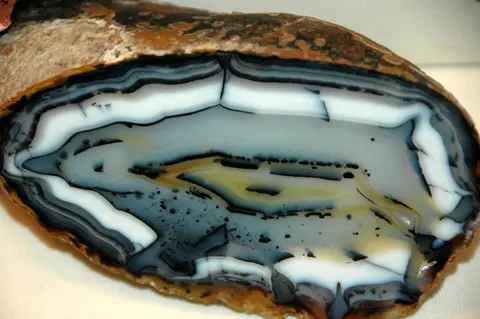
Agate: Agate 28
Agate 28. Photo: James St. John, CC BY 2.0, via Wikimedia Commons.
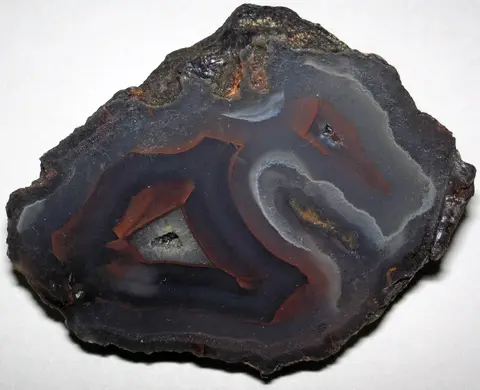
Agate: Agate (Turkey)
Agate (Turkey). Photo: James St. John, CC BY 2.0, via Wikimedia Commons.
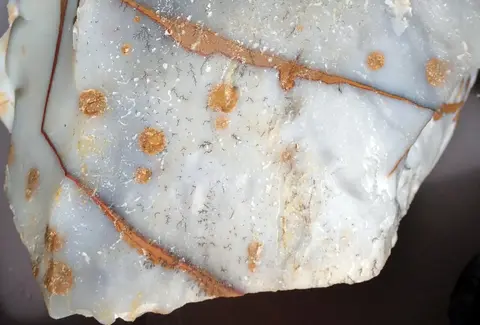
Agate: "Polka Dot Agate" (Polka Dot Agate Mine, northeast of Madras, Oregon, USA) 4
"Polka Dot Agate" (Polka Dot Agate Mine, northeast of Madras, Oregon, USA) 4. Photo: James St. John, CC BY 4.0, via Wikimedia Commons.
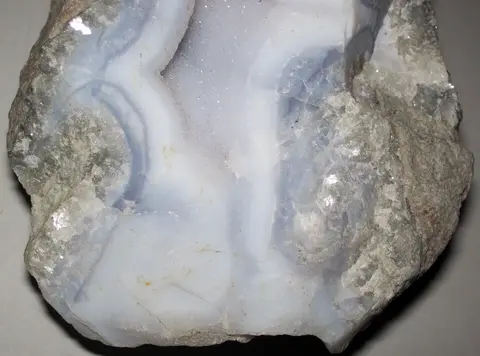
Agate: Agate (Madagascar) 2 (31941596973)
Agate (Madagascar) 2 (31941596973). Photo: James St. John, CC BY 2.0, via Wikimedia Commons.

What agate is worth

Dealer asking prices for agate, middle half of current listings, checked 2026-11-20. Bar shows the 25th to 75th percentile; the dark tick is the median.
Form and sizeTypical asking priceRange chartMedianListings
Rough (per pound)$6.44 to $21$1120 from 2 dealers
Tumbled stones (per pound)$23 to $72$2716 from 2 dealers
Carvings and shapes (per piece)Not enough data (2 listings, need 5)
Specimens (per piece)Not enough data (1 listing, need 5)

By variety

Median dealer asking price by variety (rough).
VarietyMedianListings
Brazilian agate$5.99 per pound5
Crazy lace agateNot enough data2
Botswana agateNot enough data2
Tree agateNot enough data2
Montana agateNot enough data2
Blue lace agateNot enough data1
Plume agateNot enough data1
Show 12 of the listings behind these numbers
Sample dealer listings for Agate
ListingSizeLocalityAskingSeen
1.5" Moss Agate Worry Stones
FossilEra
3.8 cm$4
Brazilian Agate Rough - Small
Kingsley North
1 lbBrazil$4
1.5" Polished Blue Lace Agate Worry Stone
FossilEra
3.8 cm$5
Brazilian Agate Rough - 2nd Grade
Kingsley North
1 lb$5
BANDED AGATE Tumbled Stones - Tumbled Crystals, Self Care, Healing Crystals and Stones, E1377 (Small)
Throwin Stones
2.5 cm$5.40
BANDED AGATE Tumbled Stones - Tumbled Crystals, Self Care, Healing Crystals and Stones, E1377 (Extra Small)
Throwin Stones
2.5 cm$5.85
BANDED AGATE Tumbled Stones - Tumbled Crystals, Self Care, Healing Crystals and Stones, E1377 (Medium)
Throwin Stones
2.5 cm$5.85
1.7" Polished Moss Agate Pocket Stones
FossilEra
4.3 cm$6
Brazilian Agate Rough - Large
Kingsley North
1 lbBrazil$6
Green Tree Agate, Tumbling Rough, per lb (Tumbling)
The Gem Shop
3.8 cmIndia$6
Brazilian Agate Rough - Medium
Kingsley North
1 lbBrazil$6.60
1.9" Polished Crazy Lace Agate Worry Stones
FossilEra
4.8 cm$7

These are dealer asking prices: what shops list agate for, not what it sells for and not an appraisal. Selling to a dealer usually brings well below retail, because the dealer has to resell it at a margin.

How to identify agate

Agate is banded chalcedony, a microcrystalline form of quartz (silicon dioxide) that fills cavities in volcanic rock and sediments layer by layer. The bands, translucency and color come from changes in impurities such as iron oxides as each layer was deposited.

  • Concentric or parallel banding, visible on a broken face or when light is shone through a thin edge
  • Waxy to glassy luster on fresh breaks, and smooth shell-like (conchoidal) fractures with no flat cleavage faces
  • Translucent: a flashlight pressed against the stone makes it glow, especially at thin edges, unlike jasper which stays dark
  • Hardness about 7: scratches glass and a steel knife blade without being marked itself
  • Rough nodules often have a pitted, rind-like outer husk, sometimes with iron staining, and may show a clear quartz or crystal-lined center
  • Feels heavier than glass of the same size would suggest only slightly; specific gravity about 2.6, so it is not unusually heavy or light

Agate varieties

Coyamito agate

Coyamito agate is a fortification agate from the Coyamito ranch area of Chihuahua, Mexico, with fine bands in red, orange, yellow, pink and grey. It is a named Mexican locality agate, closely comparable to Laguna agate in band quality.

Condor agate

Condor agate is a brightly colored agate from Mendoza Province, Argentina, with red, orange, yellow, purple and white bands and frequent sagenitic or plume inclusions. It stands out for intense natural color and the mix of bands with inclusions, and is one of the newer high value locality agates.

Mexican lace agate

Mexican lace agate is the general name for lace-patterned agates from Chihuahua, Mexico, including crazy lace and red and blue lace types. Its bands are tightly wavy and lace-like rather than concentric fortification rings, and much of it is semi-opaque.

Tube agate

Tube agate is agate containing tubular structures formed where chalcedony coated needle or stalactite-like growths in the cavity before the rest filled in. It is defined by the tubes, seen as rings or eyes in cross section and long channels lengthwise, rather than by locality.

Sagenite agate

Sagenite agate is agate containing radiating sprays of needle-like mineral crystals, or the hollow casts and pseudomorphs they left behind. The needles, often of zeolites, goethite or other minerals replaced by chalcedony, form fan or starburst shapes not found in plain agate.

Teepee Canyon agate

Teepee Canyon agate is a fortification agate from limestone in the southern Black Hills near Custer, South Dakota. It is related to Fairburn agates in origin and commonly shows red, orange, yellow and white bands; provenance matters since styles overlap.

Ocean agate

Ocean agate is a trade name most often used for orbicular chalcedony and jasper from the northwest coast of Madagascar, better known as ocean jasper. It is mostly opaque orbicular material rather than translucent banded agate, so the name describes a market label more than a true agate.

Dryhead agate

Dryhead agate is a fortification agate from the Dryhead area of the Pryor Mountains, south central Montana, with red, orange, brown and white bands. It is a limestone-hosted locality agate known for bold reddish fortification patterns.

Polish agate

Polish agate is agate from Lower Silesia in southwestern Poland, formed in Permian volcanic rocks. It is a European locality agate prized by collectors for its fine fortification bands, often in red, white and grey.

Keswick agate

Keswick agate is a locality label used by some sellers; we have not confirmed a single well documented deposit behind the name. Treat it as ordinary agate unless the seller can document the find site; its value depends on proven provenance and pattern quality.

Priday plume agate

Priday plume agate is plume agate from thunderegg cores in the Priday beds near Madras, Jefferson County, Oregon. It is a classic named plume agate, usually with white, yellow or red plumes in clear chalcedony inside thundereggs.

Carey plume agate

Carey plume agate is a scarce plume agate from central Oregon, known for red, yellow and black plumes in clear chalcedony. It is one of the most valued named American plume agates, sold mainly as slabs and cabochons.

Apache agate

Apache agate is a trade name for Mexican agate; the name does not point to one well documented deposit. Do not confuse it with Apache tears, which are obsidian; value depends on pattern and color of the individual stone rather than the name.

Scottish agate

Scottish agate comes from ancient volcanic lavas of Scotland, especially the Devonian lavas of Angus, Fife and Ayrshire, and was used in Victorian pebble jewelry. Scottish agates are often small with fine, delicate bands and are collected for their history and locality more than size.

Queen Creek agate

Queen Creek agate is a locality name used for agate attributed to the Queen Creek area of Arizona; details of the deposit are poorly documented. Treat it as ordinary agate unless provenance is documented; it is not the same as the Apache tears obsidian also found near Superior, Arizona.

Where agate comes from

Rio Grande do Sul, Brazil, and Artigas, Uruguay
The largest commercial source of agate nodules and geodes, much of it sliced and dyed for the decor trade.
Lake Superior region, USA
Glacially transported agates from Midcontinent Rift basalts found in Minnesota, Wisconsin, Michigan and Iowa; the iron-red fortification pattern is a collector favorite.
Chihuahua, Mexico
Laguna, Coyamito and crazy lace agates with fine, tight, colorful banding valued by collectors.
Bobonong district, Botswana
Source of Botswana agate, with fine pink, grey and peach banding.
Yellowstone River, Montana, USA
Montana moss and dendritic agates picked from river gravels.
Gujarat, India
Major source of moss, tree and dendritic agate and carnelian, cut at Khambhat for centuries.
Idar-Oberstein, Germany
Historic agate mining and still a world cutting and dyeing center, now working mostly imported rough.
South Dakota and Nebraska, USA
Fairburn and Teepee Canyon agates with tight multicolor fortification bands.

Agate lookalikes

Jasper

Shine a flashlight through it: agate glows at thin edges, jasper stays opaque.

  • Both are microcrystalline quartz with hardness about 7
  • Jasper is packed with clay and iron oxide, so it is opaque and often more evenly colored
  • Banding in jasper is rarer and less translucent

agate vs jasper

Chalcedony (unbanded)

Look for bands: plain chalcedony is the same material without distinct layering.

  • Same hardness, SG and RI
  • Many trade names call unbanded chalcedony agate (moss, dendritic, tree agate)

chalcedony vs agate

Carnelian

Carnelian is orange to red chalcedony, usually unbanded or with faint cloudy bands; strongly banded orange material is called carnelian agate.

  • Identical physical properties
  • Much commercial carnelian is heated or dyed agate

carnelian vs agate

Onyx

Onyx has straight parallel bands, typically black and white, rather than curved fortification bands.

  • Same material as agate
  • Most black onyx on the market is dyed agate

onyx vs agate

Chert and flint

Chert has a dull to waxy, non-translucent look and no clear banding; edges let little light through.

  • Also microcrystalline quartz with hardness about 7
  • Usually grey, brown or black and opaque

chert vs agate

Common opal

Opal is softer (5.5 to 6.5) and lighter (SG about 2.0 to 2.2), so it feels lighter in the hand and may be scratched by a hardened steel file.

  • Opal RI is about 1.45 against 1.54 for agate
  • Opal lacks agate's fine concentric banding

common opal vs agate

Crystalline quartz

Quartz forms visible six-sided crystals and is glassy and clear, while agate is waxy and fine-grained.

  • Same chemistry and hardness
  • Many agates have a quartz crystal center

agate vs quartz

Glass imitation

Glass shows round gas bubbles and swirl lines under a loupe and has no fine layered structure.

  • Glass hardness about 5.5, does not scratch a good glass plate easily
  • Glass feels warmer faster than agate when held

Also mistaken for agate: geodes, dugway geode, petrified wood, palm wood, fairburn agate, laguna agate, plume agate, flint ridge flint, sardonyx, stromatolite, agatized coral.
Fake, dyed and treated agate

  • Dyed agate in blue, pink, purple, green and black

    Very common

    • Unnaturally saturated colors such as electric blue, hot pink or bright teal
    • Color is strongest in the more porous bands and fades in the dense ones
    • Dye collects in cracks and around drill holes
    • Bulk lots of identical bright slices or geodes
  • Heated agate sold as natural carnelian or red agate

    Very common

    • Even orange to red color across what should be varied bands
    • Hard to prove at home; buy carnelian and red agate assuming heat unless documented
  • Crackle or fire-crackled agate (heated, quenched and dyed)

    Common

    • Network of internal cracks filled with color
    • Often sold as dragon vein agate
    • Colors follow the fractures, not the bands
  • Coated or painted geodes and slices

    Common

    • Metallic or glittery surface that scratches or flakes
    • Titanium or aura coatings give a rainbow oily sheen
    • Edges and cut faces painted gold or silver
  • Glass beads and cabochons sold as agate

    Occasional

    • Gas bubbles and swirl marks under a loupe
    • Perfectly uniform color or printed-looking bands
    • Mold seams on beads
  • Jasper, chalcedony and dyed quartzite sold under agate names

    Common

    • Opaque material sold as agate (tree agate and some ocean agate are opaque)
    • Granular, sugary texture under a loupe points to quartzite

Is my agate real? Tests you can do at home

  1. Flashlight translucency

    In a dark room, press a small flashlight against the stone and look at the edges and thin areas.

    Real
    Agate glows and bands become visible inside the stone.
    Fake or lookalike
    Jasper, chert and most painted or opaque fakes stay dark; glass glows evenly with no layering.
  2. Scratch test against glass

    Try to scratch a clean glass bottle or tile with a sharp edge of the stone, then rub the mark to check it is a real scratch and not a streak.

    Real
    Agate scratches glass easily.
    Fake or lookalike
    Glass imitations and resin will not scratch glass, or only barely.

    Can leave a small mark.

  3. Loupe check for dye and bubbles

    Look at cracks, drill holes and the boundaries between bands with a 10x loupe.

    Real
    Natural color shifts gradually and is not concentrated in cracks.
    Fake or lookalike
    Dyed agate shows color pooled in fractures and porous bands; glass shows round bubbles and swirls.
  4. Acetone swab

    Rub an inconspicuous spot with a cotton swab dampened with acetone nail polish remover.

    Real
    No color transfers.
    Fake or lookalike
    Cheap surface dyes may stain the swab. Many dyed agates pass this test because the dye is fixed deep in the stone, so a clean swab does not prove natural color.
  5. Shortwave UV

    Shine a shortwave UV lamp on the stone in the dark, using eye protection.

    Real
    Many natural agates show patchy green or whitish glow following the bands.
    Fake or lookalike
    Glass is usually inert or glows evenly; dyed stones may show odd colors. Treat as a supporting clue only.

A stone that passes these tests is consistent with natural agate, not proven. For valuable pieces, a gem lab report settles treatment and origin.

Treatments

Dyeing (common)
Turns porous grey agate into bright blue, pink, purple, green or black. Dyed agate sells as decorative material and is worth much less than natural colored agate. Unnatural colors and dye concentration in porous bands and cracks under a loupe; labs confirm with spectroscopy.
Sugar and acid treatment (black onyx) (almost always)
Carbonizes sugar inside porous layers to make black. Nearly all uniform black onyx and black agate is treated this way and priced as a commodity. Perfectly even jet black with white unaffected bands; natural black chalcedony is uncommon.
Heating (common)
Converts iron hydroxides to red iron oxide, turning yellow or brown agate orange to red (carnelian color). Accepted in the trade but natural red material from known localities is preferred by collectors. Usually not detectable at home; locality documentation is the best evidence.
Stabilizing and coating (occasional)
Resin fills fractures in slices and geodes; metal coatings add rainbow or gold effects. Lowers collector value. Shiny resin patches under a loupe, coatings that scratch off.

What moves the price of agate

  1. Variety and locality. Named collector agates such as Fairburn, Laguna, Coyamito, Lake Superior and Condor sell on locality; generic Brazilian agate is a bulk material.
  2. Pattern quality. Tight, sharp, unbroken fortification bands, eyes, plumes or iris effects add value; washed out or broken patterns lower it.
  3. Natural color. Strong natural reds, oranges, purples and contrasting multicolor bands are sought; dyed color adds little.
  4. Size. Large whole nodules with good pattern are rare for most collector localities, so size multiplies value.
  5. Condition and presentation. Whole uncut nodules, clean face-polished halves and matched pairs command more than fractured or chipped pieces.
  6. Treatment. Untreated stones are worth more than dyed or heat-enhanced ones of similar look.

Questions collectors ask about agate

How can I tell if a rock is an agate?
Look for translucency when you shine a light through a thin edge, a waxy luster, smooth shell-like fractures and any curved or parallel banding. Agate also scratches glass easily.
How to identify fake agate?
Most fake agate is real agate that has been dyed: look for electric blue, hot pink or purple colors and dye concentrated in cracks and porous bands. Glass imitations show bubbles and swirls under a loupe and do not scratch glass.
What is carnelian agate?
Carnelian is orange to red chalcedony colored by iron oxide, and carnelian agate is the same material with visible banding. Much commercial carnelian is heated or dyed agate from Brazil.
Which agates are worth money?
Collector agates from named localities with sharp, colorful banding, such as Fairburn, Laguna, Lake Superior and Condor agates, carry the strongest values, along with large whole nodules and rare effects like iris. Dyed and generic decor agate sells cheaply; see the price table above for current figures.
What is the rarest color of agate?
Strong natural blue, purple and green are uncommon in banded agate, and most bright examples of those colors on the market are dyed. Among collectors, vivid natural multicolor banding from specific localities matters more than any single color.
Is a black agate rare?
Natural black agate is uncommon, but black agate itself is not, because almost all black agate and black onyx sold is grey agate treated with sugar and acid or dye to turn it black.

Sources

Prices: 51 current listings from Dave's Rock Shop, FossilEra, Kingsley North, The Gem Shop, Throwin Stones, seen 2026-11-20 to 2026-11-20. How we collect prices.