Dealers list stromatolite slabs and polished pieces 10 to 20 cm (4 to 8 in) at $69 to $95; tumbled stones run about $100 to $135 per pound.
Prices checked . Page updated .
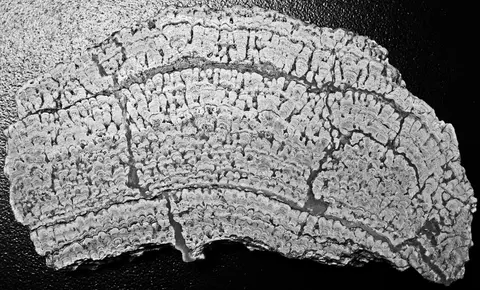
Lacustrine stromatolite (Green River Formation, Eocene; White Hill, near Ephraim, Utah, USA) 4 (45309295295). Photo: James St. John, CC BY 2.0, via Wikimedia Commons.
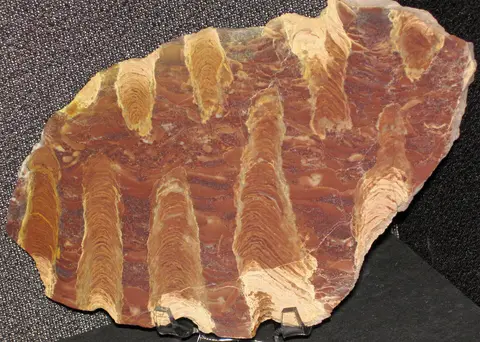
Inzeria tjomusi (stromatolite) (Neoproterozoic, 850 Ma to 1 Ga; Bashkiria, Russia) (41559659220). Photo: James St. John, CC BY 2.0, via Wikimedia Commons.
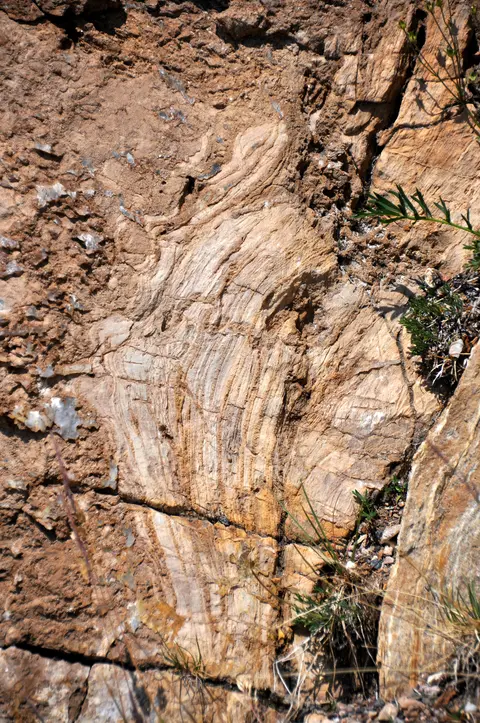
Stromatolite in metadolostone (Nash Fork Formation, Paleoproterozoic, 2.06-2.08 Ga; Rt. 130 roadcut across from Miner's Cabin Trailhead, Medicine Bow Mountains, southeastern Wyoming, USA) (15201947482). Photo: James St. John, CC BY 2.0, via Wikimedia Commons.
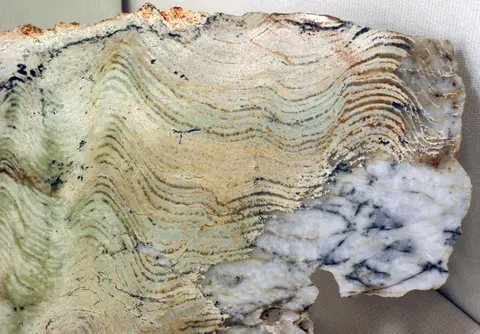
Stromatolite (Strelley Pool Formation, Paleoarchean, 3.35-3.46 Ga; East Strelley Greenstone Belt, Pilbara Craton, Western Australia) 5 (17372575815). Photo: James St. John, CC BY 2.0, via Wikimedia Commons.
What stromatolite is worth
Dealer asking prices for stromatolite, middle half of current listings, checked 2026-11-20. Bar shows the 25th to 75th percentile; the dark tick is the median.
These are dealer asking prices: what shops list stromatolite for, not what it sells for and not an appraisal. Selling to a dealer usually brings well below retail, because the dealer has to resell it at a margin.
How to identify stromatolite
A stromatolite is a layered sedimentary structure built by microbial mats, mainly cyanobacteria, that trapped sediment and precipitated carbonate one thin layer at a time. Fossil examples are usually limestone or dolomite, or have been replaced by chert or jasper, and they include some of the oldest evidence of life, about 3.4 billion years old.
Fine, wavy laminations stacked one on another, usually a millimeter or less thick.
Layers bulge upward into domes, cabbage-like heads or columns rather than lying flat.
Columns and domes repeat side by side across a cut face, with sediment filling the gaps between them.
Carbonate stromatolites are soft (3 to 4) and fizz in vinegar; silicified ones are hard (about 7) and do not.
Colors follow the host rock: gray, tan and cream for carbonate; red, yellow and black for jasper and chert.
The layering looks the same on two cut faces at right angles, showing three dimensional heads or columns.
Where stromatolite comes from
Pilbara, Western Australia
Strelley Pool chert stromatolites about 3.4 billion years old, among the oldest accepted fossils; mainly scientific, rarely sold.
Shark Bay (Hamelin Pool), Western Australia
Best known living stromatolites; protected, nothing collectible.
Mesabi Range, Minnesota, USA
Silicified red and green stromatolites in iron formation, sold as Mary Ellen jasper.
Upper Peninsula of Michigan, USA
Precambrian stromatolitic dolomite sold as Kona dolomite.
Morocco
Large polished slabs and spheres of carbonate stromatolites are a common modern supply.
Saratoga Springs, New York, USA
Cambrian Hoyt Limestone heads exposed at Lester Park, a classic field site.
Bands are concentric or flat rather than domed and columnar
No repeated heads across the face
Dyed stromatolite slabs and spheres
Occasional
Unnatural blue, green or pink tones
Color pooled in pores and cracks
Acetone swab picks up color
Resin stabilized or filled slabs
Common
Glossy filled pits that feel softer than the stone
Fills look plastic under a loupe
Is my stromatolite real? Tests you can do at home
Vinegar drop
Place a drop of household vinegar on an unpolished spot and watch with a loupe.
Real
Limestone stromatolites fizz; dolomitic and silicified ones do not.
Fake or lookalike
Not decisive alone; confirms carbonate versus silica.
Can leave a small mark.
Layer pattern check
Look at a cut face and, if possible, a second face at right angles.
Real
Upward-bulging laminae form repeated domes or columns in both views.
Fake or lookalike
Agate rings close around a center; travertine bands run flat.
Acetone swab for dye
Rub a cotton swab with nail polish remover on a hidden area.
Real
Swab stays clean.
Fake or lookalike
Dye transfers to the swab.
Scratch with a steel knife
Press a knife point on the back or edge.
Real
Carbonate types scratch; silicified types resist.
Fake or lookalike
Use with the vinegar result to tell carbonate from silica.
Can leave a small mark.
A stone that passes these tests is consistent with natural stromatolite, not proven. For valuable pieces, a gem lab report settles treatment and origin.
Treatments
Polishing and resin stabilization (common)
Most decorative slabs are polished and many are filled; filling lowers value modestly if disclosed. Loupe for glossy fills in pits.
Dyeing (occasional)
Dyed pieces are decorative only and rank well below natural. Acetone swab, color concentrated in pores.
What moves the price of stromatolite
Pattern clarity. Crisp, well defined domes or columns with strong contrast rank highest.
Silicification. Jasper or chert replaced stromatolites take a better polish and are more durable.
Age and locality. Documented Precambrian localities and named materials (Mary Ellen jasper, Kona dolomite) have steady demand.
Size and finish. Large polished slabs, spheres and bookends sell as decor.
Treatment. Natural color and no filling rank above dyed or heavily stabilized pieces.
Sources
Prices: 60 current listings from FossilEra, Throwin Stones, seen 2026-11-20 to 2026-11-20. How we collect prices.