RockValues

Fairburn agate value and identification

Fairburn agate is a fortification agate from the Fairburn area of southwestern South Dakota and adjacent Nebraska, weathered out of Paleozoic limestones and carried into gravels. It is South Dakota's state gemstone.

A variety of agate. Prices checked .
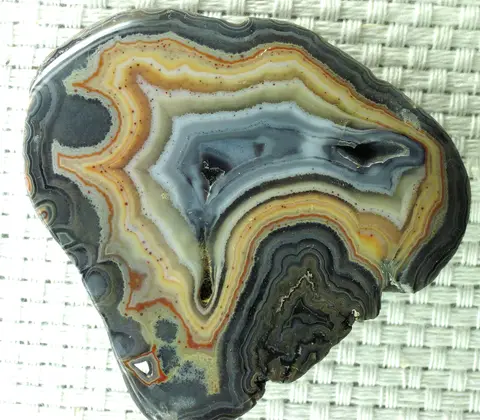
Fairburn agate: Fairburn Agate (ultimately derived from the Minnelusa Formation, Pennsylvanian-Permian; collected east of the Black Hills, western South Dakota, USA) 8 (31972280503)
Fairburn Agate (ultimately derived from the Minnelusa Formation, Pennsylvanian-Permian; collected east of the Black Hills, western South Dakota, USA) 8 (31972280503). Photo: James St. John, CC BY 2.0, via Wikimedia Commons.

What fairburn agate is worth

Not enough data. We have not yet seen 5 or more current dealer listings for fairburn agate in any one form, so we show no range rather than guess.

These are dealer asking prices: what shops list fairburn agate for, not what it sells for and not an appraisal. Selling to a dealer usually brings well below retail, because the dealer has to resell it at a margin.

How to identify fairburn agate

It is one of the most sought locality agates in North America, known for tight, sharply defined fortification bands in multiple colors, often with eyes and a frosted, pitted exterior. See agate value for the species as a whole.

  • Very tight, sharp-cornered fortification bands
  • Colors of red, orange, yellow, black, white and grey, often in many layers
  • Frosted, pitted husk from weathering
  • Found on the grasslands rather than in volcanic rock

Other agate varieties

Where fairburn agate comes from

Buffalo Gap National Grassland, South Dakota
Classic surface collecting area; check current rules for collecting on federal land.
Oglala National Grassland, Nebraska
Also yields Fairburn type agates.

Fairburn agate lookalikes

Teepee Canyon agate

Teepee Canyon agates from the Black Hills tend toward red and orange with softer banding and are found in limestone near Custer.

  • Related limestone-hosted agates
  • Locality provenance is key

Look-alike fortification agates from Asia and Africa

Provenance is the main tell; imported agates often lack the frosted grassland husk.

  • Similar band style possible
  • Buy from collectors with find documentation

Fake, dyed and treated fairburn agate

  • Imported agates sold as Fairburns

    Occasional

    • No provenance or find location
    • Unusual husk or tumble polish
    • Too many top quality pieces from one seller

Is my fairburn agate real? Tests you can do at home

  1. Husk and band inspection

    Study the exterior and any exposed bands with a loupe.

    Real
    Frosted, pitted exterior and very tight, angular fortification bands.
    Fake or lookalike
    Glossy tumbled surfaces or loose, rounded bands.
  2. Backlight

    Shine a flashlight through thin areas.

    Real
    Translucent bands glow.
    Fake or lookalike
    Jasper and chert stay dark.

A stone that passes these tests is consistent with natural fairburn agate, not proven. For valuable pieces, a gem lab report settles treatment and origin.

Treatments

None routinely (rare)
Collectors expect natural stones; polishing an excellent natural face can lower value for some buyers. Visible polish.

What moves the price of fairburn agate

  1. Pattern quality. Tight, crisp, multicolor fortification across a face is the main driver.
  2. Natural face. Patterns showing on the natural surface without cutting are prized.
  3. Size. Larger complete agates are rare.
  4. Provenance. Documented finds and well-known collection histories add value.

Sources

Prices: no current dealer listings yet. How we collect prices.