RockValues

Fire agate value and identification

Fire agate is brown chalcedony containing thin layers of iron oxide (goethite or limonite) that create iridescent red, orange, green, blue and violet flashes by thin-film interference.

A variety of agate. Prices checked .
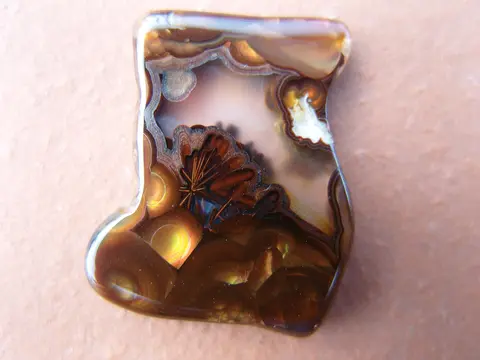
Fire agate: Sagenitic Fire Agate 01
Sagenitic Fire Agate 01. Photo: Lysergian, Public domain, via Wikimedia Commons.
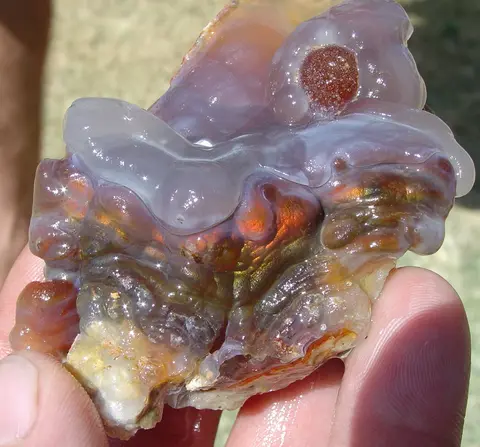
Fire agate: Fire Agate
Fire Agate. Photo: Malinadams, CC BY-SA 3.0, via Wikimedia Commons.
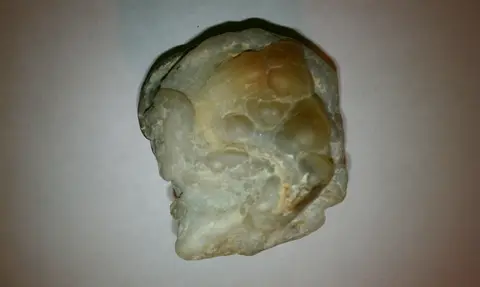
Fire agate: High Grade Slaughter Mountain Arizona Fire Agate Rough
High Grade Slaughter Mountain Arizona Fire Agate Rough. Photo: Maricopa Mining LLC, CC BY-SA 3.0, via Wikimedia Commons.

What fire agate is worth

Not enough data. We have not yet seen 5 or more current dealer listings for fire agate in any one form, so we show no range rather than guess.

Show 2 of the listings behind these numbers
Sample dealer listings for Fire agate
ListingSizeLocalityAskingSeen
1.9" Polished Fire Agate Worry Stones
FossilEra
4.8 cm$7
1.5" Polished Fire Agate Hearts
FossilEra
3.8 cm$9

These are dealer asking prices: what shops list fire agate for, not what it sells for and not an appraisal. Selling to a dealer usually brings well below retail, because the dealer has to resell it at a margin.

How to identify fire agate

Its value lies in the iridescent fire under the surface, not in banding, and each stone must be carved by hand to follow the curved, botryoidal layers. See agate value for the species as a whole.

  • Brown to dark reddish brown botryoidal (bubbly) surface
  • Iridescent colors that shift as you tilt the stone, seen just under the surface
  • Cut stones have freeform, undulating tops that follow the layers
  • Hardness about 7

Other agate varieties

Where fire agate comes from

Aguascalientes and Chihuahua, Mexico
Main commercial sources of fire agate.
Arizona, USA (Slaughter Mountain, Deer Creek)
Collector localities, some open to fee or claim-based digging.
California, USA (Opal Hill, Mule Mountains)
Historic fire agate digging area near Blythe.

Fire agate lookalikes

Fire opal

Fire opal is orange body color, often transparent; fire agate is brown with iridescent flashes inside.

  • Opal is softer (5.5 to 6.5) and lighter (SG about 2.0)

fire agate vs fire opal

Rainbow obsidian

Rainbow obsidian shows sheen in flat parallel bands, and is volcanic glass with hardness about 5.5.

  • Obsidian has bubbles and no botryoidal layers

Labradorite

Labradorite flash appears on flat cleavage directions and is usually blue to gold on grey.

  • Labradorite has cleavage and hardness 6 to 6.5

Also mistaken for fire agate: fire obsidian, iris agate.

Fake, dyed and treated fire agate

  • Iridescent coated glass or stones

    Occasional

    • Color sits on the surface, not under it
    • Coating scratches off
    • Flat, even rainbow sheen
  • Plain brown chalcedony or poorly cut material sold as fire agate

    Occasional

    • Little or no visible play of color
    • Colors only visible when wet

Is my fire agate real? Tests you can do at home

  1. Tilt test for depth of color

    Rotate the stone under a single light and watch where the colors sit.

    Real
    Fire appears beneath a thin layer of brown chalcedony and moves with the curved layers.
    Fake or lookalike
    Coatings show a surface rainbow film.
  2. Scratch test against glass

    Try to scratch glass with an unpolished edge.

    Real
    Scratches glass.
    Fake or lookalike
    Coated glass will not.

    Can leave a small mark.

A stone that passes these tests is consistent with natural fire agate, not proven. For valuable pieces, a gem lab report settles treatment and origin.

Treatments

None routinely (rare)
Fire agate is generally sold untreated; backing or doublets for thin layers are uncommon. Check the back for glue lines.

What moves the price of fire agate

  1. Color range and intensity. Green, blue and violet fire are rarer than red and orange; full spectrum stones command the most.
  2. Cutting quality. Skilled carving that exposes fire without breaking through the layer adds much value.
  3. Coverage. Fire across the whole face beats patchy fire.
  4. Size. Larger stones with continuous fire are uncommon.

Sources

Prices: 2 current listings from FossilEra, seen 2026-11-20 to 2026-11-20. How we collect prices.