Dealer asking prices for labradorite, middle half of current listings, checked 2026-11-20. Bar shows the 25th to 75th percentile; the dark tick is the median.
These are dealer asking prices: what shops list labradorite for, not what it sells for and not an appraisal. Selling to a dealer usually brings well below retail, because the dealer has to resell it at a margin.
How to identify labradorite
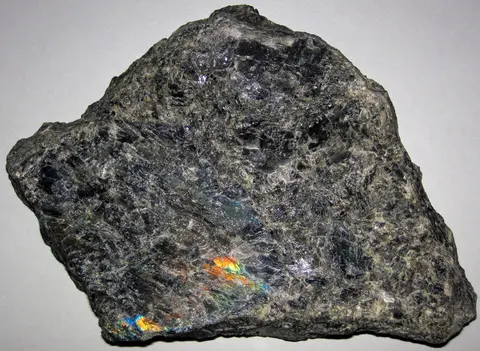
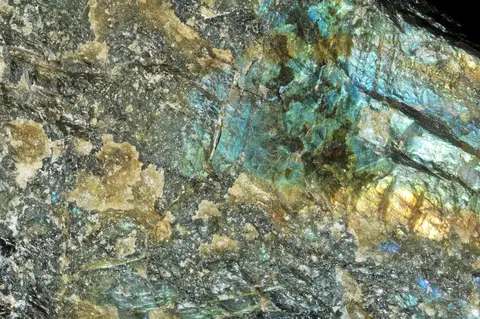
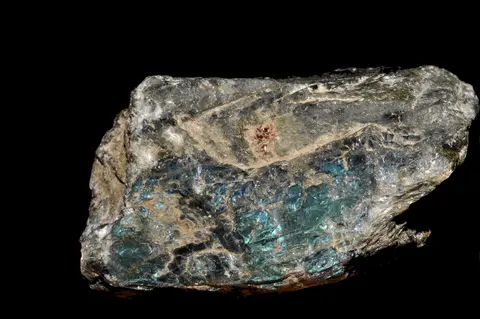
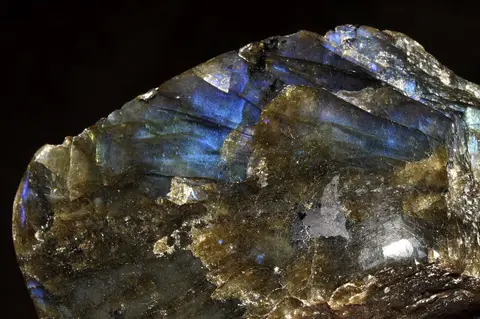
Labradorite is a calcium-rich plagioclase feldspar whose thin internal layers produce labradorescence, a flash of blue, green, gold or rarely orange and purple when the stone is turned to the light.
Labradorite is a specific plagioclase composition known for its strong colored flash, unlike the soft glow of moonstone or the plain look of most feldspar. See feldspar value for the species as a whole.
Gray to dark gray body that flashes vivid color only at one angle
Flash usually blue and green, sometimes gold, orange or purple
Fine straight parallel lines (twinning) and dark needles visible on polished surfaces
Color flashes only within a narrow angle; the stone looks plain gray elsewhere.
Fake or lookalike
Glass or coated imitations show color across many angles.
Loupe for twinning and needles
Look at the polished surface with a 10x loupe.
Real
Straight parallel lines, black needle inclusions and small cleavage cracks.
Fake or lookalike
Glass shows bubbles and swirls.
Scratch test against glass
Try an unpolished edge against a glass tile.
Real
Scratches glass with effort.
Fake or lookalike
Resin and plastic imitations do not.
Can leave a small mark.
A stone that passes these tests is consistent with natural labradorite, not proven. For valuable pieces, a gem lab report settles treatment and origin.
Treatments
Resin stabilizing (occasional)
Fills cracks in lower grade slabs and beads; lowers value. Glassy fillings in cracks under a loupe.
What moves the price of labradorite
Flash color. Multicolor flashes with orange, red, pink and purple rank above plain blue.
Flash coverage. Full face coverage ranks above patchy flash.
Body. Dark bodies that make color pop rank above pale gray.
Cracks and inclusions. Fewer visible cracks and needles add value.
Size and cut. Large clean pieces cut to center the flash on the face.
Questions collectors ask about labradorite
What is the rarest color of labradorite?
Purple, pink and red flashes are the least common; blue and green are the most common colors.
What does a labradorite stone look like?
A gray to dark gray stone that looks plain until turned to the light, when broad patches flash blue, green, gold or sometimes orange and purple. Polished surfaces often show fine straight lines and dark needles.
Is labradorite worth money?
Most labradorite is abundant and modestly valued, but pieces with full coverage multicolor flash, and spectrolite from Finland, sell higher. See the price table above.
How to spot a fake labradorite?
Real labradorite shows its color only at certain angles and has twinning lines and needle inclusions under a loupe. A color visible from every angle, bubbles or a painted back point to glass or a coated piece.
Sources
Prices: 110 current listings from Dakota Matrix Minerals, FossilEra, iRocks (The Arkenstone), The Gem Shop, Throwin Stones, seen 2026-11-20 to 2026-11-20. How we collect prices.