Ammolite is the iridescent fossil shell layer of certain ammonites, made of thin plates of aragonite that split light into vivid colors. Gem-grade ammolite comes almost entirely from the Late Cretaceous Bearpaw Formation in southern Alberta, Canada.
Prices checked . Page updated .
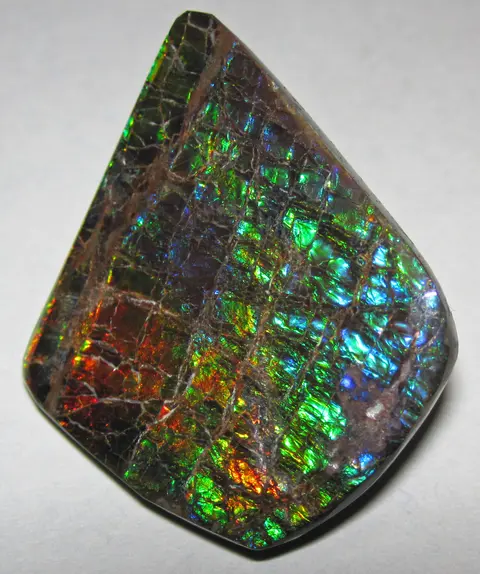
Ammolite from Placenticeras fossil ammonite (Bearpaw Formation, Upper Cretaceous, 70-75 Ma; mine in St. Mary River Valley, Alberta, Canada) 12 (40630261304). Photo: James St. John, CC BY 2.0, via Wikimedia Commons.
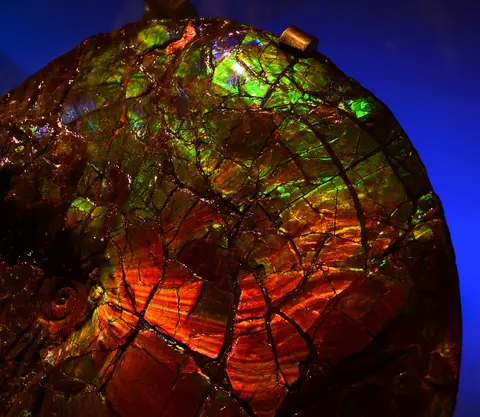
Placenticeras meeki Musée des Confluences 18102015 5. Photo: Vassil, CC0, via Wikimedia Commons.
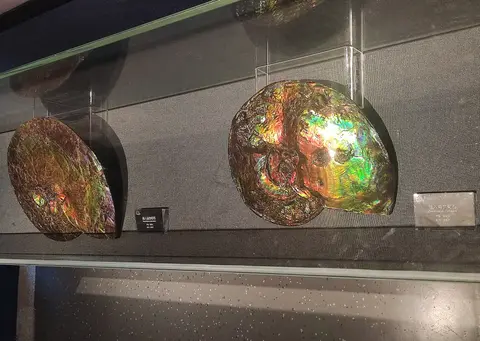
Zhejiang Geological Museum 20240804 120549. Photo: Dlyj0604, CC BY-SA 4.0, via Wikimedia Commons.
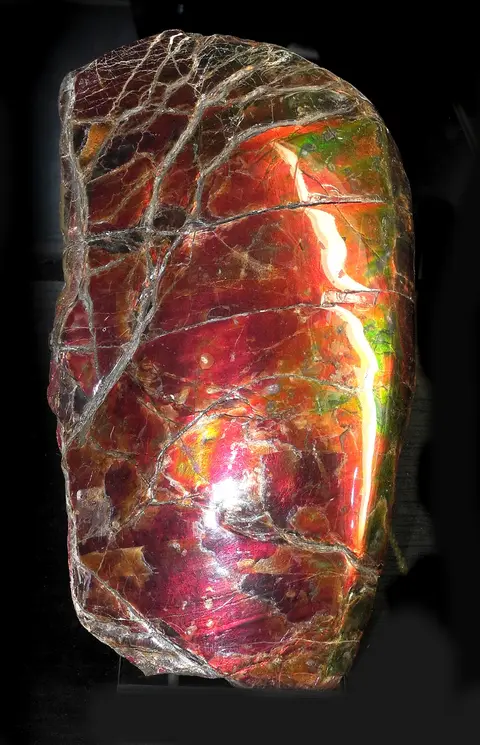
Ammolit. Photo: Mariuszjbie, CC BY-SA 3.0, via Wikimedia Commons.
What ammolite is worth
Not enough data. We have not yet seen 5 or more current dealer listings for ammolite in any one form, so we show no range rather than guess.
These are dealer asking prices: what shops list ammolite for, not what it sells for and not an appraisal. Selling to a dealer usually brings well below retail, because the dealer has to resell it at a margin.
How to identify ammolite
Patches of intense iridescent color (red, orange, green, and less often blue and violet) that shift as you tilt the piece.
Color often broken into a mosaic of cells by fine cracks, a pattern sold as 'dragon skin' or stained glass.
The color layer is very thin; in a finished stone it usually sits on dark shale backing.
Many finished pieces are doublets or triplets: look at the side for a flat backing and a clear cap.
Soft for a gem, about 3.5 to 4.5, so polished surfaces scratch easily unless capped.
Whole fossils show the coiled ammonite shape and suture patterns under the colored layer.
Where ammolite comes from
Bearpaw Formation, St. Mary River area, southern Alberta, Canada
Essentially the only commercial source of gem ammolite, from the ammonite Placenticeras and related genera.
Madagascar
Produces iridescent ammonite fossils (such as Cleoniceras) whose nacre is sold whole; the color is usually less intense and they are not the same as Alberta ammolite.
Side view shows layers: a clear cap, a thin colored film and a dark backing
Cap of quartz or synthetic spinel has a glassy dome
Value is lower than a solid piece of the same color
Dichroic glass sold as ammolite
Occasional
Even, regular color streaks or metallic film
No natural cell pattern or shale backing
Glass bubbles under a loupe
Painted or film-coated fossils and shells
Occasional
Color sits in a uniform film that scratches or peels
Color does not follow the shell structure
Other iridescent ammonites or shell sold as Canadian ammolite
Occasional
Weaker, pearly color
No locality paperwork
Is my ammolite real? Tests you can do at home
Side view for layers
Look at the edge of a loose stone or the girdle of a set stone with a loupe.
Real
Solid ammolite shows the thin color layer sitting directly on its natural shale matrix, with no clear cap.
Fake or lookalike
A doublet or triplet shows a glued flat join and, in a triplet, a clear dome on top.
Loupe inspection of the color
Tilt the stone under a bright light and view the surface at 10x.
Real
Irregular cells and fine cracks with color that follows the shell structure.
Fake or lookalike
Glass shows regular streaks or bubbles; coatings look like a uniform skin.
Angle test
Turn the piece slowly through many angles under one light.
Real
Color is visible over a wide range of angles with shifting hues.
Fake or lookalike
Labradorite turns dark gray outside a narrow viewing angle.
A stone that passes these tests is consistent with natural ammolite, not proven. For valuable pieces, a gem lab report settles treatment and origin.
Treatments
Stabilization with resin or epoxy (common)
Fragile flaking layers are impregnated so they can be cut and polished. Widely accepted in the trade; disclosure is expected. Glassy filled cracks under a loupe; lab confirmation.
Capping (triplets) (common)
A clear quartz or synthetic spinel cap protects thin color layers. Triplets are worth less than solid ammolite. Visible layers from the side.
What moves the price of ammolite
Color range. Stones showing three or more colors, especially blue and violet, are graded highest; mostly red or brown is lowest.
Brightness. Intense, saturated color across the whole face is the top grade.
Construction. Solid ammolite is worth much more than doublets and triplets.
Pattern. Even sheets or attractive dragon skin cells are preferred over dull or blotchy areas.
Size. Larger clean color areas are rarer.
Whole fossils. Complete ammonites with full ammolite shell are priced as display fossils.
Care and safety
Soft and layered. Avoid acids, cleaners, ultrasonic and steam cleaning, heat and hard knocks; wipe with a soft damp cloth.
Sources
Prices: 48 current listings from FossilEra, seen 2026-11-20 to 2026-11-20. How we collect prices.