Dealer asking prices for opal, middle half of current listings, checked 2026-11-20. Bar shows the 25th to 75th percentile; the dark tick is the median.
These are dealer asking prices: what shops list opal for, not what it sells for and not an appraisal. Selling to a dealer usually brings well below retail, because the dealer has to resell it at a margin.
How to identify opal
Opal is hydrated silica (SiO2·nH2O), an amorphous or poorly crystalline mineraloid that usually holds about 3 to 10 percent water. Precious opal shows play of color from light diffracting off tiny stacked silica spheres; common opal lacks it.
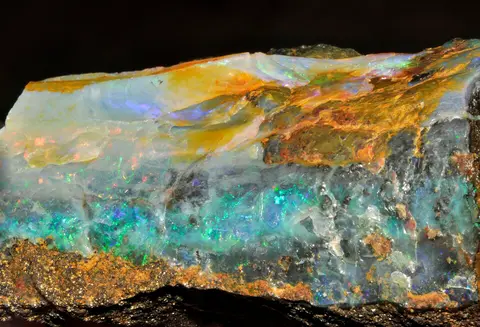
Play of color: flashes of spectral color in patches that shift and change as the stone is turned (precious opal only)
Body color ranges from black and gray to white, colorless, orange, red, blue, green and pink
Waxy to glassy luster and a smooth, conchoidal fracture, with no cleavage
Light in the hand: SG about 2.0 to 2.2, noticeably lighter than quartz or glass of the same size
Softer than quartz (5.5 to 6.5), so old stones show worn, scratched facet edges or domes
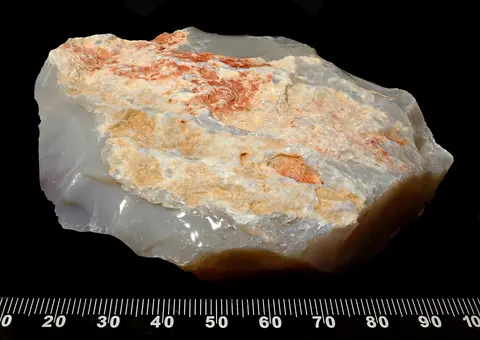
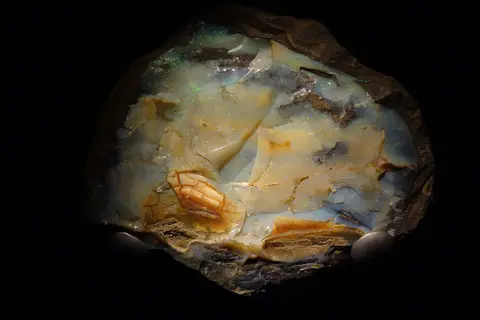
Often shows potch (colorless or gray common opal) or host rock in the same piece
May show crazing, a network of fine surface cracks from water loss
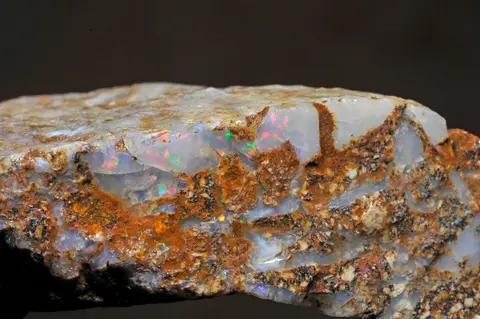
Matrix opal is precious opal dispersed through its host rock, such as sandstone, ironstone or basalt, as fine specks or seams rather than a solid layer. The opal and rock are cut together as one material; porous Andamooka matrix is usually sugar-acid treated to darken it, while Queensland ironstone matrix is generally untreated.
Andamooka opal
Andamooka opal comes from the Andamooka field in South Australia, known for crystal opal and porous matrix opal. A locality name; Andamooka matrix opal is routinely sugar-acid treated to give a dark background, so it is sold as treated.
Koroit opal
Koroit opal is boulder opal from the Koroit field in southwest Queensland, known for intricate patterns where opal and ironstone interweave. A type of boulder opal with fine opal veins and spots mixed through the ironstone, creating picture-like patterns.
Contra luz opal
Contra luz opal is transparent precious opal that shows its play of color when light comes from behind the stone. Most opal shows color in reflected light; contra luz (Spanish for against the light) reveals its best color in transmitted light.
Mintabie opal
Mintabie opal comes from the Mintabie field in northern South Australia, known for crystal and semi-black opal. A locality name; Mintabie produced darker and crystal opal than Coober Pedy, but production has dwindled.
Idaho opal
Idaho opal is precious opal from Idaho, mainly from Spencer, where it forms thin layered seams. A locality name; Spencer opal is often too thin to cut solid and is frequently made into doublets and triplets.
Virgin Valley opal
Virgin Valley opal comes from Humboldt County, Nevada, known for black and crystal opal, often replacing wood. A locality name; Virgin Valley opal can be very bright but is notorious for crazing as it dries, so much is kept in water or sold as specimens.
Cantera opal
Cantera opal is Mexican opal, usually fire opal, cut together with its pinkish to tan rhyolite host rock. The host rock (cantera) is left on and often carved, framing the opal instead of being removed.
Honduran opal
Honduran opal is precious opal in dark basalt from Honduras, typically small flecks of color in black rock. A form of matrix opal; the dark basalt gives contrast, and some material is treated to darken it further.
Yowah opal
Yowah opal is boulder opal from Yowah, Queensland, famous for Yowah nuts, small ironstone concretions with opal at the center. A type of boulder opal; Yowah nuts are cracked open to reveal opal kernels, and the field also produces fine patterned matrix opal.
Where opal comes from
Lightning Ridge, New South Wales, Australia
Main source of black opal, the most valuable opal type.
Coober Pedy, South Australia
Long the largest opal field in the world by output; mostly white and crystal opal.
Triplets have a clear glass or quartz dome on top that looks glassy and too high
Closed-back settings that hide the side
Opalite or sea opal glass
Very common
Milky blue body that glows orange against light
No spectral patches
Gas bubbles under a loupe
Sold cheaply as opalite, sometimes mislabeled as opal
Lab-created opal (Gilson type and later makers)
Common
Regular columnar or lizard-skin (chicken wire) pattern within each color patch under a loupe
Color patches too evenly sized and bright
Lab testing confirms
Resin or polymer imitation opal
Common
Very light (SG about 1.2)
Warm to the touch
Soft: scratches with a steel pin
Smoked or dyed Ethiopian opal sold as black opal
Common
Dark color is only a surface layer; chips show light body
Columnar digit pattern typical of Welo opal
Hydrophane behavior: becomes more transparent when wet
Sugar-acid or smoke treated matrix opal
Common
Black, peppery specks of carbon in the host rock under a loupe
Color layer is shallow
Typical of Andamooka and Honduran material
Slocum stone and other foil-flake glass
Rare
Flat, crinkled flakes like foil
Glass hardness and bubbles
Is my opal real? Tests you can do at home
Side view for layers
Look at the edge of a loose stone or the girdle of a set stone under a loupe.
Real
Solid opal, or natural opal fading irregularly into potch or ironstone.
Fake or lookalike
Doublets and triplets show a perfectly straight join with a black or glass layer.
Loupe on the color patches
Examine the play of color at 10x from several angles.
Real
Irregular patches with soft edges and varied shapes that shift as you move.
Fake or lookalike
Synthetic opal shows repeating columns or a lizard-skin pattern; opalite shows no patches at all.
Backlight check
Hold the stone in front of a small flashlight in a dim room.
Real
Precious opal still shows patches of color; potch and host rock block light irregularly.
Fake or lookalike
Opalite glows uniform orange to amber with a milky blue face.
Specific gravity with a kitchen scale
For loose solid stones only, weigh dry, then suspended in water; divide dry weight by the loss in water. Skip this for doublets, triplets and hydrophane Ethiopian opal.
Real
About 2.0 to 2.2.
Fake or lookalike
Glass about 2.4 to 2.5; plastic about 1.2.
Steel pin on the back
Lightly press a steel pin into an unseen spot on the back of a loose stone.
Real
Opal resists a light touch (5.5 to 6.5).
Fake or lookalike
Plastic and resin dent or scratch easily.
Can leave a small mark.
A stone that passes these tests is consistent with natural opal, not proven. For valuable pieces, a gem lab report settles treatment and origin.
Treatments
Smoke treatment (common)
Darkens light Ethiopian opal to imitate black opal; treated stones are worth far less than natural black opal. Shallow dark layer, light body at chips and drill holes, lab confirmation.
Sugar-acid treatment (common)
Deposits carbon in porous matrix opal to darken the background; standard for Andamooka matrix opal and priced as treated. Black pepper-like carbon specks under a loupe.
Dyeing (occasional)
Adds dark or bright body color to porous opal; lowers value. Color concentrated in cracks and pores, lab testing.
Polymer or resin impregnation (occasional)
Stabilizes porous or crazed opal and can darken the body; must be disclosed and reduces value. Low SG, plastic luster, lab testing (infrared spectroscopy).
Oiling or waxing (occasional)
Hides crazing and surface cracks temporarily. Cracks reappear after cleaning; greasy surface.
What moves the price of opal
Type and body tone. Black opal ranks highest, then boulder, crystal and dark opal, then white opal; common opal without play of color is least valuable.
Brightness. Bright, vivid play of color matters more than any other single factor within a type.
Play-of-color hues. Red flashes are rarest and most valued, then orange and green; blue-only stones are the most common.
Pattern. Named patterns such as harlequin, rolling flash and broad flash command large premiums over pinfire.
Solid versus assembled. Solid opal is worth many times a doublet or triplet showing the same face.
Treatment. Smoked, dyed, sugar-treated and impregnated stones sell at a deep discount to natural material.
Origin. Australian black and boulder opal command more than Ethiopian opal of similar appearance.
Size and thickness. Larger stones with enough thickness for durability are worth more.
Flaws. Crazing, cracks, sand spots, potch lines and dead windows reduce value sharply.
Cut. A well-domed cabochon that shows color from all angles beats a flat, thin cut.
Care and safety
Opal is softer than quartz dust, so store it apart from other jewelry. Avoid heat, sudden temperature changes, ultrasonic and steam cleaners. Do not soak doublets or triplets, and keep oils, lotions and colored liquids away from hydrophane Ethiopian opal, which absorbs them.
Questions collectors ask about opal
What is an opal stone?
Opal is hydrated silica, a non-crystalline relative of quartz that holds water in its structure. Precious opal flashes spectral colors from tiny stacked silica spheres; common opal has no play of color.
What are the different colors of opal?
Opal body color runs from black and gray (black opal) through white and colorless (white and crystal opal) to yellow, orange and red (fire opal), plus blue, green and pink in common opal. Play-of-color flashes can show every spectral hue, with red the rarest.
How to spot fake opal?
Check the side for a straight glued layer (doublet or triplet), look under a loupe for the regular lizard-skin pattern of lab-created opal, and watch for opalite glass, which has a milky blue face and an orange glow when backlit but no color patches.
How to test opal at home?
Use a loupe on the edge for layers, on the face for synthetic patterns, a flashlight behind the stone for the opalite glow, and a kitchen scale for specific gravity (about 2.0 to 2.2 for solid opal). A lab is needed to confirm treatments such as smoking or polymer.
What happens if you leave opals in water?
Most Australian solid opal is not harmed by brief contact with water. Hydrophane opal, including much Ethiopian Welo opal, soaks up water, turns clear and may lose its color until it dries, and doublets and triplets can cloud or separate when soaked.
Is my opal worth anything?
Value depends mostly on whether it is solid, the body tone, how bright the play of color is, the colors and pattern, and any treatment. Check the price table above against stones of similar type and size.
Sources
Prices: 226 current listings from FossilEra, iRocks (The Arkenstone), Kingsley North, Natural Gemstones, The Gem Shop, Throwin Stones, seen 2026-11-20 to 2026-11-20. How we collect prices.