RockValues

Ethiopian opal value and identification

Ethiopian opal is precious opal from Ethiopia, mostly hydrophane opal from Wollo (Welo) province, mined in quantity since 2008. It ranges from white and crystal to brown, with often very bright play of color.

A variety of opal. Prices checked .
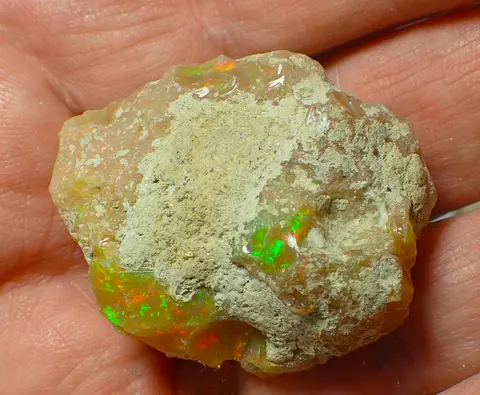
Ethiopian opal: Rough Welo Ethiopian Opal
Rough Welo Ethiopian Opal. Photo: Dpulitzer, CC BY-SA 4.0, via Wikimedia Commons.

What ethiopian opal is worth

Not enough data. We have not yet seen 5 or more current dealer listings for ethiopian opal in any one form, so we show no range rather than guess.

Show 2 of the listings behind these numbers
Sample dealer listings for Ethiopian opal
ListingSizeLocalityAskingSeen
Ethiopian Opal Rough - Per Gram (Grade B)
Kingsley North
3 g$12
Ethiopian Opal Rough - Per Gram (Grade A)
Kingsley North
3 g$24

These are dealer asking prices: what shops list ethiopian opal for, not what it sells for and not an appraisal. Selling to a dealer usually brings well below retail, because the dealer has to resell it at a margin.

How to identify ethiopian opal

Same material as other precious opal, but most Welo opal is hydrophane: it absorbs water and turns transparent when wet, then recovers as it dries. It is also the opal most often smoked or dyed. See opal value for the species as a whole.

  • White, crystal, yellowish or brown body with bright play of color
  • Columnar or honeycomb digit pattern visible in some stones
  • Turns clearer and may lose color temporarily when wet (hydrophane)
  • Often sold in large sizes and in broad flash or crinkle patterns
  • Shewa material is darker brown to chocolate, often in nodules

Other opal varieties

Where ethiopian opal comes from

Wegel Tena, Wollo (Welo) province, Ethiopia
Main source since 2008 of bright hydrophane opal.
Mezezo, Shewa province, Ethiopia
Earlier find (1994) of dark brown nodules with play of color.

Ethiopian opal lookalikes

Australian black opal

Natural black opal is dark throughout, not a shallow dark skin.

  • Lightning Ridge source

Lab-created opal

Synthetic opal shows a regular lizard-skin pattern; the Welo digit pattern is columnar but less regular.

  • Lab testing may be needed

Also mistaken for ethiopian opal: crystal opal, coober pedy opal, lightning ridge opal.

Fake, dyed and treated ethiopian opal

  • Smoked Welo opal sold as black opal

    Common

    • Dark skin only, light body at chips
    • Lab confirms
  • Dyed Ethiopian opal in bright or dark colors

    Common

    • Unnatural blue, purple, green or black body
    • Color concentrated near the surface
  • Lab-created opal sold as Ethiopian

    Occasional

    • Lizard-skin pattern
    • Does not change when wet

Is my ethiopian opal real? Tests you can do at home

  1. Brief water drop test

    Place a single drop of clean water on the back of a loose stone for a minute, then dry it and let it rest.

    Real
    Hydrophane Welo opal becomes clearer where wet and recovers as it dries.
    Fake or lookalike
    Synthetic and non-hydrophane opal do not change.
  2. Look at drill holes and chips

    Inspect drill holes on beads and any chipped spots.

    Real
    Natural body color throughout.
    Fake or lookalike
    Smoked or dyed stones show a lighter body under a colored skin.
  3. Loupe on the pattern

    Inspect play of color at 10x.

    Real
    Irregular patches, sometimes a columnar digit structure.
    Fake or lookalike
    Synthetic shows a tight, repeating lizard-skin pattern.

A stone that passes these tests is consistent with natural ethiopian opal, not proven. For valuable pieces, a gem lab report settles treatment and origin.

Treatments

Smoke treatment (common)
Creates a black opal look; value is far below natural black opal. Shallow color, lab testing.
Dyeing (common)
Adds unusual body colors; dyed stones have low value. Unnatural color, surface concentration.

What moves the price of ethiopian opal

  1. Brightness and color. Bright multicolor play with reds and full face coverage ranks highest.
  2. Pattern. Broad flash, rolling flash and honeycomb patterns are sought after.
  3. Stability. Stones that stay clear and bright after drying out command more; some Welo opal crazes.
  4. Body tone. Natural dark and crystal stones are less common than white.
  5. Treatment. Smoked and dyed stones sell at deep discounts.

Care and safety

Hydrophane opal absorbs oils, lotions and dirty water, which can stain it permanently. Remove jewelry before washing hands or applying creams, and clean with a dry soft cloth.

Sources

Prices: 2 current listings from Kingsley North, seen 2026-11-20 to 2026-11-20. How we collect prices.