Dealers list feldspar carvings under 5 cm (2 in) at $81 to $160; tumbled stones run about $120 to $285 per pound.
Prices checked . Page updated .
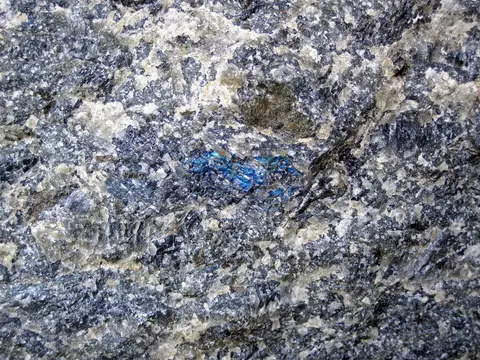
Labradorescent plagioclase feldspar (Marcy Anorthosite, Mesoproterozoic, 1.16 Ga; Route 3 roadcut south of Bartlett Pond, New York State, USA) 2. Photo: James St. John, CC BY 2.0, via Wikimedia Commons.
What feldspar is worth
Dealer asking prices for feldspar, middle half of current listings, checked 2026-11-20. Bar shows the 25th to 75th percentile; the dark tick is the median.
These are dealer asking prices: what shops list feldspar for, not what it sells for and not an appraisal. Selling to a dealer usually brings well below retail, because the dealer has to resell it at a margin.
How to identify feldspar
Feldspar is the most abundant mineral group in the Earth's crust: aluminum silicates of potassium (orthoclase, microcline, sanidine) or of sodium and calcium (the plagioclase series from albite to anorthite). Gem feldspars include moonstone, labradorite, sunstone and amazonite.
Two good cleavages meeting at or near 90 degrees, giving flat, step-like breaks that flash in light
Hardness 6 to 6.5: scratches window glass but is scratched by quartz
Fine parallel lines (twinning striations) on cleavage faces mean plagioclase; their absence and a pink, salmon or cream color in granite usually mean potassium feldspar
Vitreous luster, pearly on cleavage surfaces
Optical effects unique to the group: moonstone's floating blue or white glow, labradorite's flash of blue, green and gold, sunstone's metallic glitter
Blocky crystals, often twinned (Carlsbad, Baveno, Manebach twins in orthoclase)
Light in the hand, near quartz (specific gravity about 2.55 to 2.76)
Peristerite is albite to oligoclase plagioclase (sodium rich) with fine intergrowths that give a blue to white sheen similar to moonstone. It is a sodium plagioclase with moonstone-like sheen, sometimes sold as moonstone, rather than potassium feldspar.
Where feldspar comes from
Sri Lanka
Classic source of transparent moonstone with blue adularescence, mined from gravels around Meetiyagoda.
India
Main source of commercial moonstone, including rainbow, peach and cat's eye moonstone, and of hematite sunstone.
Labrador, Canada
Type area for labradorite (Paul's Island near Nain), with strong blue and green labradorescence.
Finland
Ylamaa in southeast Finland produces spectrolite, dark labradorite with the full color range.
Madagascar
Large producer of labradorite slabs and carvings, plus yellow gem orthoclase from Itrongay.
Oregon, USA
Transparent copper-bearing labradorite sold as Oregon sunstone, from Lake and Harney counties.
Pikes Peak, Colorado, USA
Blue-green amazonite crystals paired with smoky quartz, among the best known amazonite specimens.
Larvik, Norway
Quarries of larvikite, a feldspar-rich rock with blue schiller used as polished building stone.
Weigh the stone dry on a kitchen scale reading to 0.01 g, then weigh it suspended in water; divide dry weight by the loss in weight.
Real
Feldspar gives about 2.55 to 2.76.
Fake or lookalike
Glass imitations usually read above 2.4 but vary; opal reads about 2.1, spinel about 3.6.
A stone that passes these tests is consistent with natural feldspar, not proven. For valuable pieces, a gem lab report settles treatment and origin.
Treatments
Copper diffusion (occasional)
Turns pale andesine-labradorite red or green; sharply lowers value compared with natural Oregon sunstone once disclosed. Gem lab testing; natural color origin cannot be confirmed at home.
Coating or backing (occasional)
Dark backing or coatings intensify the sheen of pale moonstone or labradorite; lowers value. Check the back of the stone for paint, glue or a layer line with a loupe.
Fracture filling and stabilizing (occasional)
Resin fills cleavage cracks in lower grade labradorite and moonstone beads; makes them look cleaner. Loupe may show glassy filled cracks or flattened bubbles.
What moves the price of feldspar
Variety. Transparent gem varieties (blue moonstone, Oregon sunstone, spectrolite) sit well above common feldspar and larvikite.
Optical effect. Strength, color and coverage of adularescence, labradorescence or schiller drive most of the value.
Transparency. Clear bodies that let the sheen float are worth more than milky or cloudy ones.
Inclusions and cracks. Visible cleavage cracks and dark inclusions lower value in faceted and cabochon stones.
Size. Fine blue moonstone and red Oregon sunstone become scarce in larger sizes.
Treatment. Untreated stones sell above diffused, coated or backed ones.
Specimen quality. For crystals, sharp form, twinning, matrix association (amazonite with smoky quartz) and damage matter most.
Care and safety
Two good cleavages make feldspar prone to chipping from knocks. Avoid ultrasonic and steam cleaners; wash with warm soapy water.
Questions collectors ask about feldspar
Is my moonstone real?
Real moonstone shows a soft glow that moves across the stone only at certain angles, and under a loupe often has small parallel cleavage cracks. Opalite glass glows from every angle, turns orange against light backgrounds and contains round bubbles.
Is moonstone a birthstone?
Yes, moonstone is one of the birthstones for June, alongside pearl and alexandrite.
Do moonstones glow in the dark?
No. The glow of moonstone is light scattered by thin internal layers of feldspar, so it needs a light source to show.
How to spot a fake labradorite?
Real labradorite flashes color only at certain angles and is gray or dark when turned away from the light. A fixed color visible from every angle, bubbles, or a painted back point to glass or a coated piece.
Opal vs moonstone
Opal shows separate patches of spectral color that change as you move it, while moonstone shows a single white or blue glow. Opal is also lighter in the hand and has no cleavage.
Lapis lazuli vs labradorite
Lapis lazuli is an opaque deep blue rock with gold pyrite flecks and white calcite, with the same color at every angle. Labradorite is gray to dark and flashes blue, green or gold only when turned toward the light.
Sources
Prices: 242 current listings from Dakota Matrix Minerals, FossilEra, iRocks (The Arkenstone), Kingsley North, The Gem Shop, Throwin Stones, seen 2026-11-20 to 2026-11-20. How we collect prices.