Feldspar vs opal
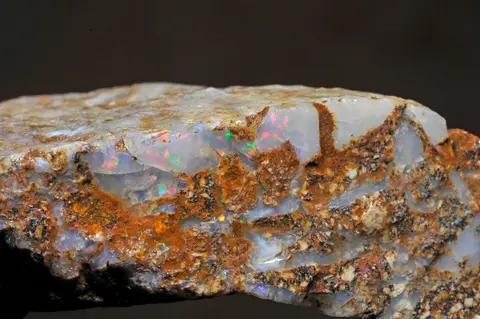
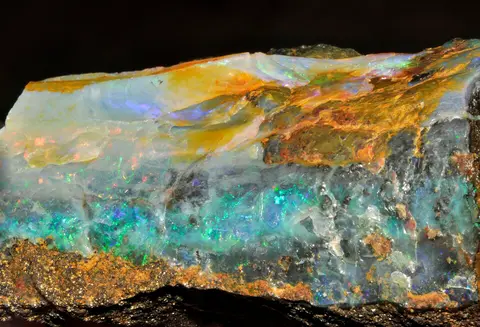
Opal shows patches of spectral color that shift across the stone; moonstone shows a single soft glow that floats across the dome.
Side by side
| Property | Feldspar | Opal |
|---|---|---|
| Hardness (Mohs) | 6 to 6.5 | 5.5 to 6.5 |
| Specific gravity | 2.55 to 2.76 | 1.98 to 2.25 (usually about 2.15) |
| Luster | Vitreous, pearly on cleavage | Vitreous to waxy or resinous |
| Streak | White | White |
| Crystal system | Monoclinic (orthoclase, sanidine) or triclinic (microcline, plagioclase) | Amorphous (opal-A) to poorly crystalline (opal-CT) |
| Cleavage | Perfect in one direction, good in a second, at or near 90 degrees | None |
| Refractive index | 1.518 to 1.526 (orthoclase moonstone); 1.559 to 1.572 (labradorite) | 1.37 to 1.47 (usually about 1.45; Mexican fire opal can be as low as 1.37) |
| Formula | KAlSi3O8 (potassium feldspar); NaAlSi3O8 to CaAl2Si2O8 (plagioclase series) | SiO2·nH2O |
| Typical dealer asking price | $45 to $151 (carvings and shapes) | $135 to $796 (specimens) |
How to tell them apart
- Opal hardness 5.5 to 6.5, SG about 2.1, feels lighter
- Opal has no cleavage
- Opal has no internal centipede-like cleavage cracks
Photos of each
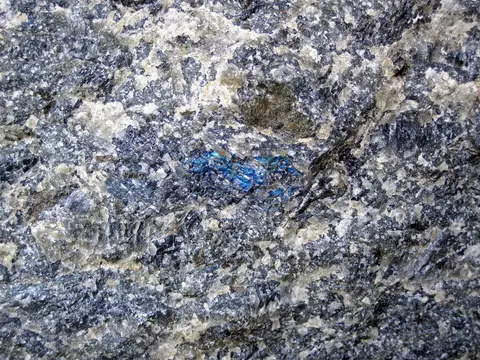
Feldspar

Opal


More on each: feldspar value and identification and opal value and identification.