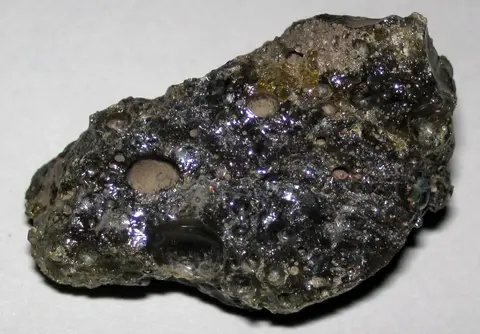
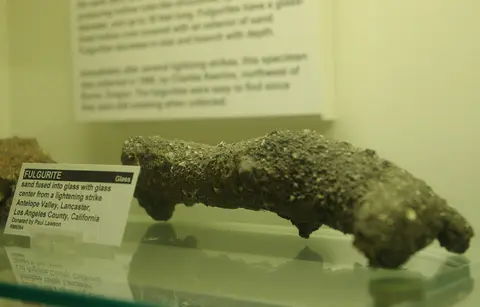
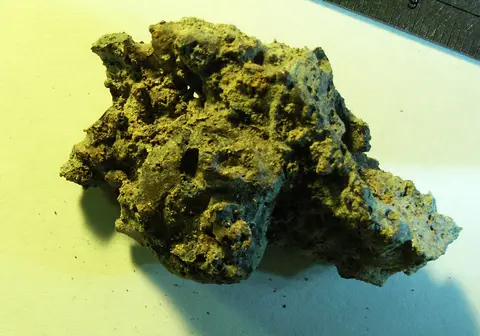
Fulgurite is natural glass formed when lightning fuses sand, soil or rock, leaving a hollow, branching tube or a glassy crust. The glass is mostly lechatelierite, amorphous silica melted at very high temperature, with grains of the original sediment stuck to the outside.
These are dealer asking prices: what shops list fulgurite for, not what it sells for and not an appraisal. Selling to a dealer usually brings well below retail, because the dealer has to resell it at a margin.
How to identify fulgurite
Hollow tube or branching root shape, usually a few millimeters to a few centimeters across
Smooth, shiny, bubbly glass lining on the inside of the tube
Rough, sandy or gritty outer surface made of partly melted grains stuck to the glass
Very light for its size because it is hollow and full of gas bubbles
Fragile and brittle: thin walls break easily into short sections
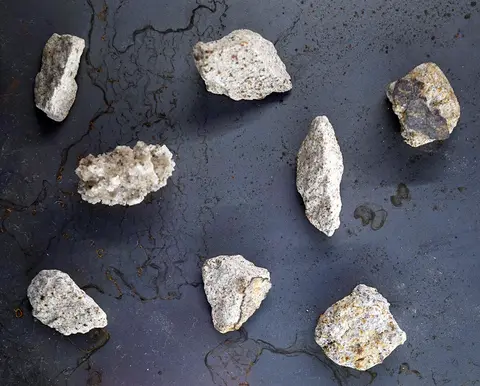
Rock fulgurites form as thin glassy crusts or splashes on exposed rock, often on mountain summits
Where fulgurite comes from
Sahara Desert (Algeria, Libya, Egypt and neighboring countries)
Source of most sand fulgurites on the market: pale tan tubes collected from dune sand.
Florida, USA
Quartz sand beaches and inland sands produce frequent sand fulgurites, some dug out in long branching sections.
Great Lakes dunes, USA
Quartz-rich dune sand yields sand fulgurites similar to Saharan tubes.
Mount Thielsen, Oregon, USA
Classic rock fulgurite locality: the summit is struck so often that the rock carries patches of dark lightning glass.
Fulgurite lookalikes
Root casts (rhizoliths)
Root casts are solid or filled with cemented sand and have no glassy, bubbly inner lining.
Formed by minerals cementing sand around plant roots
Often calcite cemented, so they are dull and may fizz in vinegar
Man-made fulgurites from power line faults or triggered lightning
Rare
Real lightning glass, but the origin is not a natural strike
Seller story or documentation usually reveals the source
Is my fulgurite real? Tests you can do at home
Loupe on the inner lining
Look into the broken end of the tube with a 10x loupe.
Real
Smooth, glossy glass lining with round gas bubbles.
Fake or lookalike
Root casts and concretions show dull, grainy or earthy interiors.
Weight in hand
Compare the piece with a pebble of similar size.
Real
Noticeably light because it is hollow and bubbly.
Fake or lookalike
Iron concretions and slag feel heavy.
Magnet
Hold a strong magnet against the piece.
Real
Sand fulgurites usually show little or no pull.
Fake or lookalike
Iron-rich slag and iron pipe concretions often pull toward the magnet.
Check joins for glue
Examine any narrow points along the length with a loupe and bright light.
Real
Breaks show fresh glass and sand with no shiny film.
Fake or lookalike
Glued joins show a smooth film, glue squeeze-out or mismatched sections.
A stone that passes these tests is consistent with natural fulgurite, not proven. For valuable pieces, a gem lab report settles treatment and origin.
Treatments
Consolidation with glue or resin (occasional)
Strengthens fragile tubes so they survive shipping; heavily glued pieces are less desirable to purists. Shiny film or wet look on the sandy crust under a loupe.
What moves the price of fulgurite
Length and completeness. Long unbroken tubes and pieces with intact branches are far scarcer than short fragments.
Type. Rock fulgurites and well-formed branching sand fulgurites draw more interest than plain short tube sections.
Glass quality. A clean, glossy inner lining visible at the ends adds appeal.
Locality and documentation. Pieces with a known strike site or locality record sell better than unlabeled fragments.
Repairs. Glued or reassembled pieces are worth less than natural, unrepaired sections.
Care and safety
Fulgurites are fragile. Store them in padded boxes, lift them by the thickest part and avoid washing, which can loosen the sandy crust.
Sources
Prices: 2 current listings from Dave's Rock Shop, FossilEra, seen 2026-11-20 to 2026-11-20. How we collect prices.