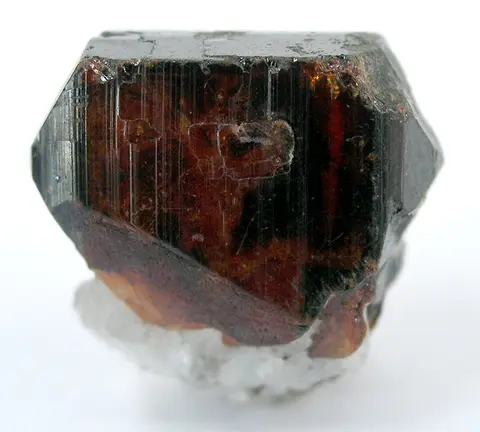
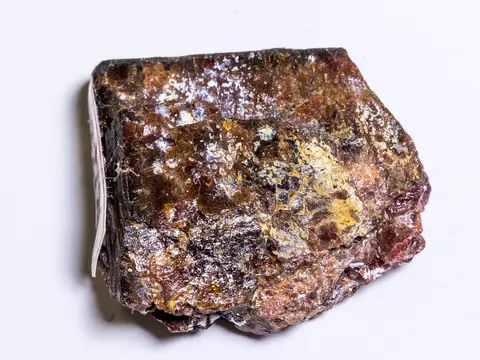
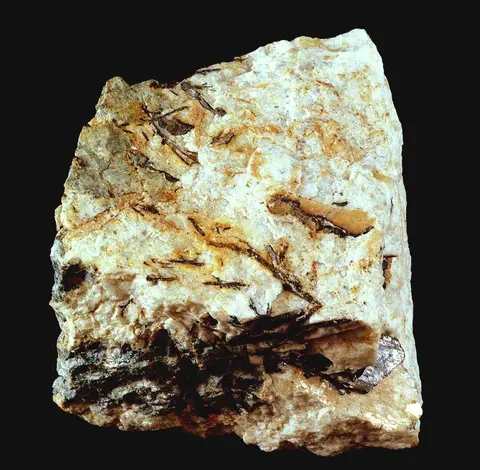
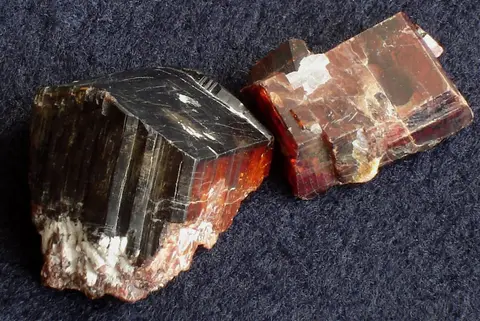
Tantalite is an iron manganese tantalum oxide, (Fe,Mn)Ta2O6, the main ore of tantalum. It is the tantalum-rich end of the columbite-tantalite series, sold in bulk as 'coltan', and is among the heaviest black minerals a collector will handle.
Not enough data. We have not yet seen 5 or more current dealer listings for tantalite in any one form, so we show no range rather than guess.
These are dealer asking prices: what shops list tantalite for, not what it sells for and not an appraisal. Selling to a dealer usually brings well below retail, because the dealer has to resell it at a margin.
How to identify tantalite
Black to brownish black, heavy, blocky or tabular crystals in granite pegmatite.
Extremely heavy: specific gravity rises with tantalum content to about 8, far heavier than other black pegmatite minerals.
Submetallic to resinous luster; thin edges of manganese-rich crystals glow reddish brown against a light.
Dark brown to black streak, reddish brown in manganese-rich tantalite.
Hard: 6 to 6.5, scratches glass.
Not magnetic or only weakly so.
Found with albite, lepidolite, spodumene, beryl, cassiterite and quartz.
Where tantalite comes from
Greenbushes and Wodgina, Western Australia
Large pegmatite mines that have been among the world's main tantalum producers.
Minas Gerais, Brazil
Pegmatites and placers; Brazil holds large reserves.
Democratic Republic of Congo and Rwanda
Artisanal 'coltan' mining; material from eastern DRC is regulated as a conflict mineral.
Tanco mine, Bernic Lake, Manitoba, Canada
Famous rare-element pegmatite producing tantalum, cesium and lithium.
Alto Ligonha, Mozambique
Pegmatites with collector-grade crystals.
Maine, Colorado and South Dakota, USA
Pegmatite occurrences that yield specimens for collectors.
Tantalite lookalikes
Columbite
Columbite is noticeably lighter (SG about 5.2 to 5.4); only weight or a lab separates the series members.
Uraninite is pitch-black and strongly radioactive; a Geiger counter separates them.
SG 6.5 to 10
Black to brownish black streak
Fake, dyed and treated tantalite
Black pegmatite minerals or slag sold as tantalite or coltan
Common
Low weight in hand
Glassy slag with bubbles
Strong magnet response
Columbite sold as tantalite
Common
Specific gravity near 5.3 rather than 7 to 8
Is my tantalite real? Tests you can do at home
Specific gravity with a kitchen scale
Weigh the dry specimen, then hang it on a thread in a cup of water on the scale and note the gain; divide dry weight by the gain.
Real
About 7 to 8 for true tantalite.
Fake or lookalike
Columbite about 5.3, magnetite about 5.2, tourmaline about 3.1, slag usually under 4.
Streak plate
Rub a corner on unglazed porcelain.
Real
Dark brown to black, or reddish brown in manganese-rich pieces.
Fake or lookalike
Cassiterite white to pale brown; hematite red.
Can leave a small mark.
Magnet test
Hang the specimen on a thread and bring a strong magnet close.
Real
No pull or very faint.
Fake or lookalike
Magnetite and many slags pull strongly.
Glass scratch
Try to scratch a glass bottle with a sharp edge.
Real
Scratches glass.
Fake or lookalike
Wolframite does not.
Can leave a small mark.
A stone that passes these tests is consistent with natural tantalite, not proven. For valuable pieces, a gem lab report settles treatment and origin.
What moves the price of tantalite
Specimen vs ore. Sharp crystals on matrix are sold as specimens; massive material is valued as ore by tantalum oxide content.
Crystal quality. Lustrous, well-formed, undamaged crystals command the most.
Locality. Classic pegmatite localities and documented sources add value; undocumented coltan may be hard to sell legally.
Associations. Crystals with lepidolite, albite or tourmaline make attractive specimens.
Tantalum content. For ore, higher Ta2O5 grade and lower radioactivity raise value.
Care and safety
Some tantalite and coltan concentrates contain uranium and thorium. Store large lots away from living areas and wash hands after handling; buyers of ore may require radioactivity checks.