What uraninite is worth
Not enough data. We have not yet seen 5 or more current dealer listings for uraninite in any one form, so we show no range rather than guess.
These are dealer asking prices: what shops list uraninite for, not what it sells for and not an appraisal. Selling to a dealer usually brings well below retail, because the dealer has to resell it at a margin.
How to identify uraninite
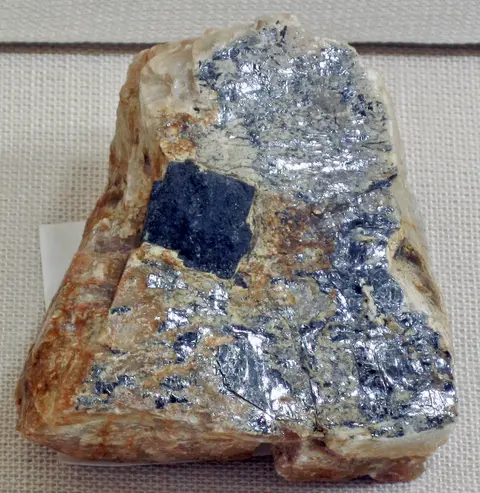
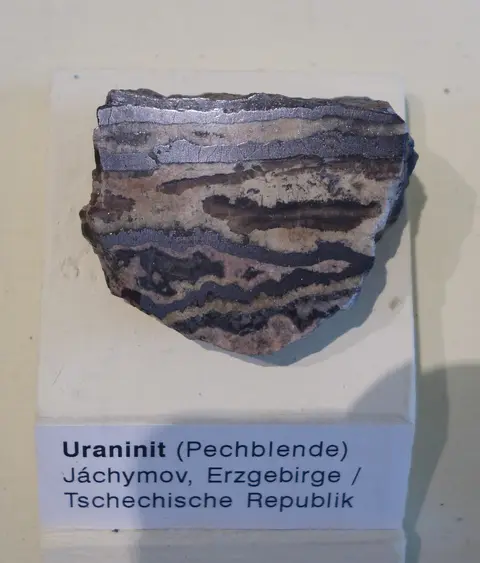
- Black to brownish black with a submetallic to pitchy, greasy luster.
- Extremely heavy for a dark mineral: SG roughly 6.5 to 10, depending on oxidation and form.
- Crystals are cubes, octahedrons or combinations; massive pitchblende is botryoidal or banded.
- Strong reading on a Geiger counter or other radiation detector.
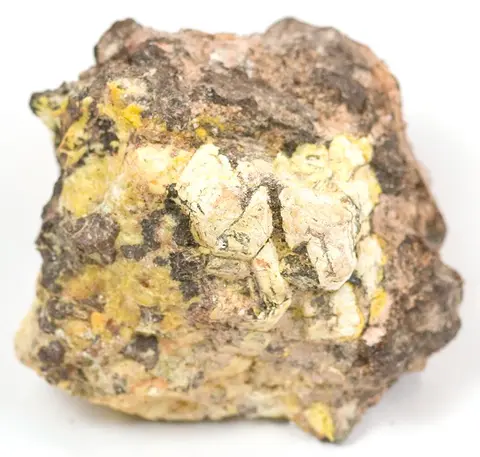
- Often coated or veined with bright yellow, orange or green secondary uranium minerals such as gummite, autunite or torbernite.
- Brownish black streak; not magnetic.
Where uraninite comes from
- Jachymov (Joachimsthal), Czech Republic
- Historic pitchblende source from which Marie and Pierre Curie isolated radium and polonium.
- Shinkolobwe, Katanga, Democratic Republic of Congo
- Rich uranium deposit with large crystals and many colorful secondary uranium minerals.
- Great Bear Lake (Port Radium), Northwest Territories, Canada
- Historic pitchblende mine.
- Bancroft area, Ontario, Canada
- Cubic and octahedral crystals in pegmatite and marble.
- Ruggles and other pegmatite mines, New Hampshire, USA
- Crystals in granite pegmatite with yellow and orange alteration rinds.
- Colorado Plateau, USA
- Uranium ore districts, mostly fine grained pitchblende and secondary minerals.
Uraninite lookalikes
Magnetite is strongly attracted to a magnet and gives no radiation reading.
- Magnetite SG about 5.2
- Black streak
Schorl forms striated prisms with a triangular cross section and is much lighter (SG about 3.2).
- Hardness 7
- Not radioactive
Psilomelane is botryoidal like pitchblende but lighter and not radioactive.
- SG about 4.4 to 4.7
- Black to brownish black streak
Tantalite forms tabular to prismatic black crystals and gives little or no radiation reading.
- SG 5.2 to 8.0
- Dark red-brown to black streak
Hematite gives a red-brown streak and is not radioactive.
Fake, dyed and treated uraninite
Black rocks sold as 'uranium ore' or uraninite
Common
- No elevated reading on a Geiger counter
- Too light for its size
- Magnetic (magnetite) or prismatic (tourmaline)
Low-grade radioactive rock sold as uraninite
Occasional
- Reads radioactive, but no visible black uraninite grains
- Mostly granite or sandstone with yellow staining
Is my uraninite real? Tests you can do at home
-
Radiation check with a Geiger counter
Hold a Geiger counter or consumer radiation meter near the specimen and compare against the background reading taken away from it.
- Real
- Readings far above background.
- Fake or lookalike
- Magnetite, tourmaline, hematite and psilomelane read at background.
-
Magnet test
Hold a strong magnet next to the specimen.
- Real
- No attraction.
- Fake or lookalike
- Magnetite sticks firmly.
-
Weight in hand
Compare with a similar size piece of ordinary dark rock (handle briefly and wash hands afterward).
- Real
- Noticeably very heavy.
- Fake or lookalike
- Tourmaline, psilomelane and most black rocks feel much lighter.
-
UV check of alteration minerals
Shine a longwave UV torch on yellow or green coatings in a dark room.
- Real
- Secondary uranium minerals such as autunite often glow bright green.
- Fake or lookalike
- Ordinary black rocks with rust staining show no green glow.
A stone that passes these tests is consistent with natural uraninite, not proven. For valuable pieces, a gem lab report settles treatment and origin.
What moves the price of uraninite
- Crystal form. Sharp cubic or octahedral crystals are far more valuable than massive pitchblende.
- Locality. Historic localities such as Jachymov and Shinkolobwe, and well documented crystal localities such as Bancroft, carry a premium.
- Associated minerals. Colorful secondary uranium minerals on the specimen add interest.
- Size. Larger crystals are rare; most crystals are small.
- Shipping and legal limits. Radioactivity restricts shipping and sale in many places, which narrows the market.
Care and safety
Uraninite is strongly radioactive and gives off radon gas. Keep specimens in a sealed container in a ventilated area away from living spaces, handle briefly and wash hands afterward, never break, grind or streak it indoors where dust can be inhaled, and keep it away from children and pets. Check local laws before buying, selling or shipping.