Psilomelane is a field and trade name for hard, black, massive or botryoidal manganese oxides, not a single mineral species. Most material sold under the name is romanechite, a barium manganese oxide, often mixed with cryptomelane, hollandite or pyrolusite.
Prices checked . Page updated .
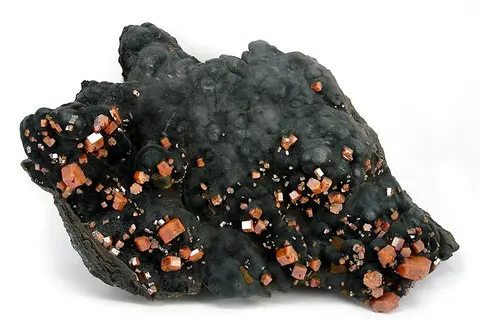
Vanadinite-Psilomelane-112809. Photo: Robert M. Lavinsky, CC BY-SA 3.0, via Wikimedia Commons.
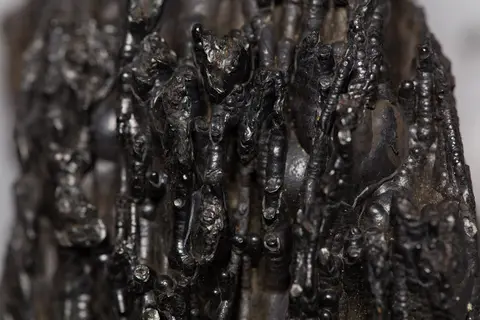
Psilomelane (48723936133). Photo: Auckland Museum Collections from Auckland, Aotearoa New Zealand, CC BY 2.0, via Wikimedia Commons.
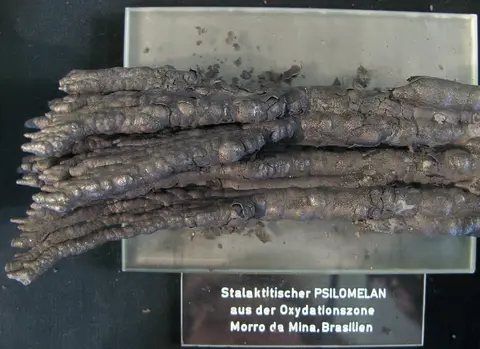
Psilomelan (stalaktitisch) - Morro da Mina, Brasilien. Photo: Ra'ike (see also: de:Benutzer:Ra'ike ), CC BY-SA 3.0, via Wikimedia Commons.
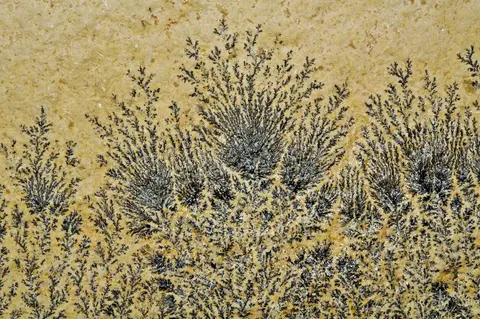
Pyrolusite (Solnhofen Bavière - Allemagne). Photo: Parent Géry, CC BY-SA 3.0, via Wikimedia Commons.
What psilomelane is worth
Not enough data. We have not yet seen 5 or more current dealer listings for psilomelane in any one form, so we show no range rather than guess.
These are dealer asking prices: what shops list psilomelane for, not what it sells for and not an appraisal. Selling to a dealer usually brings well below retail, because the dealer has to resell it at a margin.
How to identify psilomelane
Black to steel gray, often in smooth rounded botryoidal (grape-like) or stalactitic masses; the name means smooth black.
Submetallic luster on fresh or polished surfaces, dull on weathered ones.
Streak brownish black to black.
Fairly hard (5 to 6): resists a fingernail and coin and only marks with a steel knife; does not soil the fingers, unlike sooty pyrolusite.
Heavy (SG roughly 4 to 4.7) but not magnetic.
Polished lapidary pieces show concentric black and silvery bands, often with chalcedony.
Where psilomelane comes from
Romaneche-Thorins, Saone-et-Loire, France
Type locality of romanechite, the main component of psilomelane.
Mexico
Banded psilomelane with chalcedony cut into cabochons and polished slabs for the lapidary trade.
Imini, Morocco
Manganese oxide mining district producing botryoidal black specimens.
Arizona and New Mexico, USA
Manganese oxide deposits with botryoidal psilomelane masses.
Botryoidal hematite or goethite labeled as psilomelane
Occasional
Red-brown or yellow-brown streak instead of black
Black stones sold under the name for the metaphysical market
Occasional
Magnetic tumbles are hematine or magnetite
Glassy black stones with no banding are often obsidian or glass
Is my psilomelane real? Tests you can do at home
Streak test
Rub a hidden corner across the back of an unglazed porcelain tile.
Real
Brownish black to black streak.
Fake or lookalike
Hematite gives red-brown; goethite yellow-brown.
Can leave a small mark.
Magnet test
Bring a strong magnet close to the piece.
Real
No attraction.
Fake or lookalike
Magnetite and hematine are attracted.
Finger smudge test
Rub a fingertip firmly over a broken, unpolished surface.
Real
Finger stays mostly clean.
Fake or lookalike
Sooty pyrolusite leaves black marks on the skin.
Weight in hand
Compare with a quartz or agate piece of similar size.
Real
Noticeably heavier, around one and a half times or more.
Fake or lookalike
Obsidian and black glass feel ordinary or light.
A stone that passes these tests is consistent with natural psilomelane, not proven. For valuable pieces, a gem lab report settles treatment and origin.
Treatments
Polishing and stabilization (occasional)
Porous pieces may be resin-impregnated before polishing; minor effect on value. Plastic luster in pores.
What moves the price of psilomelane
Pattern. Crisp concentric banding, especially with contrasting chalcedony, for lapidary pieces.
Form. Well-developed botryoidal or stalactitic specimens with bright surfaces.
Size. Large intact botryoidal masses.
Locality and labeling. Analyzed pieces identified as a specific species carry more interest for collectors.
Condition. Unchipped surfaces and no cracks in polished pieces.
Care and safety
Manganese oxide dust should not be inhaled; cut and polish wet and wash hands after handling broken material.