Chrysocolla vs turquoise
Turquoise is harder (5 to 6) and heavier (SG 2.6 to 2.9); chrysocolla scratches more easily and feels lighter.
Side by side
| Property | Chrysocolla | Turquoise |
|---|---|---|
| Hardness (Mohs) | 2 to 4 (silicified material up to 7) | 5 to 6 |
| Specific gravity | 1.9 to 2.4 | 2.6 to 2.9 |
| Luster | Vitreous to waxy or earthy | Waxy to subvitreous; dull on porous material |
| Streak | Pale blue to white or greenish | White to pale greenish blue |
| Crystal system | Orthorhombic; usually amorphous or very fine grained | Triclinic (crystals are microscopic; normally massive) |
| Cleavage | None | Perfect and good in two directions, not seen in massive material |
| Refractive index | About 1.46 to 1.57 (variable) | 1.61 to 1.65 (spot reading about 1.61) |
| Formula | (Cu,Al)2H2Si2O5(OH)4·nH2O (variable) | CuAl6(PO4)4(OH)8·4H2O |
| Typical dealer asking price | $35 to $370 (slabs and polished pieces) | $5 to $17 (rough) |
How to tell them apart
- Turquoise often has a matrix web
- Both are copper minerals
Much softer: a fingernail or copper coin can mark pure chrysocolla, and it often shows bright cyan with brown or black streaks of other copper minerals.
- Hardness 2 to 4 unless silicified
- SG 1.9 to 2.4, lighter in hand
- Often occurs with malachite and azurite
Photos of each
Chrysocolla
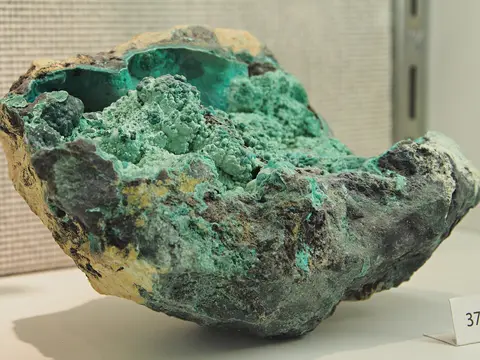

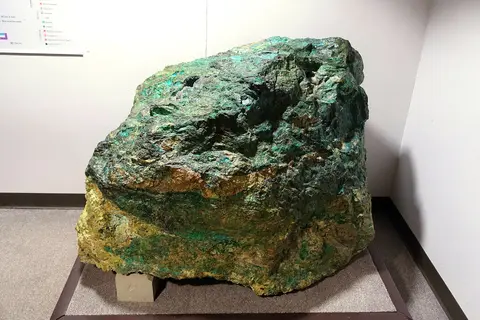

Turquoise
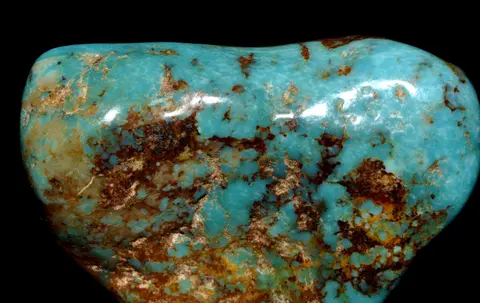

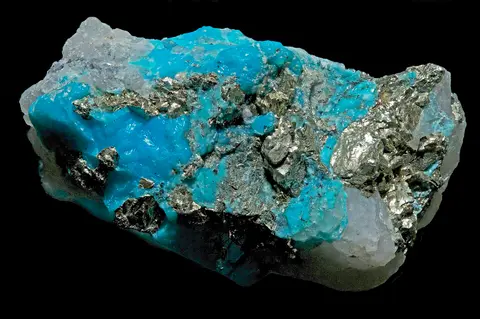

More on each: chrysocolla value and identification and turquoise value and identification.