Dealers list sodalite tumbled stones at $80 to $205 per pound; rough runs about $7 to $12 per pound.
Prices checked . Page updated .
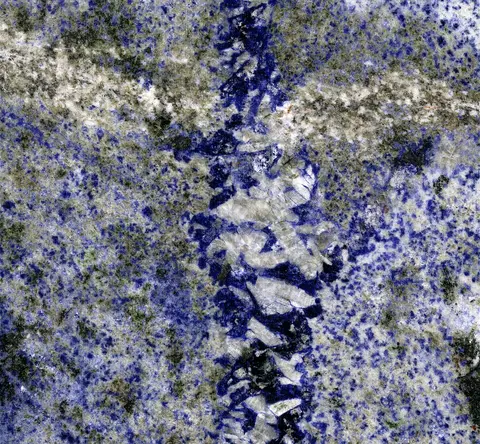
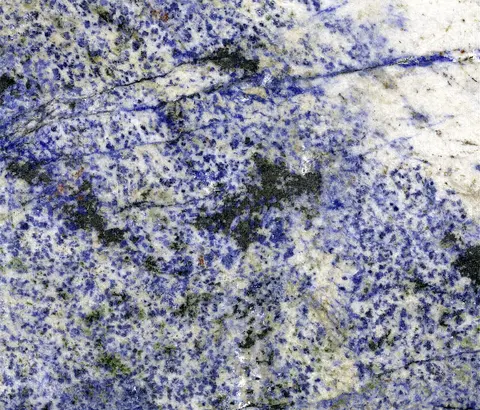
Azul Bahia "Granite", sodalite metasyenite, Itabuna Syenite Complex,Bahia. Photo: James St. John, CC BY 2.0, via Wikimedia Commons.
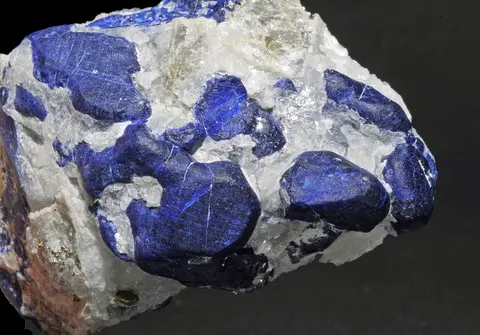
Sodalite, pyrite 1. Photo: Parent Géry, CC BY-SA 3.0, via Wikimedia Commons.
Azul Bahia Granite (sodalite metasyenite, Itabuna Syenite Complex, Neoproterozoic, ~676 Ma; Fazenda Hiassu, Bahia State, Brazil) 17. Photo: James St. John, CC BY 2.0, via Wikimedia Commons.
What sodalite is worth
Dealer asking prices for sodalite, middle half of current listings, checked 2026-11-20. Bar shows the 25th to 75th percentile; the dark tick is the median.
These are dealer asking prices: what shops list sodalite for, not what it sells for and not an appraisal. Selling to a dealer usually brings well below retail, because the dealer has to resell it at a margin.
How to identify sodalite
Sodalite is a sodium aluminum silicate with chlorine, a feldspathoid mineral that forms in silica-poor igneous rocks such as nepheline syenite. Most collectors know it as the royal blue rock with white veins used for beads, spheres and carvings.
Royal blue to violet-blue with white or gray veins and patches; the white is often feldspar, nepheline or calcite.
Gives a white streak on unglazed porcelain, a key difference from lapis lazuli, which gives a light blue streak.
Pyrite flecks are rare; lots of gold pyrite points to lapis lazuli instead.
Hardness 5.5 to 6: it scratches with difficulty by a steel knife and barely marks glass.
Light for a blue stone (SG about 2.3), lighter in hand than lapis lazuli or azurite.
Many pieces glow orange in patches or veins under a longwave (365 nm) UV light.
Vitreous to greasy luster on polished surfaces; crystals are rare and usually dodecahedral.
Violet-blue tone with white veins and little or no pyrite
Light in the hand compared with lapis
Dyed howlite or magnesite sold as sodalite
Occasional
Dye collects in cracks and veins, which look darker blue
An acetone swab may pick up blue
Much softer (howlite about 3.5) and scratches easily with steel
Dyed jasper or quartzite in sodalite blue
Occasional
Uniform blue with darker dye concentrated in fractures
Hardness 7, scratches glass easily
No orange UV fluorescence
Blue glass or resin beads
Occasional
Round bubbles under a loupe
Perfectly uniform color with no veining
Resin feels warm and light
Is my sodalite real? Tests you can do at home
Streak test
Rub a corner of the stone firmly across the back of an unglazed porcelain tile.
Real
Sodalite leaves a white streak.
Fake or lookalike
Lapis lazuli leaves a light blue streak; azurite leaves a blue streak.
Can leave a small mark.
Longwave UV torch
In a dark room, shine a 365 nm UV flashlight on the stone.
Real
Many sodalites glow orange in spots or veins, though some do not.
Fake or lookalike
Dyed quartzite, glass and lapis typically do not glow orange.
Acetone swab for dye
Rub a cotton swab dampened with acetone (nail polish remover) on an inconspicuous spot.
Real
Swab stays clean.
Fake or lookalike
Dyed stones often leave blue on the swab.
Specific gravity with a kitchen scale
Weigh the stone dry, then weigh it hanging on a thread in water; divide dry weight by the weight gain.
Real
About 2.3.
Fake or lookalike
Lapis 2.7 to 2.9, azurite about 3.8, kyanite about 3.6.
Scratch test on glass
Try to scratch a glass plate with a sharp edge, then wipe off any powder.
Real
Sodalite marks glass only weakly or not at all.
Fake or lookalike
Blue quartz and aventurine scratch glass easily; howlite cannot scratch it.
Can leave a small mark.
A stone that passes these tests is consistent with natural sodalite, not proven. For valuable pieces, a gem lab report settles treatment and origin.
Treatments
Waxing or oiling (common)
Improves luster on polished beads and carvings; accepted practice with little effect on price. Waxy feel; a hot point near the surface can sweat wax (destructive, test only on rough).
Dyeing (occasional)
Deepens a pale or gray-blue stone; lowers value when disclosed. Color concentrated in cracks; acetone swab may lift dye.
Resin stabilization (occasional)
Fills fractured material so it can be cut into beads. Shiny resin filled cracks under a loupe; lab confirmation.
What moves the price of sodalite
Color. Deep, even royal blue with little white matrix is worth the most; gray or heavily veined material is common.
Translucency. Rare translucent to transparent material, such as some Namibian and Afghan stones, sells for far more than opaque rock.
Crystals vs massive. Well formed crystals from classic localities such as Mont Saint-Hilaire are collector items; massive sodalite is a common decorative stone.
Size and workmanship. Large spheres, carvings and slabs with good polish and no cracks carry more value.
Locality. Named classic localities such as Bancroft add interest for collectors.
Treatment. Dyed or stabilized pieces sell below natural, untreated material.
Questions collectors ask about sodalite
Lapis lazuli vs sodalite: how do you tell them apart?
Do a streak test: lapis lazuli leaves a light blue streak and sodalite leaves a white one. Lapis usually shows gold pyrite and is heavier, while sodalite tends to be violet-blue with white veins and little or no pyrite.
Sources
Prices: 26 current listings from FossilEra, iRocks (The Arkenstone), Kingsley North, The Gem Shop, Throwin Stones, seen 2026-11-20 to 2026-11-20. How we collect prices.