What chalcanthite is worth
Not enough data. We have not yet seen 5 or more current dealer listings for chalcanthite in any one form, so we show no range rather than guess.
These are dealer asking prices: what shops list chalcanthite for, not what it sells for and not an appraisal. Selling to a dealer usually brings well below retail, because the dealer has to resell it at a margin.
How to identify chalcanthite
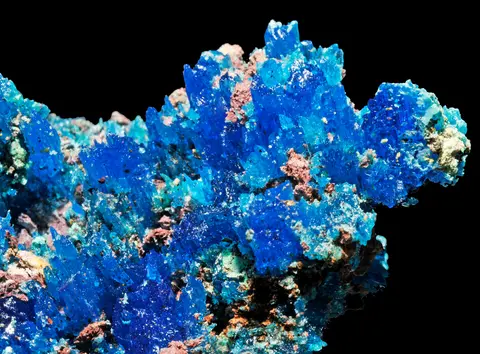
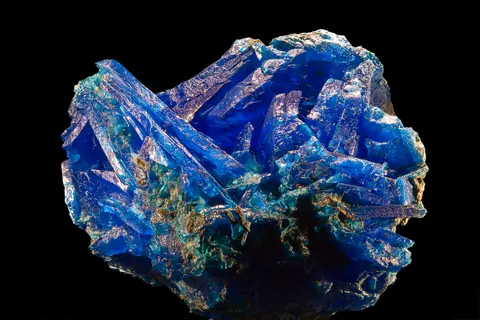
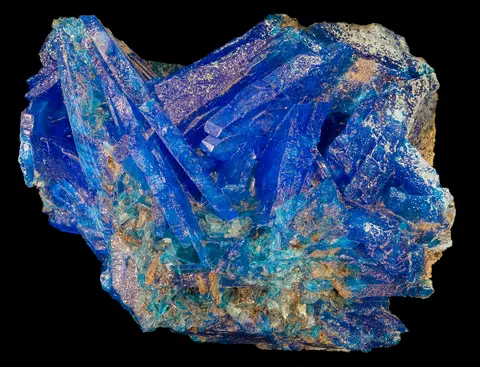
- Vivid sky blue to deep Berlin blue color
- Natural material is mostly crusts, fibrous veins, stalactites and small crystals rather than large sharp crystals
- Very soft (hardness 2.5) and light (SG about 2.3)
- Dissolves in water and turns pale and powdery when it dries out in low humidity
- Vitreous luster on fresh surfaces, dull on dehydrated crusts
- Found with other secondary copper minerals in arid mine workings
Where chalcanthite comes from
- Chuquicamata, Chile
- Natural chalcanthite in the arid oxidized zone of one of the world's largest copper mines.
- Rio Tinto, Huelva, Spain
- Old workings with natural chalcanthite crusts and stalactites.
- Arizona, USA
- Arid copper mines, including Bisbee, where natural chalcanthite forms on mine walls.
Chalcanthite lookalikes
Azurite is insoluble, deeper blue and heavier.
- Azurite SG about 3.8
- Hardness 3.5 to 4
- Light blue streak
Chrysocolla is opaque, earthy to glassy blue green and does not dissolve.
- Hardness 2 to 4
- Never forms transparent crystals
Kyanite forms long blades, is much harder along the blade and does not dissolve.
Blue glass
Glass is much harder, is not marked by a copper coin, and does not dissolve or dehydrate.
- Hardness 5 to 6
- Bubbles and conchoidal fracture
Fake, dyed and treated chalcanthite
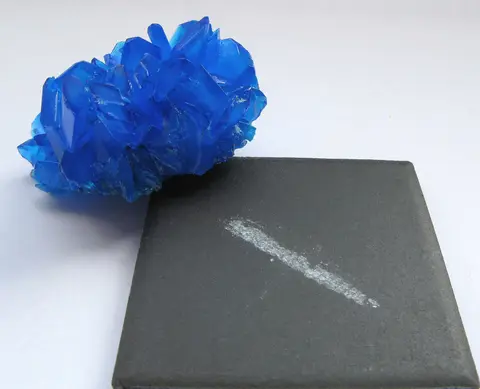
Lab-grown copper sulfate crystals sold as natural chalcanthite
Very common
- Large, perfectly sharp deep blue crystals in dense clusters
- Grown on an unrelated rock, slag or geode with no copper ore
- Price and supply too good for a rare natural habit
- Seller cannot name a specific mine
Rocks coated with grown copper sulfate
Common
- Even crystal crust over all surfaces including broken edges
- Crust easily scraped off to a non-copper rock
Blue glass or resin
Occasional
- Does not dull in dry air
- Bubbles
- Harder than chalcanthite
Is my chalcanthite real? Tests you can do at home
-
Fingernail scratch
Gently draw a fingernail or copper coin across a hidden spot, then wash your hands.
- Real
- Copper marks it; a fingernail may just mark it.
- Fake or lookalike
- Glass is not marked by copper.
Can leave a small mark.
-
Habit and context check
Look at the crystal form and the rock it sits on with a 10x loupe.
- Real
- Natural chalcanthite is usually crusts, fibers or stalactites on oxidized copper ore with other copper minerals.
- Fake or lookalike
- Grown material is large, sharp, glassy tabular crystals clustered on an unrelated rock or in a geode.
-
Humidity response
Observe the piece over weeks in a dry room without handling.
- Real
- Chalcanthite surfaces may turn pale and powdery as they lose water; grown copper sulfate does the same.
- Fake or lookalike
- Glass and resin stay unchanged.
A stone that passes these tests is consistent with natural chalcanthite, not proven. For valuable pieces, a gem lab report settles treatment and origin.
Treatments
- Coating with lacquer or acrylic (occasional)
- Seals specimens against humidity changes; accepted for preservation if disclosed. Unusual gloss, sticky or plastic feel.
What moves the price of chalcanthite
- Natural origin. Documented natural specimens from a named mine are worth far more than lab-grown clusters.
- Habit. Natural stalactites and well formed natural crystals rank above crusts.
- Condition. Unweathered blue surfaces rank above pale dehydrated ones.
- Locality. Classic localities such as Chuquicamata and Rio Tinto.
- Size. Larger natural pieces are uncommon because the mineral is fragile and soluble.
Care and safety
Copper sulfate is harmful if swallowed and irritates skin and eyes. Keep away from children and pets, wash hands after handling and do not put it in water used for drinking, aquariums or crystal elixirs.
Store in a sealed container at stable, moderate humidity, away from water and heat. Never wash it; it dissolves. Dry air turns it pale and powdery, and damp air can make it deliquesce or recrystallize.