


Pentagonite
Pentagonite, the same chemistry, grows as single prismatic crystals often twinned into five-sided shapes rather than radiating balls.
- Same formula
- Much rarer
- Usually needs lab confirmation
Dealers list cavansite tumbled stones at $530 to $1,000 per pound.
Prices checked . Page updated .
| Form and size | Typical asking price | Range chart | Median | Listings |
|---|---|---|---|---|
| Tumbled stones (per pound) | $531 to $1,021 | $776 | 5 from 1 dealer | |
| Specimens (per piece) | Not enough data (1 listing, need 5) | |||
| Listing | Size | Locality | Asking | Seen |
|---|---|---|---|---|
| CAVANSITE Tumbled Stones - Natural Polished Crystals, Chakra Rocks, Self Care, E0219 (Extra Small) Throwin Stones | 3.2 cm | $9 | ||
| CAVANSITE Tumbled Stones - Natural Polished Crystals, Chakra Rocks, Self Care, E0219 (Small) Throwin Stones | 3.2 cm | $12 | ||
| CAVANSITE Tumbled Stones - Natural Polished Crystals, Chakra Rocks, Self Care, E0219 (Medium) Throwin Stones | 3.2 cm | $17 | ||
| CAVANSITE Tumbled Stones - Natural Polished Crystals, Chakra Rocks, Self Care, E0219 (Large) Throwin Stones | 3.2 cm | $23 | ||
| CAVANSITE Tumbled Stones - Natural Polished Crystals, Chakra Rocks, Self Care, E0219 (Extra Large) Throwin Stones | 3.2 cm | $36 | ||
| Cavansite with Calcite on Stilbite iRocks (The Arkenstone) | 5.8 cm | Wagholi Quarries, Wagholi, Pune Dist., Maharashtra, India | $4,200 |
These are dealer asking prices: what shops list cavansite for, not what it sells for and not an appraisal. Selling to a dealer usually brings well below retail, because the dealer has to resell it at a margin.
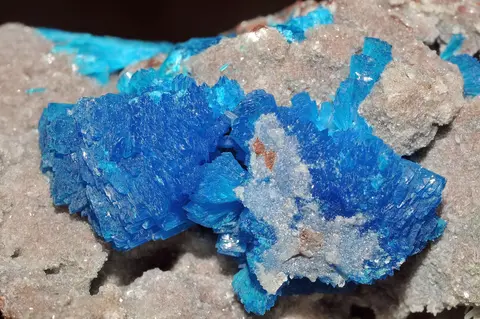
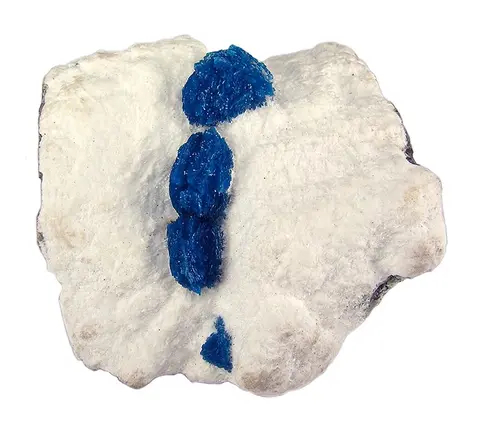
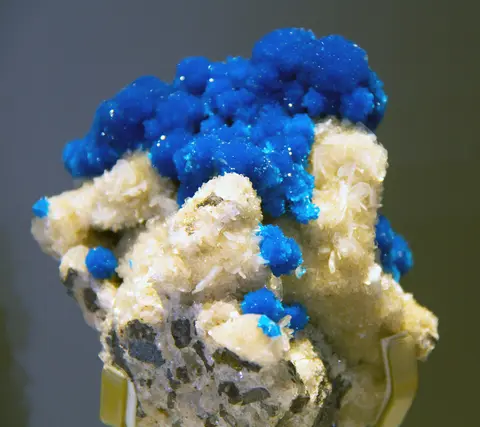
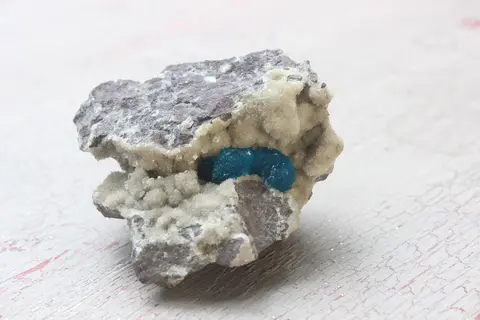
Cavansite is a hydrated calcium vanadium silicate that forms vivid blue radiating balls and rosettes in cavities of basalt. Nearly all specimens on the market come from quarries near Pune, India, where it grows with stilbite and other zeolites.
Pentagonite, the same chemistry, grows as single prismatic crystals often twinned into five-sided shapes rather than radiating balls.
Azurite is a darker royal blue and much heavier (SG about 3.8).
Chrysocolla forms crusts and botryoidal masses, not radiating crystal balls.
Occasional
Rare
Use a 10x loupe to look where each blue ball meets the matrix, turning the specimen under strong light.
In a dark room, shine a longwave UV flashlight on the contact points.
Rub a cotton swab dampened with acetone on an inconspicuous spot of the matrix near the blue.
A stone that passes these tests is consistent with natural cavansite, not proven. For valuable pieces, a gem lab report settles treatment and origin.
Very fragile. Do not touch the blue balls, keep it in a closed box, and clean only with a gentle blower; no washing or ultrasonic cleaning.
Prices: 6 current listings from iRocks (The Arkenstone), Throwin Stones, seen 2026-11-20 to 2026-11-20. How we collect prices.