Vivianite is a hydrated iron phosphate, Fe3(PO4)2·8H2O. It is nearly colorless when fresh but darkens to blue, green and almost black as its iron oxidizes in light and air.
Prices checked . Page updated .
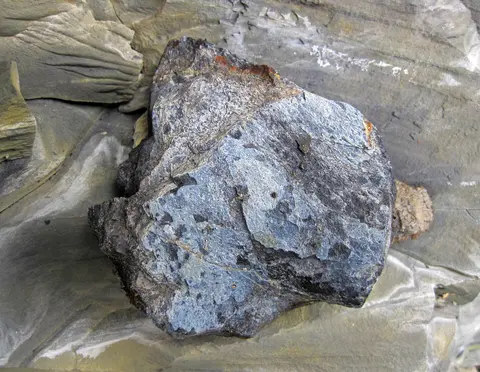
Fish bone with blue vivianite (Chattanooga Shale, Upper Devonian; Burkesville West Rt. 90 roadcut, Kentucky, USA) 1 (28475434018). Photo: James St. John, CC BY 2.0, via Wikimedia Commons.
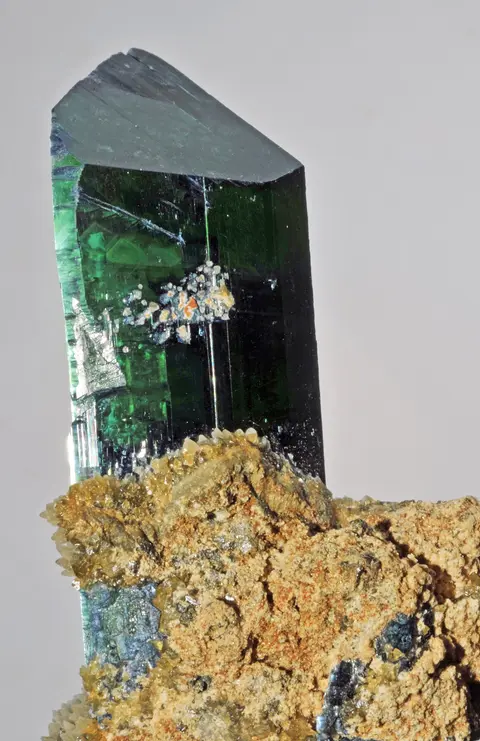
Vivianite 1. Photo: Parent Géry, CC BY-SA 3.0, via Wikimedia Commons.
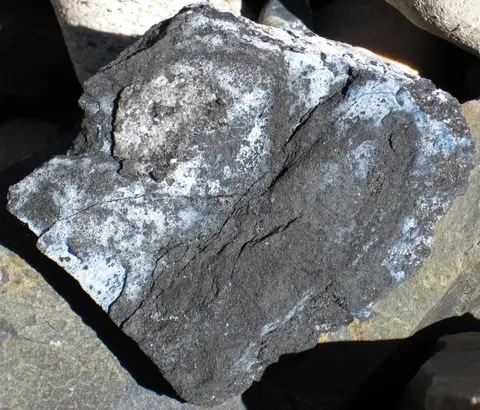
Vivianite on phosphorite (Meade Peak Member, Phosphoria Formation, Permian; Astoria Hot Springs roadcut, Teton County, Wyoming, USA) 1 (49191702513). Photo: James St. John, CC BY 2.0, via Wikimedia Commons.
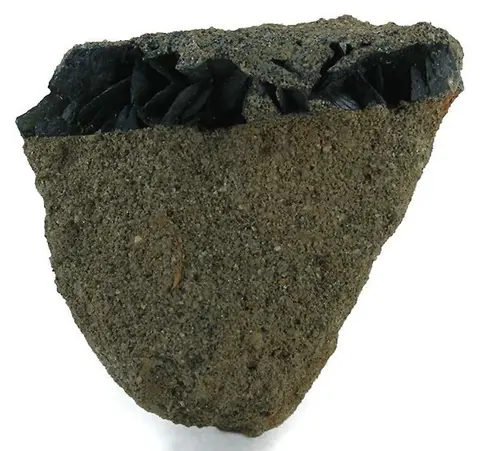
Vivianite-225075. Photo: Robert M. Lavinsky, CC BY-SA 3.0, via Wikimedia Commons.
What vivianite is worth
Not enough data. We have not yet seen 5 or more current dealer listings for vivianite in any one form, so we show no range rather than guess.
These are dealer asking prices: what shops list vivianite for, not what it sells for and not an appraisal. Selling to a dealer usually brings well below retail, because the dealer has to resell it at a margin.
How to identify vivianite
Blue-green to deep blue or almost black bladed or prismatic crystals
Very soft: scratched by a fingernail (hardness 1.5 to 2)
One perfect cleavage giving thin, flexible plates with a pearly sheen
Freshly broken surfaces look paler and darken over time
Often found in clay, in fossil shells and bones, or in bog deposits
Thin crystals look green along one direction and blue along another
Where vivianite comes from
Huanuni, Llallagua and Morococala, Bolivia
Tin mines that produced the largest and finest gem-like crystals.
Anloua, Cameroon
Large dark crystals and radiating groups in clay concretions.
Kerch Peninsula, Crimea
Vivianite in fossil shells and iron ores; classic old specimens.
Blackbird mine, Lemhi County, Idaho, USA
Long, dark blue-green crystals.
Mullica Hill, New Jersey, USA
Blue crystals in fossil shells and bones from Cretaceous marl.
Kyanite cannot be scratched by a fingernail; vivianite can.
Kyanite hardness 4.5 to 7 depending on direction
Kyanite SG about 3.6
Kyanite does not darken in light
Linarite
Linarite is a brighter deep blue lead copper sulfate that is much heavier.
Linarite SG about 5.3
Found with other lead and copper minerals
Fake, dyed and treated vivianite
Repaired or reattached crystals
Occasional
Glue visible where blades meet matrix
Breaks across the brittle cleavage plane
Crystals coated with lacquer or oil to slow darkening
Occasional
Unnatural even gloss
Tacky surface
Is my vivianite real? Tests you can do at home
Fingernail scratch
Gently press a fingernail into an inconspicuous edge.
Real
Leaves a mark (hardness 1.5 to 2).
Fake or lookalike
Azurite and kyanite are not marked by a fingernail.
Can leave a small mark.
Vinegar drop
Put a drop of household vinegar on a small, hidden spot of matrix or crystal and watch with a loupe.
Real
No fizzing.
Fake or lookalike
Azurite and other carbonates fizz.
Can leave a small mark.
Color shift with orientation
Look through a thin crystal and rotate it under a bright light.
Real
Color shifts between green and blue in different directions.
Fake or lookalike
Glass and most blue lookalikes keep one color.
A stone that passes these tests is consistent with natural vivianite, not proven. For valuable pieces, a gem lab report settles treatment and origin.
Treatments
Protective coating (occasional)
Some collectors coat crystals to slow darkening and cracking; it can reduce appeal if visible. Gloss and slight tackiness under a loupe.
Repair (occasional)
Fragile crystals are often reglued; repaired pieces are worth less. Loupe inspection at breaks.
What moves the price of vivianite
Transparency and color. Transparent blue-green crystals that have not turned black bring the most.
Crystal size. Large single crystals from Bolivia and Cameroon are the top tier.
Damage. Vivianite cracks and splits along cleavage easily; undamaged pieces are scarce.
Locality. Bolivian tin-mine specimens carry a premium.
Fossil association. Vivianite in fossil shells or bones has its own collector market.
Care and safety
Store in the dark at stable temperature and humidity. Light speeds darkening and can cause cracking; do not wash in hot water or use ultrasonic cleaners.
Sources
Prices: 1 current listings from FossilEra, seen 2026-11-20 to 2026-11-20. How we collect prices.