

Fuchsite
Fuchsite shows sparkly green mica flakes instead of feathery silver patterns.
- Chromium muscovite
- Glittery rather than silky
Dealers list seraphinite slabs and polished pieces 5 to 10 cm (2 to 4 in) at $19 to $25.
Prices checked . Page updated .
| Form and size | Typical asking price | Range chart | Median | Listings |
|---|---|---|---|---|
| Slabs and polished pieces (per piece) | $21 to $66 | $25 | 6 from 1 dealer | |
| 5 to 10 cm (2 to 4 in) | $19 to $25 | $25 | 5 from 1 dealer | |
| Spheres (per piece) | Not enough data (2 listings, need 5) | |||
| Tumbled stones (per pound) | Not enough data (0 listings, need 5) | |||
| Listing | Size | Locality | Asking | Seen |
|---|---|---|---|---|
| 2.55" Polished Seraphinite Slab - Korshunovkiy Mine, Siberia FossilEra | 6.5 cm | $19 | ||
| 2.7" Polished Seraphinite Slab - Korshunovkiy Mine, Siberia FossilEra | 6.9 cm | $19 | ||
| 2.55" Polished Seraphinite Slab - Korshunovkiy Mine, Siberia FossilEra | 6.5 cm | $25 | ||
| 2.3" Polished Seraphinite Slab - Korshunovkiy Mine, Siberia FossilEra | 5.8 cm | $25 | ||
| 1.3" Polished Seraphinite Pendant (Necklace) - 925 Sterling Silver FossilEra | 3.3 cm | $39 | ||
| 1.6" Polished Seraphinite Stone - Korshunovkiy Mine, Siberia FossilEra | 4.1 cm | $39 | ||
| 3.8" Polished Seraphinite Slab - Korshunovkiy Mine, Siberia FossilEra | 9.7 cm | $79 | ||
| 4.5" Polished Seraphinite Slab - Korshunovkiy Mine, Siberia FossilEra | 11.4 cm | $105 | ||
| 2.1" Polished Seraphinite Stone - Korshunovkiy Mine, Siberia FossilEra | 5.3 cm | $119 | ||
| 1.6" Polished Seraphinite Sphere - Siberia FossilEra | 4.1 cm | $125 | ||
| 1.6" Polished Seraphinite Sphere - Siberia FossilEra | 4.1 cm | $125 |
These are dealer asking prices: what shops list seraphinite for, not what it sells for and not an appraisal. Selling to a dealer usually brings well below retail, because the dealer has to resell it at a margin.
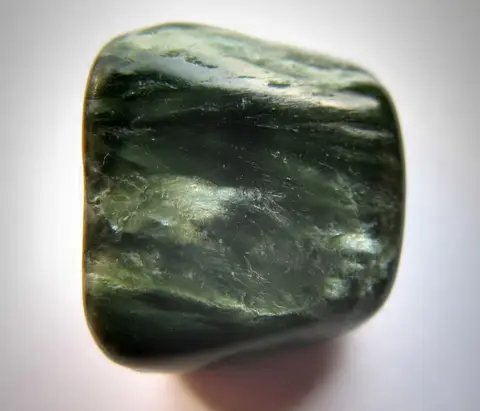
Seraphinite is a trade name for dark green clinochlore, a chlorite-group mineral (a hydrous magnesium iron aluminum silicate), with silvery feathery patterns that shimmer as the stone moves. Nearly all of it comes from one deposit in eastern Siberia.
Fuchsite shows sparkly green mica flakes instead of feathery silver patterns.
Malachite has concentric light and dark green bands, not feathers.
Nephrite is tough and resists a steel knife.
Serpentine is usually lighter green with waxy luster and no feathery shimmer.
Occasional
Rare
Rotate the stone under a single light source.
Lightly try a steel knife on the back or edge.
Can leave a small mark.
Examine the silvery areas at 10x.
A stone that passes these tests is consistent with natural seraphinite, not proven. For valuable pieces, a gem lab report settles treatment and origin.
Very soft: wear only in protected settings such as pendants and earrings, keep away from harder stones, and avoid ultrasonic cleaners and harsh chemicals.
Prices: 11 current listings from FossilEra, seen 2026-11-20 to 2026-11-20. How we collect prices.