Dealers list sugilite tumbled stones at $1,000 to $2,800 per pound.
Prices checked . Page updated .
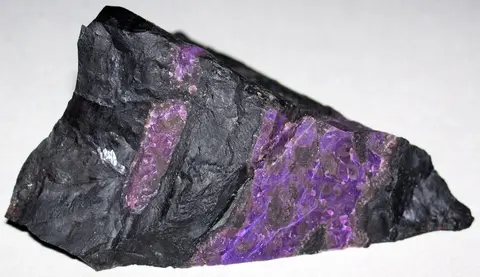
Sugilite-braunite (Hotazel Formation, Paleoproterozoic, 2.2-2.3 Ga; Wessels Mine, Kalahari Manganese Field, Northern Cape Province, South Africa) 4. Photo: James St. John, CC BY 2.0, via Wikimedia Commons.
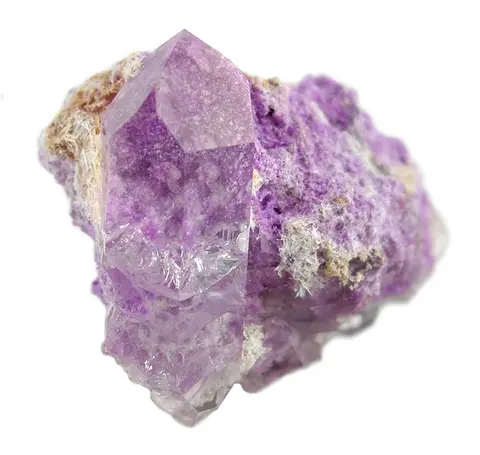
Quartz-Sugilite-t07-76a. Photo: Robert M. Lavinsky, CC BY-SA 3.0, via Wikimedia Commons.
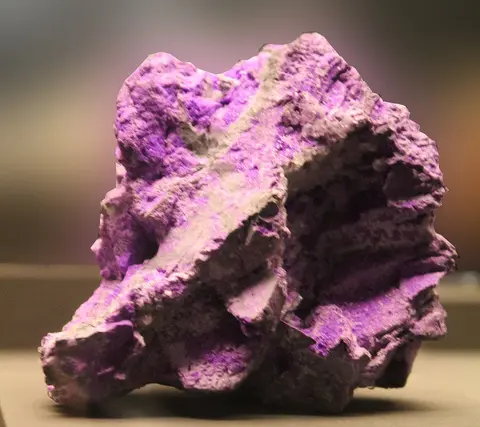
Freiberg, Terra mineralia, Sugilith. Photo: Dguendel, CC BY 4.0, via Wikimedia Commons.
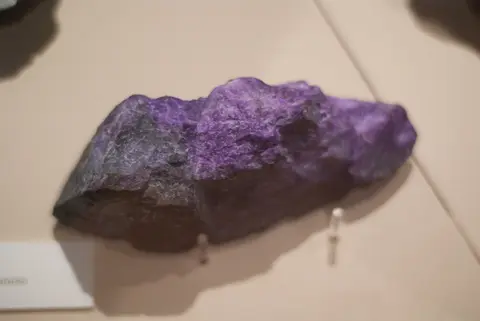
Museo de La Plata - Sugylita, Silicato de manganeso. Photo: Beatrice Murch from Buenos Aires, Argentina, CC BY 2.0, via Wikimedia Commons.
What sugilite is worth
Dealer asking prices for sugilite, middle half of current listings, checked 2026-11-20. Bar shows the 25th to 75th percentile; the dark tick is the median.
These are dealer asking prices: what shops list sugilite for, not what it sells for and not an appraisal. Selling to a dealer usually brings well below retail, because the dealer has to resell it at a margin.
How to identify sugilite
Sugilite is a potassium sodium lithium iron manganese silicate in the milarite group, colored purple by manganese. Nearly all gem sugilite comes from the Wessels mine in the Kalahari manganese field of South Africa.
Opaque to translucent purple, from pinkish violet to deep grape, often mottled with black manganese oxide matrix.
Waxy to glassy polish on cabochons and beads.
Hardness about 6: scratches glass weakly and resists a steel knife.
Fine-grained, massive texture with no visible crystals; best grade is translucent and glows when backlit (gel sugilite).
Color is in the stone itself, not concentrated along cracks or grain boundaries.
SG about 2.75, slightly heavier than dyed howlite or chalcedony.
Where sugilite comes from
Wessels mine, Kalahari manganese field, Northern Cape, South Africa
Source of nearly all purple gem sugilite, found in manganese ore from the late 1970s.
N'Chwaning mines, Kalahari manganese field, South Africa
Additional sugilite from the same manganese field.
Iwagi Island, Ehime, Japan
Type locality; yellowish brown non-gem grains, named for petrologist Ken-ichi Sugi.
Dye concentrated along grain boundaries in quartzite under a loupe
Glassy rather than waxy look
Reconstituted or resin-bonded sugilite
Occasional
Angular fragments in a uniform binder
Low weight
Plastic smell with a hot point
Purple resin or glass
Occasional
Too uniform
Bubbles
Warm and light for plastic, cold and glassy for glass
Is my sugilite real? Tests you can do at home
Acetone swab for dye
Rub a cotton swab dipped in acetone on a hidden spot or inside a drill hole for 20 seconds.
Real
Swab stays clean.
Fake or lookalike
Dyed howlite, magnesite and quartzite often leave purple on the swab.
Knife scratch test
Try a steel knife tip on a hidden edge.
Real
Resists the knife.
Fake or lookalike
Dyed howlite, magnesite and lepidolite scratch easily.
Can leave a small mark.
Loupe check of color distribution
Look at the surface and drill holes with a 10x loupe.
Real
Even purple through the stone, with natural black manganese patches.
Fake or lookalike
Dye pooled in cracks, darker around drill holes or along grain edges.
Backlight test
Hold a thin bead or cabochon edge in front of a strong flashlight.
Real
Better grades glow translucent purple; lower grades are opaque.
Fake or lookalike
Dyed opaque stones stay dark, glass glows evenly with bubbles.
A stone that passes these tests is consistent with natural sugilite, not proven. For valuable pieces, a gem lab report settles treatment and origin.
Treatments
Stabilization with resin or wax (common)
Strengthens porous, lower-grade sugilite and improves polish; reduces value compared with natural material. Plastic-like luster, low SG; labs use infrared spectroscopy.
Dyeing (occasional)
Deepens color of pale or porous material; substantially lowers value. Acetone swab and dye concentrations under a loupe.
What moves the price of sugilite
Translucency. Translucent gel sugilite is valued far above opaque material.
Color. Deep, even royal purple ranks above pale or brownish purple.
Matrix. Clean purple with little black matrix brings more, although attractive patterns have a market.
Treatment. Natural, unstabilized pieces are valued above stabilized ones.
Size. Large clean pieces are scarce because supply comes from one mining area.
Questions collectors ask about sugilite
Malachite vs sugilite: what is the difference?
Malachite is a green, banded copper carbonate with hardness 3.5 to 4, while sugilite is a purple manganese-bearing silicate with hardness about 6 from South Africa. They are different minerals that are often paired in jewelry.
Sources
Prices: 9 current listings from FossilEra, Throwin Stones, seen 2026-11-20 to 2026-11-20. How we collect prices.