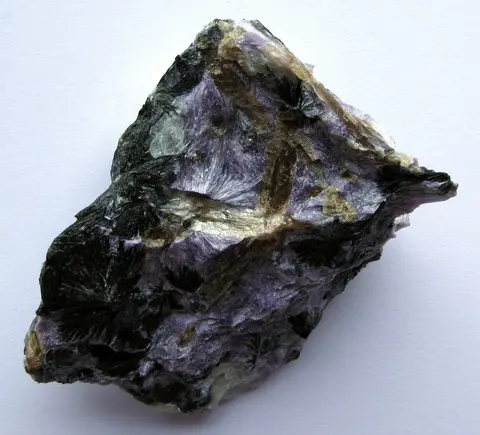
Charoite, Aegirine, Fedorite (2) - Vostochnyi Mine, Murun-Massif, Russia. Photo: Ra'ike (Wikipedia), CC BY-SA 3.0, via Wikimedia Commons.
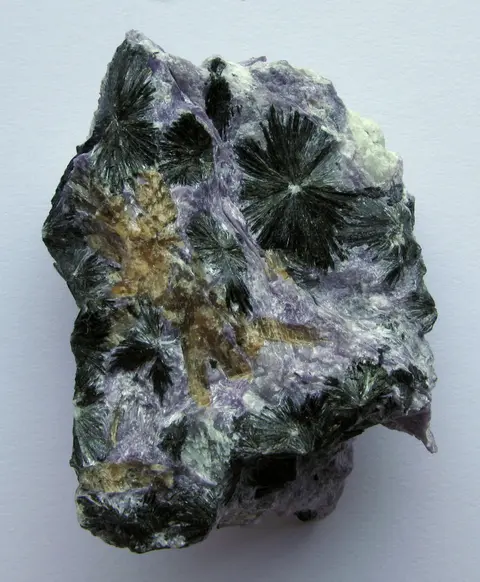
Charoite, Aegirine, Fedorite - Vostochnyi Mine, Murun-Massif, Russia. Photo: Ra'ike (Wikipedia), CC BY-SA 3.0, via Wikimedia Commons.
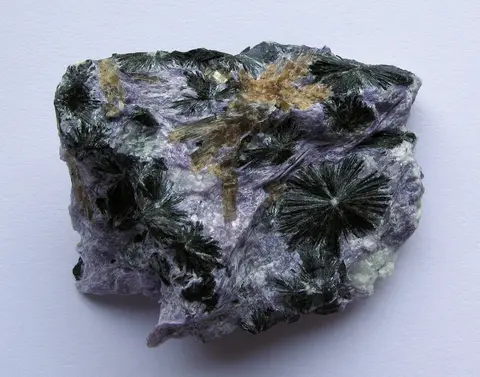
Charoite, Aegirine, Fedorite (3) - Vostochnyi Mine, Murun-Massif, Russia. Photo: Ra'ike (Wikipedia), CC BY-SA 3.0, via Wikimedia Commons.
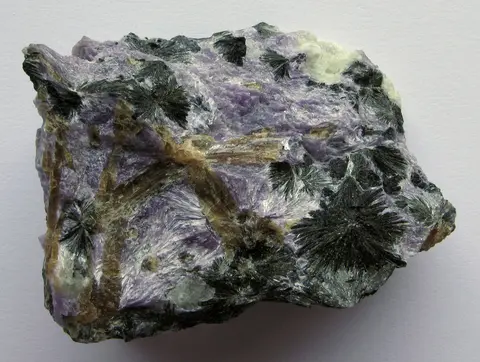
Charoite, Aegirine, Fedorite (4) - Vostochnyi Mine, Murun-Massif, Russia. Photo: Ra'ike (Wikipedia), CC BY-SA 3.0, via Wikimedia Commons.
What charoite is worth
Dealer asking prices for charoite, middle half of current listings, checked 2026-11-20. Bar shows the 25th to 75th percentile; the dark tick is the median.
These are dealer asking prices: what shops list charoite for, not what it sells for and not an appraisal. Selling to a dealer usually brings well below retail, because the dealer has to resell it at a margin.
How to identify charoite
Charoite is a rare purple silicate of potassium, calcium and sodium with water and fluorine, known from a single deposit in the Murun massif of Siberia, Russia. It forms swirling, fibrous lilac to deep violet masses used for cabochons, beads and carvings.
Lilac to deep violet color with swirling, feathery or fibrous patterns.
Silky chatoyant sheen that shifts across the fibers as the stone is turned.
Commonly contains black aegirine needles, orange-brown tinaksite grains and gray-green feldspar or white quartz.
Opaque to translucent in thin pieces; takes a good polish with a slightly pearly glow.
Hardness about 5 to 6: a steel knife will just scratch it and it will barely mark glass.
Where charoite comes from
Murun massif, near the Chara and Olyokma rivers, Siberia, Russia
The only commercial source in the world. Charoite forms in metasomatic rocks at the contact of an alkaline intrusion with limestone; the mineral is named after the Chara River.
Lavender jade is a soft even pastel with a granular texture and no swirls.
Hardness 6.5 to 7
Specific gravity about 3.33
Stichtite
Stichtite is a soft pink-purple carbonate (hardness 1.5 to 2) usually mixed with green serpentine.
Waxy to greasy feel
Mainly from Tasmania
Fake, dyed and treated charoite
Dyed stones such as howlite, marble or quartzite sold as charoite
Occasional
Color concentrated in cracks and grain boundaries
No silky fibrous swirls or chatoyancy
Lacks black aegirine and orange tinaksite inclusions
Acetone swab may pick up purple dye
Purple glass or resin imitations
Occasional
Swirls that look painted or flow-banded rather than fibrous
Round bubbles
Resin feels warm and light
Lepidolite or sugilite sold as charoite
Occasional
Glittery mica flakes (lepidolite)
Even magenta color with no fibers (sugilite)
Is my charoite real? Tests you can do at home
Loupe for fibers and inclusions
Examine the polished surface with a 10x loupe under a single light.
Real
Interlocking silky fibers in swirls, often with black aegirine needles and orange tinaksite.
Fake or lookalike
Dyed stones show color in cracks; glass shows bubbles; lepidolite shows separate sparkling flakes.
Chatoyancy check
Rotate a polished piece under one flashlight.
Real
A silky sheen moves across the fibers.
Fake or lookalike
Sugilite, dyed stones and most glass show little or no moving sheen.
Acetone swab for dye
Rub a cotton swab with acetone on an unseen area or a drill hole.
Real
The swab stays clean.
Fake or lookalike
Dyed imitations may leave purple on the swab.
Can leave a small mark.
Pin flake test
Pick gently at an unseen edge with a pin.
Real
Charoite resists and does not flake.
Fake or lookalike
Lepidolite releases small shiny mica flakes.
Can leave a small mark.
A stone that passes these tests is consistent with natural charoite, not proven. For valuable pieces, a gem lab report settles treatment and origin.
Treatments
Wax or resin stabilization (occasional)
Fills surface pores in lower-grade material to improve polish; lowers value slightly when undisclosed. Waxy or plastic luster, resin in cracks under a loupe.
Dyeing (rare)
Used to deepen pale material; reduces value. Color concentrated in cracks and an acetone swab.
What moves the price of charoite
Color. Deep, saturated violet is the most valued; pale lilac and grayish material is worth less.
Pattern and chatoyancy. Strong swirling fibrous patterns with a bright silky sheen are preferred.
Inclusions. Small amounts of black aegirine and orange tinaksite add contrast; large patches of feldspar or quartz lower value.
Size and form. Large clean slabs, spheres and carvings carry more than small cabochons and beads.
Supply. A single source in Siberia means availability and trade conditions affect the market.
Sources
Prices: 16 current listings from FossilEra, Throwin Stones, seen 2026-11-20 to 2026-11-20. How we collect prices.