What lepidolite is worth
Show 12 of the listings behind these numbers
These are dealer asking prices: what shops list lepidolite for, not what it sells for and not an appraisal. Selling to a dealer usually brings well below retail, because the dealer has to resell it at a margin.
How to identify lepidolite
Lepidolite is a lilac to pink lithium-bearing mica found in granite pegmatites. Mineralogists now treat it as a series name for the lithium micas polylithionite and trilithionite rather than a single species.
- Lilac, lavender, pink or purplish gray color
- Sparkly scaly texture of small mica flakes, or stacked six-sided books
- Flakes peel off in thin flexible sheets along one perfect cleavage
- Very soft: hardness 2.5 to 3, scratched by a fingernail or copper coin on cleavage surfaces
- Pearly luster on cleavage
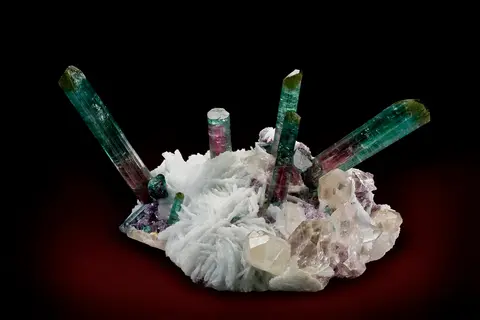
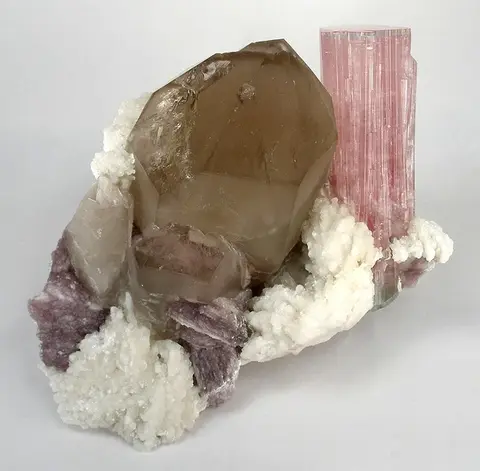
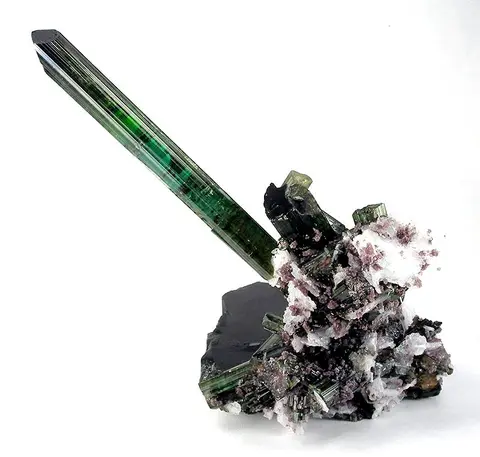
- Often found with pink or green tourmaline, quartz, albite and spodumene
Where lepidolite comes from
- Minas Gerais, Brazil
- Large supply of massive and book lepidolite, plus lepidolite with pink tourmaline.
- Madagascar
- Source of purple lepidolite used for tumbled stones and carvings.
- Bikita, Zimbabwe
- Large lithium pegmatite historically mined for lepidolite.
- Pala and Mesa Grande, California, USA
- Lepidolite with pink tourmaline from gem pegmatites.
- Tanco mine, Manitoba, Canada
- Major lithium and rare element pegmatite with lepidolite.
Lepidolite lookalikes
Amethyst is hard (7), glassy and has no flaky cleavage; lepidolite is soft and peels.
- Amethyst SG 2.65
- Amethyst forms six-sided points
lepidolite vs amethyst
Charoite has swirling silky fibers and chatoyant bands, not sparkling flakes.
- Charoite hardness 5 to 6
- Only from Siberia, Russia
lepidolite vs charoite
Muscovite is colorless, silver, pale brown or green; lilac color usually means lepidolite.
- Same cleavage and hardness
- Lepidolite carries lithium
Kunzite is transparent and hard enough to scratch glass.
kunzite vs lepidolite
Sugilite is a hard, waxy purple stone with no mica flakes.
Also mistaken for lepidolite: lavender jade, mica, purple fluorite, yttrium fluorite, spodumene.
Fake, dyed and treated lepidolite
Dyed stone or mica schist sold as lepidolite
Occasional
- Color sits in cracks and grain boundaries
- Acetone swab picks up purple
- Gray core where chipped
Purple mica-bearing rock or lilac schist sold as lepidolite
Occasional
- Lepidolite flakes make up only a small part
- Quartz or feldspar grains dominate
Resin-bound lepidolite flakes
Occasional
- Flakes suspended in glossy resin
- Uniform pattern
- Warm, plastic feel
Is my lepidolite real? Tests you can do at home
-
Flake test
Pick at an edge with a pin or fingernail on an unimportant spot.
- Real
- Thin flexible flakes lift off and spring back when bent.
- Fake or lookalike
- Amethyst, charoite and dyed quartzite do not flake.
Can leave a small mark.
-
Scratch with a copper coin
Draw a copper coin across a cleavage surface.
- Real
- Copper scratches or roughens the surface of lepidolite.
- Fake or lookalike
- Quartz, charoite and sugilite resist copper.
Can leave a small mark.
-
Acetone swab for dye
Rub a cotton swab with nail polish remover on a hidden area.
- Real
- Swab stays clean.
- Fake or lookalike
- Dyed material may stain the swab purple.
-
Loupe inspection
Look at the surface with a 10x loupe.
- Real
- Interlocking shiny mica flakes, sometimes with pink tourmaline needles.
- Fake or lookalike
- Resin-bound pieces show flakes floating in glassy resin.
A stone that passes these tests is consistent with natural lepidolite, not proven. For valuable pieces, a gem lab report settles treatment and origin.
Treatments
- Resin stabilizing (common)
- Binds crumbly flaky material so it can be polished into beads and palm stones; lowers value compared with natural books. Glossy plastic-like surface, resin pools in hollows.
- Dyeing (occasional)
- Deepens the purple of pale material; lowers value. Acetone swab, color concentration in cracks.
What moves the price of lepidolite
- Color. Saturated purple to violet ranks above gray lilac.
- Form. Sharp six-sided books and crystals rank above massive scaly material.
- Associations. Pink or watermelon tourmaline in lepidolite adds value.
- Locality. Classic California and Brazilian pegmatite pieces carry premiums.
- Polish quality. For carvings, a stable even polish without crumbling.
- Treatment. Natural untreated material ranks above stabilized or dyed.
Care and safety
Very soft and flaky; keep it away from harder stones and avoid water soaking and ultrasonic cleaners, which loosen flakes.
Questions collectors ask about lepidolite
- Amethyst vs lepidolite
- Amethyst is a hard, glassy purple quartz that scratches glass and never flakes. Lepidolite is a soft lilac mica that peels into thin sheets and sparkles from countless small flakes.
Sources
Prices: 41 current listings from FossilEra, The Gem Shop, Throwin Stones, seen 2026-11-20 to 2026-11-20. How we collect prices.