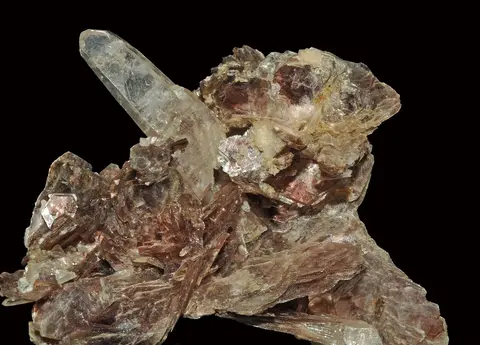
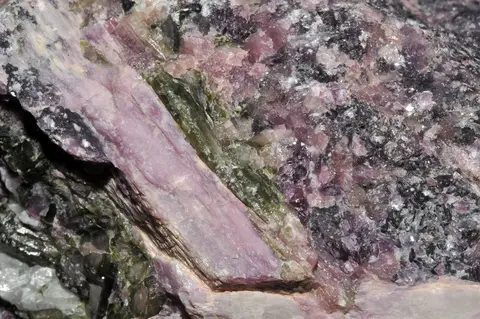
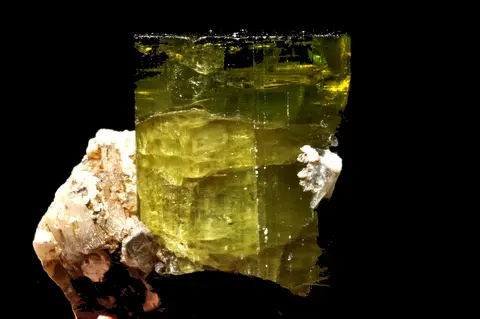
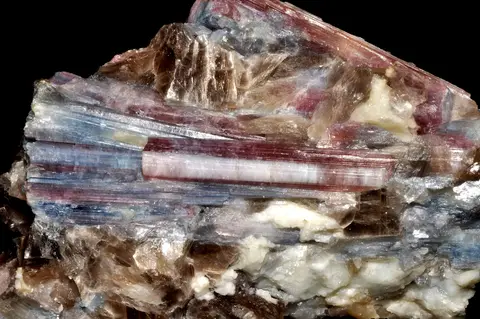
Dealer asking prices for mica, middle half of current listings, checked 2026-11-20. Bar shows the 25th to 75th percentile; the dark tick is the median.
These are dealer asking prices: what shops list mica for, not what it sells for and not an appraisal. Selling to a dealer usually brings well below retail, because the dealer has to resell it at a margin.
How to identify mica
Mica is a group of sheet silicate minerals, mainly muscovite, biotite and phlogopite, built from stacked layers of aluminum silicate held together by potassium. Their defining trait is perfect cleavage into thin, flexible, elastic sheets.
Peels into thin, flat sheets with a knife tip or fingernail; the sheets bend and spring back.
Strong pearly to glassy shine on flat cleavage faces that flashes as the piece is tilted.
Grows as stacked 'books' with a six-sided outline when crystals are well formed.
Very soft: hardness 2 to 3, so a fingernail or copper coin can mark it.
Colorless to silvery (muscovite), black to dark brown (biotite), amber to brown (phlogopite), green (fuchsite) or lilac (lepidolite).
In granite, schist and gneiss it appears as shiny flakes that glitter in sunlight.
Phlogopite is the magnesium-rich mica, KMg3(AlSi3O10)(F,OH)2, usually amber to brown with a coppery sheen, found in marbles, skarns and some ultramafic rocks. Phlogopite is the magnesium end member of the biotite series; it is lighter in color than iron-rich biotite and often shows a bronze to coppery luster.
Where mica comes from
Jharkhand and Andhra Pradesh, India
Historically the world's main source of sheet mica; mica mining in Jharkhand has been linked to child labor, a concern in the cosmetic supply chain.
Minas Gerais, Brazil
Pegmatite muscovite books, star-twinned muscovite and fuchsite for the specimen and decorative trade.
Madagascar
Major source of phlogopite and large mica books.
Spruce Pine district, North Carolina, USA
Long-worked pegmatite district producing muscovite and feldspar.
Bancroft area, Ontario, Canada
Large biotite and phlogopite crystals from pegmatites and marbles, popular with collectors.
Damage. Frayed, bent or peeling edges lower specimen value.
Care and safety
Mica is soft and peels easily. Handle specimens by the edges of the matrix, avoid rubbing cleavage faces and do not wash with brushes.
Questions collectors ask about mica
What are mica minerals used for?
Ground mica is used in paints, plastics, drywall joint compound, drilling mud and as a shimmer pigment in cosmetics. Sheet mica is used as an electrical and heat insulator, historically in stove windows.
What are the different types of mica?
The common micas are muscovite (colorless to silver), biotite (black to brown), phlogopite (amber to brown) and lepidolite (lilac, lithium-bearing). Fuchsite is a green chromium-bearing muscovite.
Are mica rocks worth anything?
Ordinary mica flakes and schist are common and have little specimen value. Large sharp books, star twins and mica crystals with garnet or tourmaline are collected and worth more; see the price table above for what drives value.
How to identify mica in a rock?
Look for shiny flat flakes that flash in light and can be lifted with a pin into thin, flexible sheets that spring back. Silvery flakes are usually muscovite and black flakes are usually biotite.
Mica vs gold: how can you tell them apart?
Gold is heavy, stays golden from every angle and dents under a pin. Golden mica is light, flashes only at certain angles and splits into thin sheets.
Mica vs pyrite: what is the difference?
Pyrite is a hard brassy metallic mineral that forms cubes and leaves a greenish black streak. Mica is soft, peels into sheets and leaves a white streak.
Sources
Prices: 17 current listings from Dakota Matrix Minerals, FossilEra, The Gem Shop, seen 2026-11-20 to 2026-11-20. How we collect prices.