Dealers list native gold nuggets at $250 to $325 per gram.
Prices checked . Page updated .
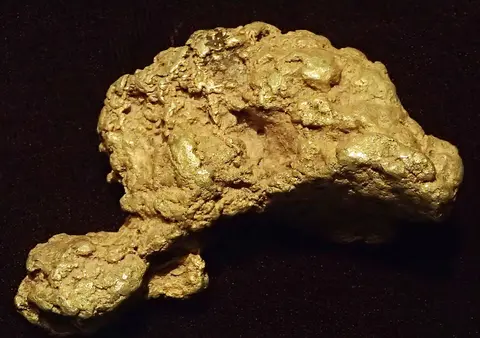
Gold nugget (placer gold) (Bulger Basin Placer Deposit, Pennsylvania Mountain, Alma Mining District, Park County, Colorado, USA) 2 (17068768015). Photo: James St. John, CC BY 2.0, via Wikimedia Commons.
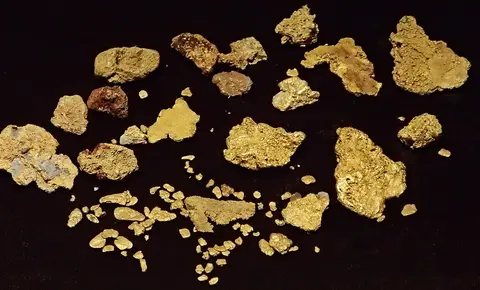
Gold nuggets (placer gold) (Wire Patch Placer Deposit, Farncomb Hill, near Breckenridge, Colorado, USA) 3 (16887542839). Photo: James St. John, CC BY 2.0, via Wikimedia Commons.
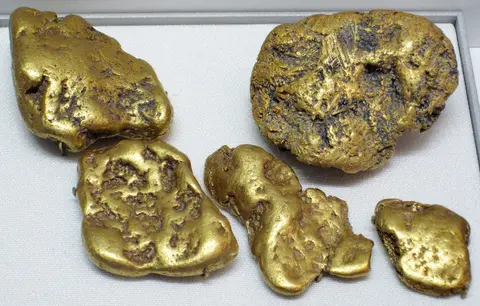
Gold fluvial pebbles (placer gold) (Washington State, USA) 5 (16848892199). Photo: James St. John, CC BY 2.0, via Wikimedia Commons.
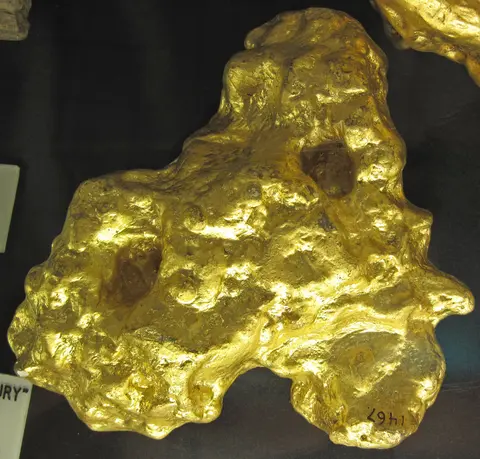
Gold - Viscountess Canterbury Nugget (replica) (John's Paddock, Berlin Diggings, Victoria, Australia) (16638736904). Photo: James St. John, CC BY 2.0, via Wikimedia Commons.
What native gold is worth
Dealer asking prices for native gold, middle half of current listings, checked 2026-11-20. Bar shows the 25th to 75th percentile; the dark tick is the median.
These are dealer asking prices: what shops list native gold for, not what it sells for and not an appraisal. Selling to a dealer usually brings well below retail, because the dealer has to resell it at a margin.
How to identify native gold
Native gold is the element gold occurring as a metal in nature, almost always alloyed with some silver and traces of copper. It forms in quartz veins and is concentrated by rivers into placer deposits as flakes and nuggets.
Rich buttery yellow that stays the same color in shade and sunlight and never tarnishes.
Very heavy for its size: specific gravity about 15 to 19.3 depending on silver content.
Soft and malleable: a pin point dents it and it flattens rather than shattering.
Golden yellow streak, though it is soft enough to smear rather than powder.
In rock it appears as irregular wires, flakes, leaves or grains, most often in white quartz.
In a pan, real gold stays put at the bottom while light mica flakes wash away.
Uniform color and casting skin; may show gas pores
Real gold, but worth only melt value
Gold-plated lead, brass or tungsten nuggets
Occasional
Base metal shows at a scratch
Lead plated fakes feel heavy but dent gray
A magnet may grab steel cores
Gold glued or melted into quartz
Occasional
Gold sits on the surface rather than wrapping into the quartz
Glue lines or burn marks under a loupe
Gold looks cast rather than wiry or crystalline
Gold paint or leaf on rock
Occasional
Thin film that scratches off
No weight increase
Paint flecks under a loupe
Is my native gold real? Tests you can do at home
Streak and malleability
Press a pin point into a hidden spot, then rub a corner on the back of an unglazed porcelain tile.
Real
Pin dents without chipping; streak is golden yellow.
Fake or lookalike
Pyrite and chalcopyrite chip and leave greenish black streaks.
Can leave a small mark.
Specific gravity by water displacement
Weigh the piece dry on a scale reading to 0.01 g, then weigh a cup of water before and after hanging the piece in it on a thread. Divide dry weight by the gain.
Real
15 to 19.3 for solid gold; gold in quartz gives a lower mixed figure.
Fake or lookalike
Pyrite about 5, brass about 8.5, lead about 11.3. Small flakes need a lab balance.
Magnet test
Touch a strong neodymium magnet to the piece.
Real
Gold is not attracted (black sand stuck in crevices may be).
Fake or lookalike
Plated steel or iron cores are pulled to the magnet.
Light and shade check
Turn the piece in sunlight and then in shadow.
Real
Gold stays the same warm yellow at every angle.
Fake or lookalike
Mica and pyrite flash bright only at certain angles and look darker in shade.
Loupe inspection of the surface
Examine crevices and texture under a 10x loupe.
Real
Natural nuggets show worn, hammered texture with quartz or iron oxide in pits; lode gold shows wires or crystal faces.
Fake or lookalike
Cast nuggets show smooth casting skin and round gas holes.
A stone that passes these tests is consistent with natural native gold, not proven. For valuable pieces, a gem lab report settles treatment and origin.
Treatments
Acid etching of quartz to expose gold (common)
Removes quartz or calcite to reveal gold wires and crystals; accepted practice for specimens but can be overdone. Frosted, etched quartz surfaces; experienced dealers can spot it.
Cleaning off iron stains (common)
Brightens nuggets and specimens; normal for the trade. Unnaturally bright color with no staining in crevices.
Polishing or reshaping nuggets (occasional)
Polished jewelry nuggets lose specimen premium. Uniform shine and smoothed high points.
What moves the price of native gold
Gold weight and purity. The gold content sets the floor; silver-rich gold is worth less by weight.
Natural specimen form. Crystallized gold, wire gold and attractive nuggets sell well above melt value.
Size. Larger nuggets are disproportionately scarce and priced accordingly.
Locality and provenance. Documented finds from famous districts add collector value.
Matrix. Bright gold contrasting with white quartz is the classic display combination.
Natural versus cast. Remelted or cast nuggets are worth melt value only.
Questions collectors ask about native gold
What does gold look like in a rock?
It shows as small bright yellow specks, wires or flakes, most often in white quartz, and it keeps the same warm color when you turn the rock out of the light. A pin will dent it, unlike pyrite.
How do I tell if my pyrite has gold in it?
Visible gold looks like separate soft yellow grains that dent with a pin and leave a golden streak. Gold locked inside pyrite is microscopic and can only be measured by a fire assay at a lab.
Is pyrite rarer than gold?
No. Pyrite is one of the most common sulfide minerals, while native gold is rare in comparison.
Can gold be found in quartz?
Yes. Quartz veins are one of the main hosts of lode gold, and gold in white quartz is a classic collector specimen.
Do geodes have gold inside?
Ordinary geodes are lined with quartz, calcite or other minerals and do not contain gold. Yellow metallic crystals inside a geode are usually pyrite or chalcopyrite.
Can meteorites have gold in them?
Meteorites contain only trace amounts of gold, far too little to see. They are valued as meteorites, not for gold content.
Sources
Prices: 58 current listings from Alaska Mint, iRocks (The Arkenstone), seen 2026-11-20 to 2026-11-20. How we collect prices.