Dealer asking prices for chalcopyrite, middle half of current listings, checked 2026-11-20. Bar shows the 25th to 75th percentile; the dark tick is the median.
These are dealer asking prices: what shops list chalcopyrite for, not what it sells for and not an appraisal. Selling to a dealer usually brings well below retail, because the dealer has to resell it at a margin.
How to identify chalcopyrite
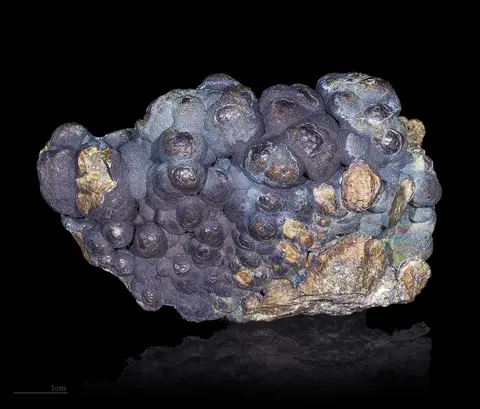
Chalcopyrite is a copper iron sulfide, CuFeS2, and the most important copper ore mineral in the world. Fresh surfaces are brassy yellow, and it tarnishes to iridescent blue, purple and gold films.
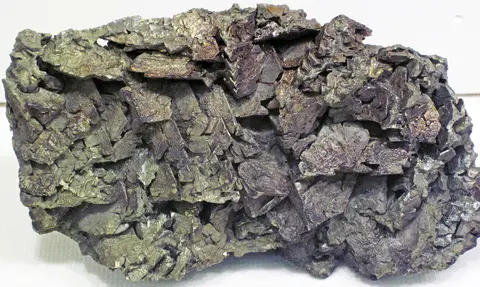
Brass yellow, slightly greener and deeper than pyrite, with a metallic luster.
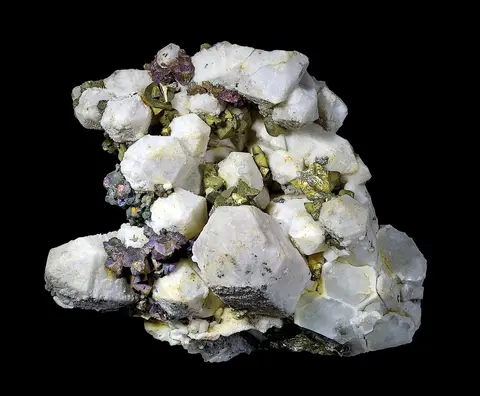
Tarnishes to iridescent blue, purple, red and gold on exposed surfaces.
Greenish black streak on unglazed porcelain.
Hardness 3.5 to 4: a steel knife scratches it and it does not scratch glass.
Brittle: scratching gives powder, not a curl or smear like gold.
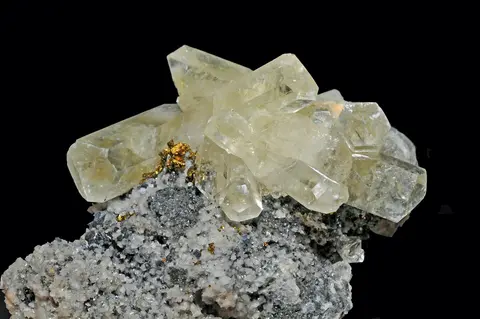
Crystals are wedge-shaped tetrahedra or disphenoids, often with sphalerite, galena, quartz or calcite; much is massive.
Acid-treated chalcopyrite sold as 'peacock ore' or bornite
Very common
Unusually bright, even electric blue, purple and gold all over
Fresh scratch or chip shows brass yellow underneath
Sold in bulk as tumbled or rough pieces
Chalcopyrite sold as gold ore
Occasional
Greenish black streak
Brittle rather than malleable
Is my chalcopyrite real? Tests you can do at home
Streak test
Rub a corner across the back of an unglazed porcelain tile.
Real
Greenish black streak.
Fake or lookalike
Gold leaves a golden yellow streak; bornite grayish black.
Can leave a small mark.
Scratch test against glass and steel
Try to scratch glass with a sharp point of the specimen, then try a steel knife on a hidden spot of the specimen.
Real
Does not scratch glass; the knife scratches it.
Fake or lookalike
Pyrite scratches glass and resists the knife.
Can leave a small mark.
Pin test for malleability
Press a pin point into a small hidden spot.
Real
Brittle; the point chips out powder.
Fake or lookalike
Gold dents and smears without breaking.
Can leave a small mark.
Check under the tarnish
Look with a loupe at a fresh chip or scratch on an iridescent piece.
Real
Chalcopyrite shows brass yellow metal under the colored film.
Fake or lookalike
True bornite shows coppery bronze under its tarnish.
Can leave a small mark.
A stone that passes these tests is consistent with natural chalcopyrite, not proven. For valuable pieces, a gem lab report settles treatment and origin.
Treatments
Acid treatment to induce iridescence (common)
Produces the bright tarnish sold as peacock ore. Treated pieces are inexpensive decorative stones, not specimens. Uniform intense colors over every surface, brass yellow under a scratch.
What moves the price of chalcopyrite
Crystal quality. Sharp, lustrous, well-formed crystals are worth far more than massive ore.
Size. Larger individual crystals are scarce.
Associations. Contrasting combinations with sphalerite, quartz, calcite or fluorite add display value.
Locality. Classic districts such as the Tri-State area and Cornwall appeal to collectors.
Natural versus treated. Natural iridescent tarnish on crystals is valued; acid-treated peacock ore is a bulk decorative item.
Damage. Chipped crystal edges and dull surfaces lower value.
Care and safety
Store dry. Humidity can slowly change the tarnish over time. Avoid washing with acids or household cleaners.
Questions collectors ask about chalcopyrite
Pyrite vs chalcopyrite
Pyrite is paler yellow and hard enough to scratch glass. Chalcopyrite is a deeper, greener brass yellow, often with iridescent tarnish, and a steel knife scratches it.
Sources
Prices: 14 current listings from Dakota Matrix Minerals, FossilEra, seen 2026-11-20 to 2026-11-20. How we collect prices.