Dealers list native copper specimens at $35 to $50.
Prices checked . Page updated .
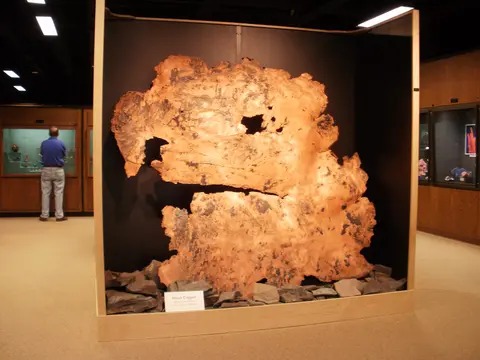
A. E. Seaman Mineral Museum copper display. Photo: Chris857, CC BY-SA 3.0, via Wikimedia Commons.
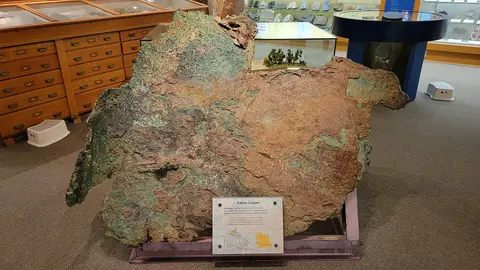
Copper rock in University of Alberta Mineralogy and Petrology Museum. Photo: OhanaUnited Talk page, CC BY-SA 4.0, via Wikimedia Commons.
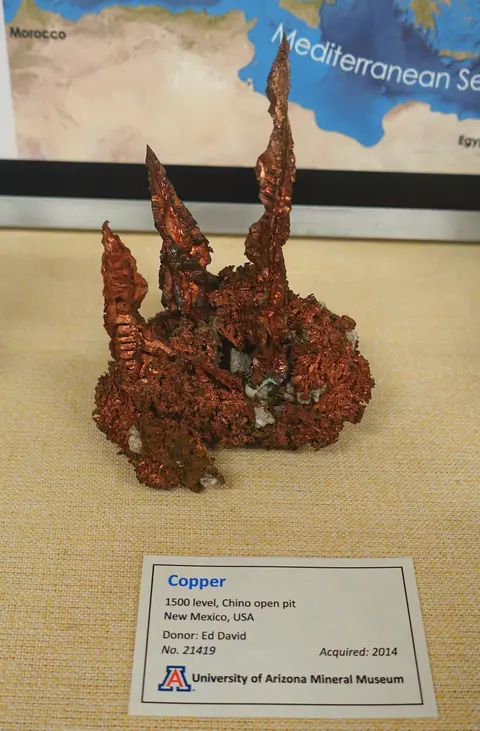
Copper, 1500 level, Chino open pit, New Mexico - Dr. Ed David Collection - University of Arizona Mineral Museum - University of Arizona - Tucson, AZ - DSC08533. Photo: Daderot, CC0, via Wikimedia Commons.
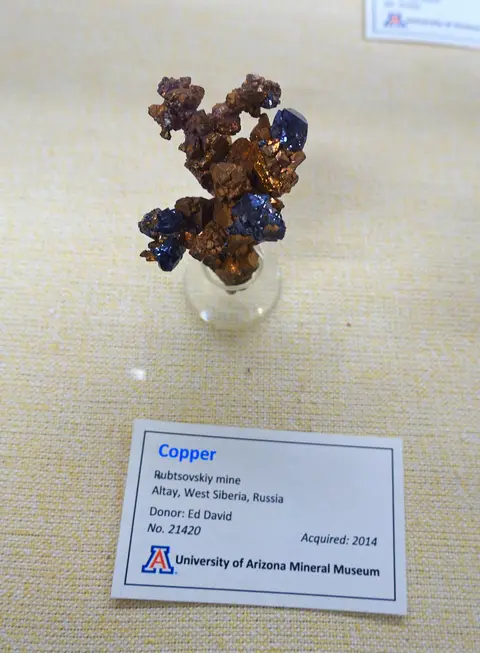
Copper, Rubtsovskiy Mine, Altay, West Siberia, Russia - Dr. Ed David Collection - University of Arizona Mineral Museum - University of Arizona - Tucson, AZ - DSC08542. Photo: Daderot, CC0, via Wikimedia Commons.
What native copper is worth
Dealer asking prices for native copper, middle half of current listings, checked 2026-11-20. Bar shows the 25th to 75th percentile; the dark tick is the median.
Calumet mine, Houghton Co., Michigan, United States
$35
These are dealer asking prices: what shops list native copper for, not what it sells for and not an appraisal. Selling to a dealer usually brings well below retail, because the dealer has to resell it at a margin.
How to identify native copper
Native copper is the element copper (Cu) occurring naturally as metal, in masses, wires, sheets, branching crystals and rare well-formed crystals. It forms where copper-rich fluids meet reducing conditions, most famously in the basalts and conglomerates of Michigan's Keweenaw Peninsula.
Copper-red to salmon pink metal on fresh or scratched surfaces, tarnishing to brown and then green (malachite) or black.
Very heavy for its size: specific gravity about 8.9, more than three times quartz.
Malleable: a knife cuts or dents it and the cut shows bright pink metal rather than powder.
Not attracted to a magnet.
Forms branching dendrites, wires, flat sheets and lumpy masses; crystals are cubes, dodecahedra and spinel-law twins.
Often embedded in calcite, quartz, epidote or basalt, or loose and water- or ice-worn as float copper.
Native copper from Michigan's Keweenaw Peninsula, the largest native copper district in the world, mined from the 1840s to the 1990s. A locality label; Michigan copper includes crystals, masses, sheets, half-breed copper with silver and copper in calcite, datolite and agate.
Copper in agate
Agate with inclusions of native copper, mainly from the Keweenaw Peninsula of Michigan, where copper filled spaces in basalt alongside chalcedony. The copper occurs as specks, wires or masses inside or along the edges of agate; it is collected for the contrast of pink metal against banded chalcedony.
Where native copper comes from
Keweenaw Peninsula, Michigan, USA
The largest native copper deposits known; source of crystals, masses, float copper and copper with native silver. Mining ran from the 1840s to the 1990s.
Arizona, USA
Ray, Bisbee and Ajo produced crystallized and dendritic copper, some with cuprite.
Corocoro, Bolivia
Known for copper pseudomorphs after aragonite crystals.
Onganja, Namibia
Copper crystals and copper with cuprite.
Isle Royale, Michigan, USA
Copper and greenstone in basalt; collecting is prohibited inside the national park.
Bornite is copper-brown on fresh surfaces but tarnishes iridescent purple-blue, and it is brittle with a gray-black streak.
Specific gravity about 5.1
Not malleable
Brass and bronze scrap
Brass is yellower; man-made pieces show casting marks, machining or uniform shapes.
Specific gravity about 8.4 to 8.7, close to copper
No natural matrix
Fake, dyed and treated native copper
Melted or cast copper sold as nuggets or float copper
Common
Gas bubbles, porous or frothy surfaces
Drips, splashes or flat casting surfaces
No matrix minerals or natural crystal forms
Very uniform color and shape across a lot
Electrolytically grown copper crystals sold as natural
Occasional
Bright, uniform crystal clusters with no matrix
Fine granular or treelike growth that looks too even
Sold in identical batches
Copper-plated steel or other metal sold as solid copper
Common
A magnet sticks
Silver or gray metal shows under scratches
Lighter than solid copper
Is my native copper real? Tests you can do at home
Magnet test
Hold a strong magnet against the piece.
Real
No attraction.
Fake or lookalike
Copper-plated steel sticks to the magnet.
Specific gravity with a kitchen scale
Weigh the piece dry, then weigh the water it displaces hanging by a thread in a cup on the scale; divide.
Real
About 8.9 for clean copper; lower if lots of matrix is attached.
Fake or lookalike
Plated base metals and chalcopyrite come in much lower.
Knife cut on a hidden spot
Scrape a small hidden spot with a steel blade.
Real
Metal cuts or dents and shows bright salmon pink.
Fake or lookalike
Nickeline and bismuth crumble or resist; plated items show a different metal under the scrape.
Can leave a small mark.
Loupe inspection
Examine surfaces and pits with a 10x loupe.
Real
Natural crystal faces, wire or dendritic growth, or matrix minerals like calcite and epidote.
Fake or lookalike
Round gas bubbles, drip textures and saw or tool marks point to melted or cast metal.
A stone that passes these tests is consistent with natural native copper, not proven. For valuable pieces, a gem lab report settles treatment and origin.
Treatments
Acid cleaning of matrix (common)
Calcite matrix around Michigan copper is often dissolved to expose crystals and branching forms. Accepted practice that can raise display value when done well. Clean, sharp, bright exposed copper with etched calcite remnants.
Cleaning and brightening (common)
Tarnish is removed to show bright copper; many collectors prefer a natural or toned patina, so over-cleaning can lower value. Uniformly bright pink surfaces with no tarnish in recesses.
Artificial patina or lacquer (occasional)
Added to color or protect the surface; reduces value for purists. Even, glossy coating or unnaturally uniform patina.
What moves the price of native copper
Crystal form. Sharp, well-formed crystals and twins are worth far more than shapeless masses of the same weight.
Locality. Documented Keweenaw, Ray and other classic mines carry collector premiums.
Associations. Copper with native silver (half-breed), cuprite, calcite or datolite is especially sought.
Size and aesthetics. Larger specimens with good shape and balance sell above small ones.
Surface and cleaning quality. Natural or skillfully toned surfaces are preferred over harshly cleaned or damaged ones.
Metal content. For plain masses, scrap metal value sets a floor that specimen value usually exceeds.
Care and safety
Copper tarnishes in humid air. Store specimens dry and avoid touching bright surfaces with bare hands. Do not use harsh cleaners on specimens with a natural patina.
Questions collectors ask about native copper
How much is copper worth per pound?
Scrap copper sells by weight at commodity prices, but native copper specimens are valued well above metal content for crystal form, locality and associations. See the price table above for specimen pricing.
Is my copper bracelet real?
Solid copper is not magnetic, is heavy for its size and shows salmon pink metal where scratched. If a magnet sticks or a scratch shows silver or gray metal, it is plated.
Sources
Prices: 19 current listings from Dakota Matrix Minerals, FossilEra, seen 2026-11-20 to 2026-11-20. How we collect prices.