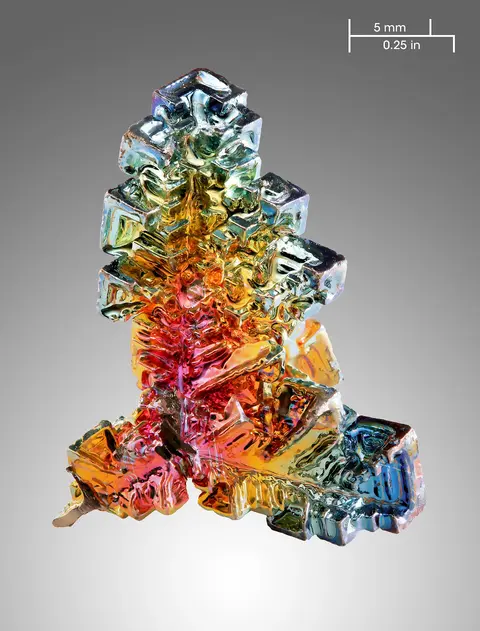
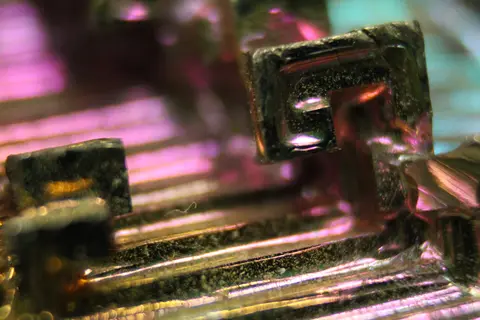
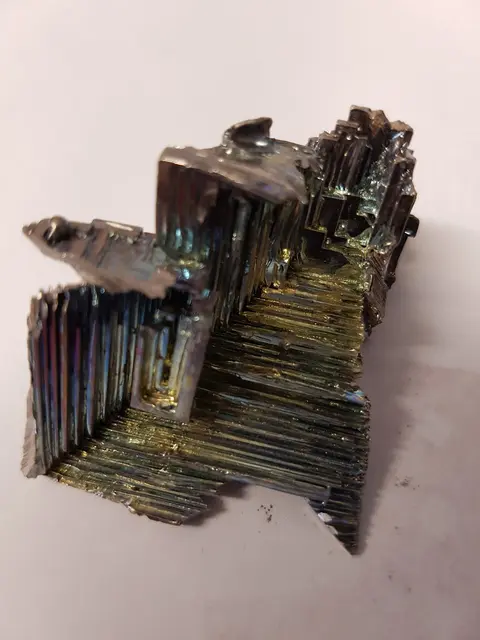
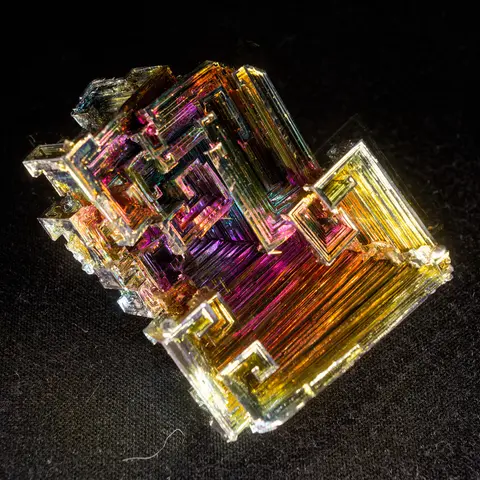
Bismuth is a heavy, brittle native element (Bi) that occurs naturally as pinkish silver grains and masses in hydrothermal veins. The rainbow stair-step crystals sold everywhere are lab grown from molten bismuth metal; their colors come from a thin oxide film.
Arsenic mine, Lower Rotgülden lake, Rotgülden, Salzburg, Austria
$95
These are dealer asking prices: what shops list bismuth for, not what it sells for and not an appraisal. Selling to a dealer usually brings well below retail, because the dealer has to resell it at a margin.
How to identify bismuth
Very heavy for its size (SG about 9.8, close to lead).
Silver white metal with a faint pink or reddish tint on fresh surfaces.
Lab grown crystals form hollow, stair-step hopper squares with bright blue, gold, pink and green oxide colors.
Natural specimens are irregular grains, plates or masses in quartz or other vein minerals, usually dull and tarnished.
Soft (2 to 2.5) and brittle: it crumbles or snaps rather than bending like lead.
Perfect cleavage gives bright flat faces on broken natural pieces.
Where bismuth comes from
Bolivia
Tin and silver districts such as Tasna produced natural bismuth masses.
Schneeberg, Saxony, Germany
Classic European source of native bismuth with cobalt and silver ores.
Kingsgate, New South Wales, Australia
Native bismuth with molybdenite in quartz pipes.
Cobalt, Ontario, Canada
Native bismuth with silver and cobalt arsenides.
Lab grown worldwide
Nearly all colorful hopper crystals are grown by melting refined bismuth and letting it cool; refined metal comes mainly from China as a byproduct of lead and tungsten processing.
Stibnite forms long gray blades and is much lighter.
Stibnite SG about 4.6
Fake, dyed and treated bismuth
Lab grown hopper crystals sold as natural bismuth
Very common
Perfect stair-step hollow squares with vivid rainbow colors
No matrix or vein minerals attached
Natural bismuth almost never forms these crystals
Painted or anodized metal sold as bismuth
Rare
Feels too light
Color is even paint rather than shifting oxide bands
Color chips off to reveal a different metal
Iridescent tarnished minerals called bismuth
Occasional
Chalcopyrite and bornite with rainbow tarnish are brassy or coppery underneath
Much lighter in hand
Is my bismuth real? Tests you can do at home
Weight in hand
Hold the piece next to a steel object of similar size.
Real
Feels heavier than steel.
Fake or lookalike
Painted aluminum or tarnished sulfides feel light.
Specific gravity by water displacement
Weigh dry on a kitchen scale, then weigh the displaced water and divide.
Real
About 9.7 to 9.8.
Fake or lookalike
Steel about 7.8, chalcopyrite about 4.2.
Look for matrix and crystal form
Check whether the metal sits in quartz or other vein minerals.
Real
Natural bismuth is grains or masses in rock.
Fake or lookalike
Free standing rainbow hopper crystals are lab grown.
Hardness with a copper coin
Press a copper coin edge on a hidden spot.
Real
Copper scratches bismuth (2 to 2.5).
Fake or lookalike
Steel and most metals resist.
Can leave a small mark.
A stone that passes these tests is consistent with natural bismuth, not proven. For valuable pieces, a gem lab report settles treatment and origin.
Treatments
Lab growth from melt (almost always)
Rainbow crystals are made, not mined; they are sold as decor and science pieces, well below natural specimen pricing. Hopper form, oxide colors, no matrix.
What moves the price of bismuth
Natural versus lab grown. Natural native bismuth specimens are collector items; lab crystals are commodity decor.
Size and crystal form. For lab crystals, large, intricate hoppers with even colors rank higher.
Locality. Labeled natural pieces from Bolivia, Saxony or Kingsgate carry collector interest.
Metal market. Bulk metal follows the industrial bismuth market, which depends heavily on Chinese supply.
Damage. Broken hopper edges and scratched oxide film lower value.
Care and safety
Soft and brittle; the oxide colors scratch off and do not regrow at room temperature. Handle by the base and keep dry.
Questions collectors ask about bismuth
What is bismuth used for?
Bismuth goes into stomach medicines (bismuth subsalicylate), pearly cosmetic pigments (bismuth oxychloride), low melting alloys, lead free solder and shot, and replacements for lead in brass and plumbing parts.
Is bismuth rare?
Native bismuth specimens are uncommon, while refined bismuth metal is a widely traded byproduct of lead, tungsten and copper processing. The colorful crystals sold everywhere are lab grown from that metal.
Is bismuth in short supply?
China is the dominant refiner, and in 2025 it placed bismuth under export controls, which tightened supply for buyers elsewhere. Lab grown crystal supply follows that metal market.
Sources
Prices: 2 current listings from Dakota Matrix Minerals, seen 2026-11-20 to 2026-11-20. How we collect prices.