RockValues

Stibnite value and identification

Dealers list stibnite specimens at $45 to $125.

Prices checked . Page updated .
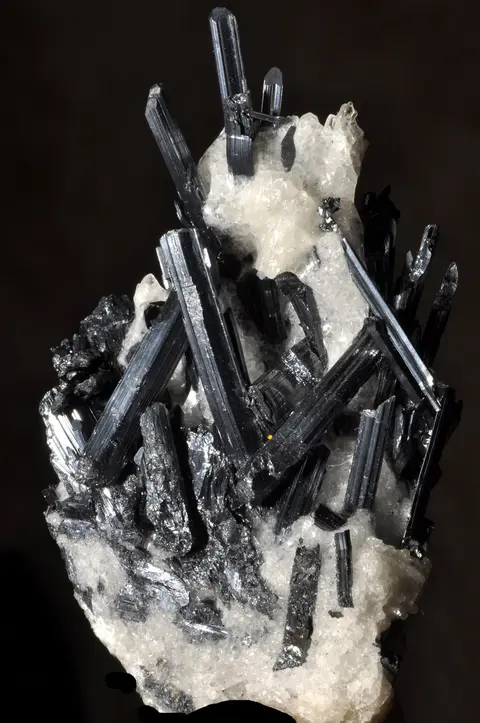
Stibnite: Stibine (=stibnite)1 (Italie)
Stibine (=stibnite)1 (Italie). Photo: Parent Géry, Public domain, via Wikimedia Commons.
Stibnite: Barite-Stibnite-tmu27b
Barite-Stibnite-tmu27b. Photo: Robert M. Lavinsky, CC BY-SA 3.0, via Wikimedia Commons.
Stibnite: Barite-Stibnite-tmu27d
Barite-Stibnite-tmu27d. Photo: Robert M. Lavinsky, CC BY-SA 3.0, via Wikimedia Commons.
Stibnite: Barite-Stibnite-tmu27a
Barite-Stibnite-tmu27a. Photo: Robert M. Lavinsky, CC BY-SA 3.0, via Wikimedia Commons.

What stibnite is worth

Dealer asking prices for stibnite, middle half of current listings, checked 2026-11-20. Bar shows the 25th to 75th percentile; the dark tick is the median.
Form and sizeTypical asking priceRange chartMedianListings
Specimens (per piece)$45 to $125$597 from 3 dealers
Show 7 of the listings behind these numbers
Sample dealer listings for Stibnite
ListingSizeLocalityAskingSeen
Stibnite #SW66995
Dakota Matrix Minerals
4 cmnear National, Nevada, United States$25
Stibnite #SW68611
Dakota Matrix Minerals
5 cmWhite Caps mine, Nye Co., Nevada, United States$45
2.1" Lustrous Metallic Stibnite Crystals - Jiangxi, China
FossilEra
5.3 cmJiangxi, China$45
2.6" Lustrous Metallic Stibnite Crystals - Jiangxi, China
FossilEra
6.6 cmJiangxi, China$59
5" Lustrous Metallic Stibnite Crystals - Jiangxi, China
FossilEra
12.7 cmJiangxi, China$99
Stibnite #65529
Dakota Matrix Minerals
3 cmPereta mine, Grosseto, Tuscany, Italy$150
Stibiconite ps. Stibnite
iRocks (The Arkenstone)
8.4 cmCatorce, Catorce Mun., San Luis Potosí, Mexico$1,260

These are dealer asking prices: what shops list stibnite for, not what it sells for and not an appraisal. Selling to a dealer usually brings well below retail, because the dealer has to resell it at a margin.

How to identify stibnite

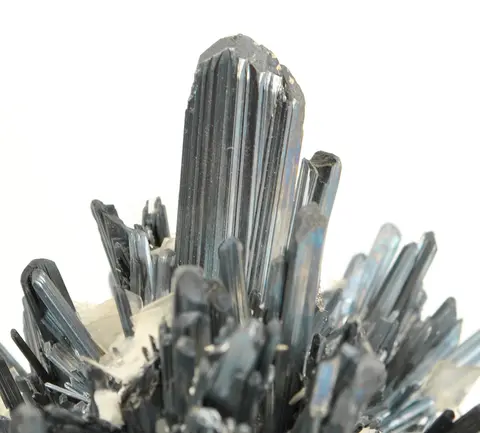
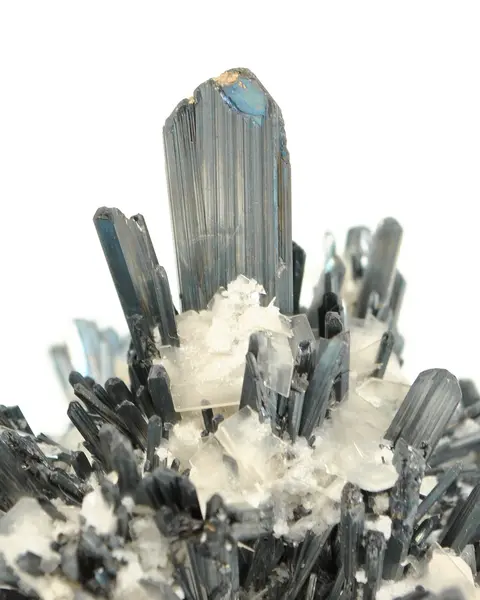
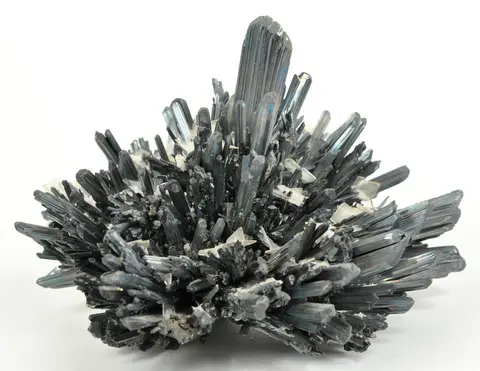
Stibnite is antimony sulfide (Sb2S3), the main ore of antimony. It forms soft, lead-gray, metallic blades and needles that are prized as display specimens.

  • Long, bladed or needle-like crystals with deep lengthwise striations, often in radiating sprays
  • Bright lead-gray to steel-gray metallic luster that tarnishes dull or iridescent with time
  • Very soft: a fingernail can mark it and a steel pin scratches it easily (hardness 2)
  • Thin blades bend slightly before breaking and often show kinks or twists along their length
  • One perfect cleavage parallel to the length of the crystal, giving bright flat flashes
  • Heavy for its size, but noticeably lighter than galena
  • Leaves a lead-gray streak on unglazed porcelain

Stibnite varieties

Romanian stibnite

Stibnite from the Baia Mare district of Maramures, Romania, including Baia Sprie, Herja and Cavnic. The same mineral, valued for its classic European origin and frequent associations with sphalerite, barite, quartz and calcite. Crystals are usually smaller than the large Chinese sprays.

Chinese stibnite

Stibnite from China, mainly from Wuning in Jiangxi and Xikuangshan in Hunan, the source of most specimens sold today. The same mineral, typically in larger and more lustrous crystals than other modern sources, often with bladed white barite.

Where stibnite comes from

Wuning, Jiangxi, China
Source of large, sharp, lustrous crystal sprays, often with white barite; most stibnite on the market today is Chinese.
Xikuangshan, Hunan, China
The largest antimony mine in the world, producing large single crystals and groups.
Baia Sprie, Herja and Cavnic, Maramures, Romania
Classic European specimens, often with sphalerite, quartz, barite or calcite.
Ichinokawa mine, Ehime, Japan
Historic source of very long, brilliant crystals that set the standard for the species; old pieces are sought after.
Kremnica, Slovakia
Older European locality with crystal groups in quartz.

Stibnite lookalikes

Galena

Galena breaks into cubes and is much heavier; stibnite breaks into long blades.

  • Galena SG about 7.5 vs 4.6
  • Galena has three cleavages at right angles
  • Galena crystals are cubic, not bladed

Bismuthinite

Bismuthinite is much heavier in the hand for the same size.

  • Bismuthinite SG about 6.8 vs 4.6
  • Very similar bladed habit and luster
  • Usually needs lab confirmation

Jamesonite and boulangerite

These lead antimony sulfides grow as hair-like felted fibers rather than thick striated blades.

  • Fibrous to feathery habit
  • Duller gray color
  • Higher SG, about 5.6 to 6.2

Manganite

Manganite gives a reddish-brown to black streak and is harder (4).

  • Striated prisms that resemble stibnite
  • Hardness 4 vs 2
  • Dark brown streak vs lead-gray

Also mistaken for stibnite: bismuth.

Fake, dyed and treated stibnite

  • Repaired or reassembled crystal sprays

    Common

    • Glue lines at the base of blades
    • Blades that sit at unnatural angles or do not match in tarnish
    • Repair is disclosed by honest dealers; ask
  • Other gray metallic sulfides labeled as stibnite

    Occasional

    • Wrong weight for size
    • Cubic or fibrous habit instead of striated blades

Is my stibnite real? Tests you can do at home

  1. Fingernail and pin scratch

    Try to scratch an inconspicuous spot with a fingernail, then a steel pin.

    Real
    A fingernail barely marks it and a pin scratches it easily (hardness 2).
    Fake or lookalike
    Hematite, manganite and most metallic lookalikes resist a pin.

    Can leave a small mark.

  2. Streak plate

    Rub a broken edge or the base of a specimen on unglazed porcelain.

    Real
    Lead-gray streak.
    Fake or lookalike
    Hematite gives red-brown, manganite gives dark brown.

    Can leave a small mark.

  3. Cleavage and habit under a loupe

    Look at the crystals with a 10x loupe.

    Real
    Deep lengthwise striations, one bright cleavage along the length, bends or kinks in thin blades.
    Fake or lookalike
    Galena shows stepped cubes; fibrous sulfides show hair-like strands.
  4. Specific gravity with a kitchen scale

    Weigh a solid piece dry, then weigh it suspended in water; divide dry weight by the loss in weight.

    Real
    About 4.6.
    Fake or lookalike
    Galena about 7.5, bismuthinite about 6.8.

A stone that passes these tests is consistent with natural stibnite, not proven. For valuable pieces, a gem lab report settles treatment and origin.

Treatments

Repair and reassembly (common)
Broken blades are glued back; repaired specimens are worth less than undamaged ones. Loupe and strong light along the base of each blade; UV can show some glues.
Cleaning off tarnish (occasional)
Restores bright luster but tarnish returns; light cleaning is accepted. Not usually detectable; bright luster fades again over months to years.

What moves the price of stibnite

  1. Crystal size and sharpness. Long, straight, sharply terminated blades bring the most.
  2. Damage. Stibnite is soft and brittle; broken tips and repairs lower value sharply.
  3. Luster. Bright, untarnished faces are preferred over dull or tarnished pieces.
  4. Associated minerals. Contrasting white barite or calcite adds display appeal.
  5. Locality. Old Japanese and Romanian specimens carry a premium over common Chinese material.
  6. Aesthetics. Balanced radiating sprays sell better than single loose blades.

Care and safety

Contains antimony, which is toxic. Wash your hands after handling, do not grind or sand it, and keep it away from children and pets.

Very soft and brittle; handle by the matrix, never by the blades. Do not use ultrasonic cleaners or heat.

Sources

Prices: 7 current listings from Dakota Matrix Minerals, FossilEra, iRocks (The Arkenstone), seen 2026-11-20 to 2026-11-20. How we collect prices.