What pyrite is worth
By variety
By origin
- Peru: $29 to $260, median $49 (15 listings)
- United States: $25 to $110, median $50 (14 listings)
- Morocco: $19 to $22, median $19 (5 listings)
- Spain: $175 to $445, median $275 (5 listings)
Show 12 of the listings behind these numbers
These are dealer asking prices: what shops list pyrite for, not what it sells for and not an appraisal. Selling to a dealer usually brings well below retail, because the dealer has to resell it at a margin.
How to identify pyrite
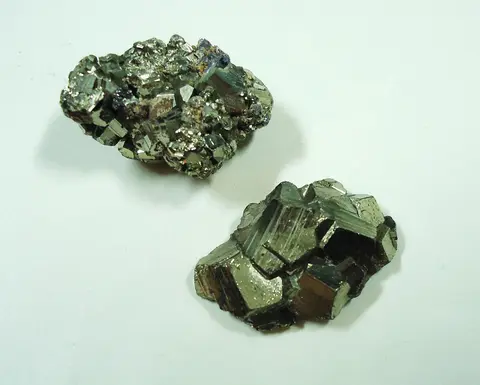
Pyrite is iron sulfide (FeS2), the most common sulfide mineral, known as fool's gold for its brassy yellow metallic luster. It forms sharp cubes, pyritohedrons and octahedrons in almost every geological setting.
- Pale brassy yellow with a bright metallic luster; tarnished surfaces turn darker brass or iridescent.
- Streak on unglazed porcelain is greenish black to brownish black, never gold.
- Hard for a metallic mineral (6 to 6.5): a steel knife will not scratch it, and it shatters rather than bends.
- Crystals are cubes, 12-sided pyritohedrons or octahedrons, often with fine parallel striations that run at right angles on neighboring cube faces.
- Heavy in the hand (SG about 5.0), but far lighter than gold.
- Not attracted to an ordinary magnet.
- A faint sulfur smell when it is streaked hard or crushed.
Pyrite varieties
Pyrite sun
Pyrite suns, also called pyrite dollars, are flat radiating discs of pyrite that grew between layers of shale in coal mines near Sparta, Illinois. The radiating flat habit is unusual for pyrite and formed under pressure between thin shale layers; many are sold with a coating to slow decay.
Pyritohedron
A pyritohedron is a 12-faced crystal form with pentagonal faces, so characteristic of pyrite that it is named after it. It is a crystal habit of ordinary pyrite rather than a separate material; sharp pyritohedrons are prized specimens.
Peruvian pyrite
Peruvian pyrite comes from polymetallic mines such as Huanzala, Huaron and Quiruvilca, which produce large, lustrous crystal groups. Same mineral as other pyrite; Peruvian material is known for large octahedral, pyritohedral and cubic crystals associated with quartz and base metal sulfides.
Pyrite in slate
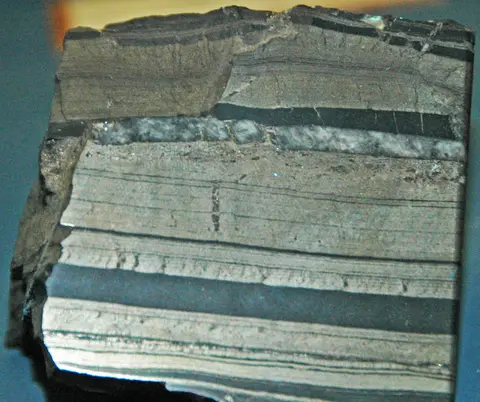
Pyrite in slate is cubic pyrite grown inside slate or phyllite, usually as scattered sharp cubes in a dark gray rock. The cubes formed within the fine-grained rock during low-grade metamorphism, so they sit embedded in matrix and are often slightly flattened by the rock's foliation.
Navajun pyrite
Navajun pyrite comes from the Ampudia and Victoria mines near Navajun, La Rioja, Spain, famous for near-perfect, mirror-faced cubes in gray marl. Same mineral as other pyrite; the Navajun deposit produces unusually sharp cubes and interpenetrant twins, which are the standard collectors use to judge pyrite cubes.
Rampura pyrite
Rampura pyrite is a locality name for pyrite crystal groups from the Rampura Agucha zinc-lead mining area in Rajasthan, India. Same mineral as other pyrite; the name marks the source rather than any difference in the material.
Where pyrite comes from
- Navajun, La Rioja, Spain
- Near-perfect cubes, singly and in interlocking groups, growing in gray marl; the classic pyrite cube locality.
- Huanzala, Huaron and Quiruvilca, Peru
- Large, lustrous crystal groups, often octahedral or pyritohedral, with quartz, sphalerite and galena.
- Rio Marina, Elba, Italy
- Classic pyritohedrons and striated cubes from iron mines worked since antiquity.
- Sparta, Illinois, USA
- Flat radiating pyrite suns from coal mine shales.
- Ulyanovsk region, Russia
- Iridescent rainbow pyrite with fine natural surface layers.
- Rampura Agucha area, Rajasthan, India
- Pyrite crystal groups sold under the Rampura name.
Pyrite lookalikes
Gold is soft and malleable: a pin dents it and it gives a golden yellow streak, while pyrite is hard, brittle and streaks greenish black.
- Gold hardness 2.5 to 3 vs 6 to 6.5
- Gold SG 15 to 19.3 vs 5.0
- Gold never forms striated cubes
- Gold keeps its color from every angle; pyrite flashes and darkens in shade
pyrite vs gold
Chalcopyrite is a deeper brassy yellow and a steel knife scratches it easily; pyrite resists the knife.
- Chalcopyrite hardness 3.5 to 4
- SG 4.1 to 4.3
- Tarnishes to blue and purple peacock colors
- Streak greenish black, like pyrite
chalcopyrite vs pyrite
Marcasite is paler, often with a greenish tint, and forms spear, blade or cockscomb crystals rather than cubes.
- Same formula, orthorhombic
- SG about 4.9
- Decays more readily
marcasite vs pyrite
Golden mica flakes peel apart into thin sheets and a fingernail scratches them.
- Hardness 2.5 to 3
- Light in the hand
- Perfect one-direction cleavage
Hematite gives a red-brown streak and is steel gray, not brassy.
- Hardness 5.5 to 6.5
- SG 5.3
pyrite vs hematite
Pyrrhotite
Pyrrhotite is bronze colored, softer and often attracted to a magnet.
- Hardness 3.5 to 4.5
- SG 4.6
Also mistaken for pyrite: gold in quartz, placer gold, crystalline gold, mica, galena, missouri galena, specular hematite, cobaltite, skutterudite.
Fake, dyed and treated pyrite
Glued or re-attached cubes on matrix
Common
- Glue line or shiny residue at the base of a cube
- Cube sits at an unnatural angle or on a surface with no growth contact
- Matrix that does not match the locality
Lacquered or artificially colored pyrite
Occasional
- Uniform plastic-like shine
- Even rainbow or gold color that scratches off
- Coating fills striations
Marcasite jewelry that is actually pyrite
Very common
- The jewelry trade name marcasite refers to small faceted pyrite set in silver; true marcasite is too unstable for jewelry
Hematine sold as pyrite or magnetic pyrite
Occasional
- Gray rather than brass color
- Strongly magnetic
- Red-brown or gray streak
Is my pyrite real? Tests you can do at home
-
Streak test
Rub the piece firmly across the back of an unglazed porcelain tile.
- Real
- Greenish black to brownish black streak.
- Fake or lookalike
- Gold leaves a golden yellow streak; hematite red-brown.
Can leave a small mark.
-
Knife scratch test
Try to scratch a hidden spot with a steel knife tip.
- Real
- The knife skids and leaves no groove; it may leave a metal mark that wipes off.
- Fake or lookalike
- Chalcopyrite and gold scratch or gouge easily.
Can leave a small mark.
-
Pin dent test for gold
Press a pin firmly into a small grain.
- Real
- Pyrite does not dent; small grains may crumble.
- Fake or lookalike
- Gold dents or flattens without breaking.
Can leave a small mark.
-
Magnet test
Bring a fridge or neodymium magnet close to the piece.
- Real
- No attraction.
- Fake or lookalike
- Pyrrhotite, magnetite and hematine are attracted.
-
Weight in hand
Compare the piece to a quartz pebble of similar size.
- Real
- Feels about twice as heavy as quartz.
- Fake or lookalike
- Brass-painted rocks feel light; gold feels far heavier still.
A stone that passes these tests is consistent with natural pyrite, not proven. For valuable pieces, a gem lab report settles treatment and origin.
Treatments
- Lacquer or oil coating (occasional)
- Keeps the surface bright and slows decay; lowers value for collectors if heavy. Plastic sheen, coating pooled in recesses, acetone softens lacquer.
- Acid cleaning (common)
- Removes iron oxide staining and matrix; accepted for specimens. Usually not detectable.
What moves the price of pyrite
- Crystal perfection. Sharp, undamaged, mirror-bright cubes or pyritohedrons are worth far more than rough masses.
- Locality. Navajun, Peruvian and Elba specimens with labels bring premiums.
- Size and arrangement. Large crystals, interpenetrant twins and aesthetic groups.
- Matrix. Crystals naturally seated on matrix, not glued.
- Condition. No decay, chips, or dull tarnish.
- Gold content. Ordinary specimens are valued as minerals; gold-bearing pyrite matters only as ore, which needs a laboratory assay.
Care and safety
Store pyrite dry, ideally below about 50 percent relative humidity. Fine-grained pyrite and marcasite can decay into white powder and acid that damages labels and boxes; do not wash it in water for long.
Questions collectors ask about pyrite
- How can I tell if pyrite is real or fake?
- Real pyrite is brassy, heavy, too hard for a steel knife to scratch, and leaves a greenish black streak. Glued cubes, coatings and magnetic hematine are the usual problems, so check the base of crystals and test with a magnet.
- How to test if something is pyrite?
- Do a streak test on unglazed porcelain (greenish black), try a knife scratch (pyrite resists it) and look for striated cubes or 12-sided crystals.
- Will a magnet pick up pyrite?
- No. Pyrite is not attracted to an ordinary magnet; if a magnet grabs your piece, it is more likely pyrrhotite, magnetite or magnetic hematine.
- Is iron pyrite worth anything?
- Common masses are inexpensive, while sharp, lustrous crystals from known localities are collected and priced as specimens; see the price table above.
- How do I tell if my pyrite has gold in it?
- Gold in pyrite is usually microscopic and invisible, so only a laboratory fire assay can tell. Visible gold in a specimen is softer, dents with a pin and gives a gold streak.
- Is pyrite rarer than gold?
- No. Pyrite is the most common sulfide mineral on Earth and occurs in far greater quantities than gold.
Sources
Prices: 90 current listings from Dakota Matrix Minerals, FossilEra, iRocks (The Arkenstone), Throwin Stones, seen 2026-11-20 to 2026-11-20. How we collect prices.