What colombian emerald is worth
Not enough data. We have not yet seen 5 or more current dealer listings for colombian emerald in any one form, so we show no range rather than guess.
These are dealer asking prices: what shops list colombian emerald for, not what it sells for and not an appraisal. Selling to a dealer usually brings well below retail, because the dealer has to resell it at a margin.
How to identify colombian emerald
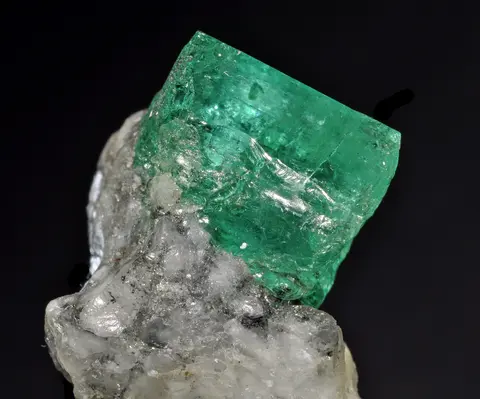
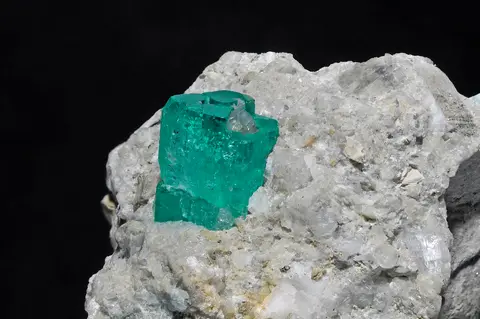
Colombian emeralds grow in calcite and pyrite veins in black shale rather than in mica schist, which gives them low iron, a warm pure green and distinctive three-phase inclusions. See beryl value for the species as a whole.
- Warm, pure to slightly bluish green with bright transparency.
- Jagged three-phase inclusions: a liquid pocket holding a gas bubble and a tiny salt cube.
- Rough often sits with white calcite, pyrite and black shale.
- Low iron content, so stones often look red through a Chelsea filter.
Where colombian emerald comes from
- Muzo, Boyaca
- Warm, grassy green; source of most trapiche emerald.
- Chivor, Boyaca
- Slightly bluer green stones.
- Coscuez, Boyaca
- Major producer of commercial to fine material.
- La Pava and Penas Blancas
- Smaller historic workings in the same belt.
Colombian emerald lookalikes
Origin can only be confirmed by a lab using inclusions and trace elements; Zambian stones tend to be bluer and contain mica rather than three-phase inclusions.
- Zambian emerald has higher iron and slightly higher RI and SG
zambian emerald vs colombian emerald
Only a lab origin report settles it.
- Afghan Panjshir stones can show similar three-phase inclusions
zambian emerald vs colombian emerald
Fake, dyed and treated colombian emerald
Non-Colombian emerald sold as Colombian
Common
- No origin report from a recognized lab
- Mica-rich inclusions suggest a schist source
Lab-grown emerald sold as Colombian
Occasional
- Unusually clean
- Flux or chevron growth inclusions
Is my colombian emerald real? Tests you can do at home
-
Loupe search for three-phase inclusions
With a 10x loupe, look for jagged cavities containing a bubble and a tiny cube.
- Real
- Present in many Colombian stones, though not all.
- Fake or lookalike
- Absent in synthetics and in most schist-type emeralds.
-
Chelsea filter
View through a Chelsea filter under strong incandescent light.
- Real
- Typically a strong pink to red.
- Fake or lookalike
- Iron-rich stones look duller; glass stays green.
A stone that passes these tests is consistent with natural colombian emerald, not proven. For valuable pieces, a gem lab report settles treatment and origin.
Treatments
- Oiling (almost always)
- Standard practice in Colombia; minor oil is accepted. Lab report grades the amount.
What moves the price of colombian emerald
- Lab-confirmed origin. A recognized lab report stating Colombian origin drives the premium.
- Color. Saturated warm green from Muzo is the most requested.
- Clarity enhancement. No oil or minor oil adds a large premium.
- Size. Fine stones above a few carats are scarce.
Questions collectors ask about colombian emerald
- Are emeralds famous in Colombia?
- Yes. Colombia has been the leading source of fine emerald for centuries, and the Muzo, Chivor and Coscuez districts are known worldwide. Colombian origin is still one of the strongest selling points on an emerald report.
- What is the price of a 1 carat Colombian emerald?
- It depends mostly on color, clarity enhancement level and whether a lab confirms the origin, so two one-carat stones can differ enormously. The price table above shows observed ranges by grade.