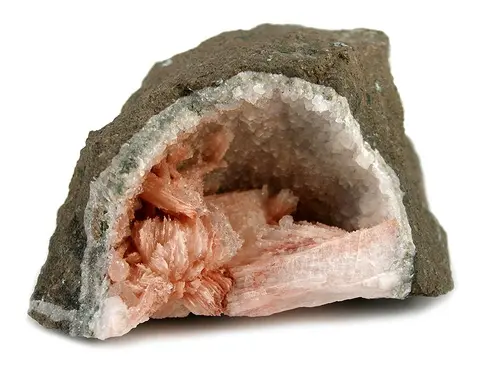
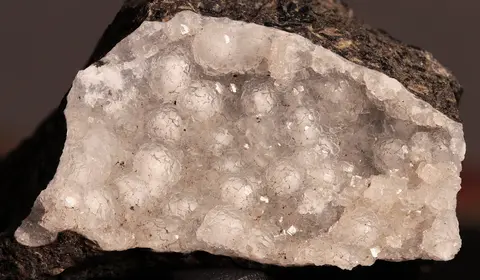
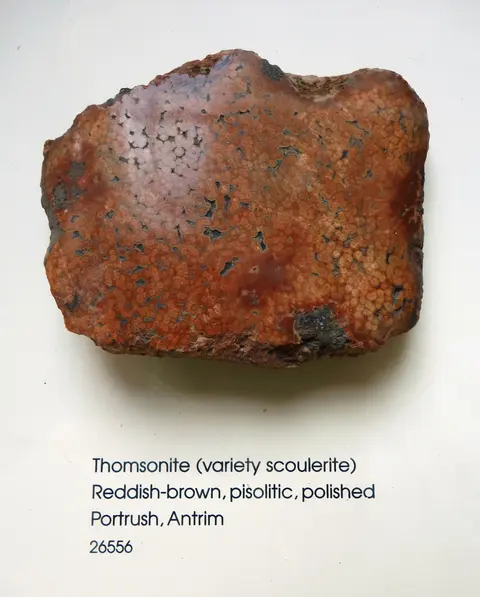
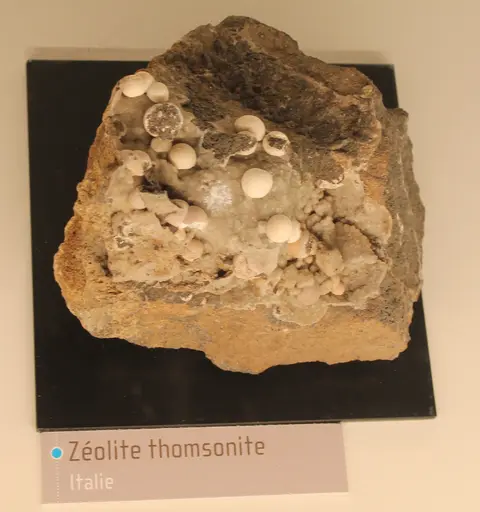
Thomsonite is a calcium sodium aluminum silicate zeolite that fills gas pockets in basalt. Collectors know it best as the pink, green and white eye-patterned nodules from the north shore of Lake Superior, polished as cabochons.
These are dealer asking prices: what shops list thomsonite for, not what it sells for and not an appraisal. Selling to a dealer usually brings well below retail, because the dealer has to resell it at a margin.
How to identify thomsonite
Concentric or radiating 'eyes' of pink, red, green, cream and white in rounded nodules (amygdules) from basalt.
Under a loupe the bands are made of fine radiating fibers rather than the waxy, microcrystalline texture of agate.
Hardness 5 to 5.5: roughly equal to glass and clearly softer than agate.
Light in the hand, specific gravity about 2.3 to 2.4.
Pearly to vitreous luster on broken fiber surfaces; polishes to a silky glow.
Nodules are usually small, from pea size to a few centimeters, and often still partly enclosed in dark basalt.
Where thomsonite comes from
North shore of Lake Superior near Grand Marais, Minnesota, USA
The classic source of patterned eye nodules eroding from basalt flows; many beach sites are now private or protected.
Keweenaw Peninsula and Isle Royale, Michigan, USA
Occurs in the same family of basalts; Isle Royale is a national park where collecting is not allowed.
Scotland and Northern Ireland
Historic basalt localities for white radiating thomsonite crystals; mostly specimen grade.
Prehnite is pale green and harder (6 to 6.5) with a botryoidal habit.
SG about 2.9
Lacks the pink eye pattern
Fake, dyed and treated thomsonite
Other zeolites or agates sold as thomsonite
Occasional
Lack of the eye pattern
Agate is too hard to be thomsonite
Stabilized or resin-filled cabochons
Occasional
Glassy plastic-looking surface in pits
Resin fills that look different under UV
Is my thomsonite real? Tests you can do at home
Scratch test against glass
On an unpolished part of a rough nodule, try to scratch a glass tile.
Real
Leaves at most a faint mark; hardness is close to glass.
Fake or lookalike
Agate and jasper scratch glass easily.
Can leave a small mark.
Loupe inspection of the eyes
Look at the colored rings with a 10x loupe under bright light.
Real
Fine radiating fibers fanning out from centers, giving a silky look.
Fake or lookalike
Agate shows smooth waxy bands; dyed material shows color in cracks.
Weight in hand
Compare against a similar sized agate or quartz pebble.
Real
Feels slightly lighter (SG about 2.35).
Fake or lookalike
Agate feels slightly heavier (about 2.6).
A stone that passes these tests is consistent with natural thomsonite, not proven. For valuable pieces, a gem lab report settles treatment and origin.
Treatments
Stabilization with resin (occasional)
Lets porous or cracked nodules be polished; stabilized pieces are worth less than solid natural ones. Look for resin in pits, an even plastic-like shine and fluorescing fills under UV.
What moves the price of thomsonite
Pattern. Distinct, well-centered eyes are the main draw.
Color. Pink and red with green rings is the most sought combination; plain white is the least.
Size. Most nodules are small, so larger solid pieces carry a premium.
Locality. Documented Minnesota north shore material is the collector standard.
Condition and polish. Pitting, cracks and undercutting lower value; a smooth, bright polish raises it.
Sources
Prices: 3 current listings from Dakota Matrix Minerals, FossilEra, seen 2026-11-20 to 2026-11-20. How we collect prices.