Dealers list garnet specimens under 5 cm (2 in) at $22 to $65.
Prices checked . Page updated .
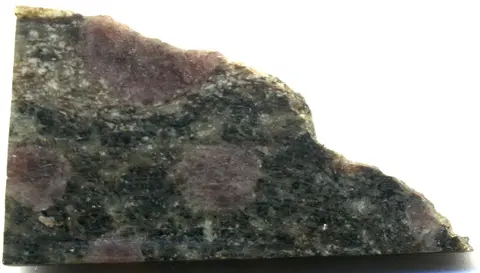
Garnet paragneiss Nuvvuagittuq Greenstone Belt, 4.28 Ga. Photo: James St. John, CC BY 2.0, via Wikimedia Commons.
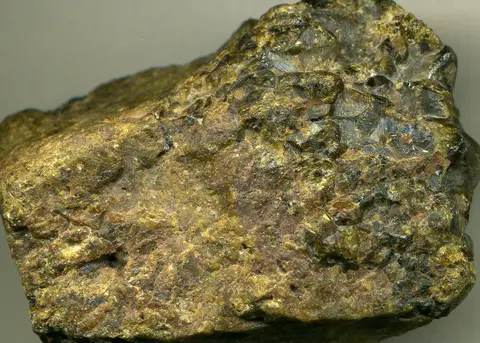
Garnetite (grossular garnet skarn) (Middle Eocene, 38-40 Ma; Concepcion del Oro Mining District, northeastern Zacatecas, central Mexico) 1 (15938239901). Photo: James St. John, CC BY 2.0, via Wikimedia Commons.
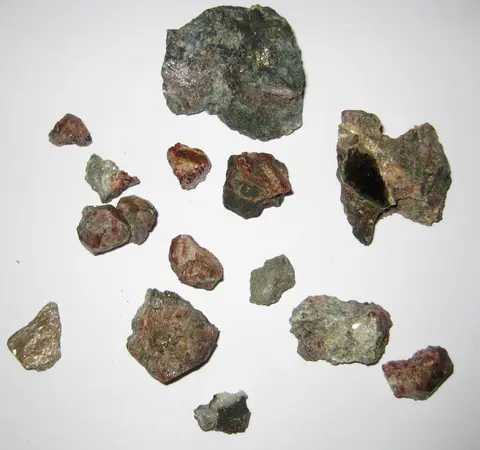
Garnet - Rough - NH (2933075486). Photo: Stephanie Clifford from Arlington, VA, USA, CC BY 2.0, via Wikimedia Commons.
What garnet is worth
Dealer asking prices for garnet, middle half of current listings, checked 2026-11-20. Bar shows the 25th to 75th percentile; the dark tick is the median.
These are dealer asking prices: what shops list garnet for, not what it sells for and not an appraisal. Selling to a dealer usually brings well below retail, because the dealer has to resell it at a margin.
How to identify garnet
Garnet is a group of closely related silicate minerals sharing one cubic crystal structure, with calcium, magnesium, iron, manganese, aluminum, chromium or vanadium swapping places in the formula. The main gem species are pyrope, almandine, spessartine, grossular and andradite, and most stones are mixtures of two or more of them.
Crystals are 12-sided dodecahedra or 24-sided trapezohedra, often rounded and equant, never long prisms.
Hardness 6.5 to 7.5: scratches window glass easily and resists a steel knife.
Heavy for its size (SG 3.6 to 4.3), noticeably heftier than glass or quartz of the same size.
No cleavage; broken edges show conchoidal or uneven fracture with a glassy shine.
Iron and manganese rich garnets (almandine, spessartine, andradite) are pulled by a strong neodymium magnet; glass is not.
Red garnets are usually dark and slightly brownish or purplish; few are the pure, bright red of fine ruby.
Singly refractive: no doubled facet edges under a loupe, unlike zircon or peridot.
Under a loupe, natural stones show needles, small crystals or fingerprint-like fluid inclusions rather than round gas bubbles.
Andradite is the calcium iron garnet, Ca3Fe2(SiO4)3, found in yellow (topazolite), green (demantoid), brown and black (melanite) forms. Andradite has the highest RI and dispersion of the garnets and is usually brown, black or yellowish rather than red.
Mali garnet
Mali garnet is a trade name for yellowish green to brownish yellow grossular-andradite mixed garnet from the Kayes region of Mali, found in 1994. Its andradite content gives it more fire and a higher RI than ordinary grossular.
Bohemian garnet
Bohemian garnet is small dark red pyrope from the Czech Republic, set in dense pave clusters in jewelry since the 1800s. It is pyrope from one region, valued for its jewelry tradition and pure red color rather than size.
Uvarovite garnet
Uvarovite is the calcium chromium garnet, Ca3Cr2(SiO4)3, forming emerald green druses of tiny crystals usually too small to facet. Uvarovite is the rarest of the main garnet species and is sold almost entirely as drusy specimens and jewelry rather than cut stones.
Melanite garnet
Melanite is black titanium-bearing andradite, found as glossy black dodecahedra in alkaline volcanic and metamorphic rocks. Melanite is opaque black rather than transparent, and is collected as crystals or used in mourning jewelry rather than as colored gems.
Raspberry garnet
Raspberry garnet is a collector name for pink to raspberry red grossular crystals, typically in white marble from Mexico. It is pink grossular in matrix, collected as specimens rather than faceted stones.
Emerald Creek garnet
Emerald Creek garnet is almandine from the Emerald Creek area of Benewah County, Idaho, including the four-rayed and occasionally six-rayed star garnets the area is known for. It is almandine identified by locality; the area is one of only two notable sources of star garnet.
Where garnet comes from
East Africa (Kenya, Tanzania)
Tsavorite, rhodolite, malaya and color change garnet; the Umba Valley and Tsavo region are the main sources of many fancy garnets.
Madagascar
Color change pyrope-spessartine from Bekily, demantoid, spessartine and rhodolite.
Namibia and Nigeria
Vivid orange mandarin spessartine and Namibian demantoid from the Green Dragon mine.
Ural Mountains, Russia
Classic demantoid with horsetail inclusions and uvarovite druse on chromite.
Sri Lanka and India
Hessonite, almandine, rhodolite and star almandine; India produces large volumes of commercial red garnet.
Czech Republic (Bohemia)
Small dark red pyrope set in 19th century Bohemian garnet jewelry.
Emerald Creek, Idaho, USA
Almandine dodecahedra and star garnet; a public fee digging area run by the Forest Service.
Gore Mountain, New York, USA
Very large almandine-rich garnets mined for abrasive; garnet is the New York state gem.
Garnet-topped doublet (thin garnet crown fused to colored glass)
Occasional
Placed table down on white paper, a red ring shows around the girdle no matter the stone's color
A join line and differing luster between crown and pavilion
Bubbles at the join plane
YAG and GGG (manmade garnet-structure crystals)
Occasional
Not natural garnet species at all; mostly used as diamond simulants
GGG is very heavy (SG about 7.0)
Flawless with possible curved growth lines or gas bubbles
Transvaal jade or African jade (massive hydrogrossular)
Occasional
Opaque green with black chromite specks
Sold as jade but is a garnet group material
SG about 3.3 to 3.5, heavier than nephrite
Red garnet sold as ruby
Common
Inert under UV
Single refraction
Lower hardness than corundum
Is my garnet real? Tests you can do at home
Neodymium magnet test
Hang a loose stone from a thread or float it on a cork in water and bring a strong neodymium magnet close.
Real
Almandine, spessartine, rhodolite and andradite visibly drag toward the magnet; pyrope moves weakly.
Fake or lookalike
Glass, ruby and most simulants do not move. Grossular and tsavorite also barely react, so no response alone does not mean fake.
Scratch test against glass
Press a sharp edge or point of the rough or bead against a glass bottle and drag firmly.
Real
Leaves a clear scratch in the glass.
Fake or lookalike
Glass of similar hardness skids or scratches poorly and may chip itself.
Can leave a small mark.
Loupe inclusion check
Look through the stone with a 10x loupe against a bright light.
Real
Needles, small crystals, fingerprints or wavy feathers; facet edges sharp.
Fake or lookalike
Round bubbles, swirl lines, or a flat join plane with bubbles in a doublet.
Red ring doublet test
Place a faceted stone table down on white paper and look at it from above.
Real
Color looks even across the stone.
Fake or lookalike
A garnet-topped doublet shows a thin red halo around the outline.
Specific gravity by water displacement
Weigh the stone dry on a kitchen scale reading to 0.01 g, then weigh a cup of water before and after suspending the stone in it by a thread; divide dry weight by the weight gain.
Real
Reads 3.6 to 4.3.
Fake or lookalike
Glass reads around 2.4 to 2.6.
A stone that passes these tests is consistent with natural garnet, not proven. For valuable pieces, a gem lab report settles treatment and origin.
Treatments
None (almost always)
Most garnet is sold untreated, which is part of its appeal; color is natural. Not applicable.
Heating of demantoid (occasional)
Low temperature heat can reduce a brownish tint in some demantoid; accepted in the trade but should be disclosed. Generally not detectable, even by labs.
Fracture filling (rare)
Hides surface-reaching fractures in lower grade stones and lowers value. Flash effects or flattened bubbles in fractures under magnification.
What moves the price of garnet
Species and variety. Demantoid, tsavorite, color change and mandarin spessartine sit far above common almandine and pyrope.
Color. Vivid, saturated color without brown or black tones; overly dark red stones lose value.
Size. Tsavorite and demantoid above a few carats are rare, so value rises steeply with size in those varieties.
Clarity. Eye-clean stones expected for most species; horsetail inclusions add value in demantoid.
Origin. Russian demantoid and Namibian mandarin carry a premium with documentation.
Cut quality. Dark garnets need shallow cuts to let light through; poorly cut stones look black.
Specimen quality. For mineral specimens, sharp undamaged crystals on contrasting matrix command more than loose rounded rough.
Questions collectors ask about garnet
Is garnet worth more than ruby?
Usually no. Fine ruby sells for far more than common red garnet of the same size, though top demantoid and tsavorite can outprice commercial-grade ruby. See the price table above for what garnet actually sells for.
How can you tell a real garnet?
A real garnet scratches glass, feels heavy for its size, shows natural inclusions instead of bubbles under a loupe, and red iron-rich garnets are pulled by a strong neodymium magnet. Glass fails all four.
What birthstone is garnet?
Garnet is the birthstone for January.
Why are garnets so cheap?
Common red almandine and pyrope are mined in large volumes in India, Africa and elsewhere, and many stones are dark. Rarer green, orange and color change garnets are not cheap.
What is the rarest color of garnet?
Blue is the rarest: it occurs only in color change pyrope-spessartine, mainly from Bekily, Madagascar, which shifts from blue-green in daylight to purple-red under warm light.
Ruby vs garnet: how do you tell them apart?
Ruby is harder (9 vs about 7), doubly refractive and glows red under a UV torch; red garnet is inert under UV and usually darker and more brownish or purplish.
Sources
Prices: 79 current listings from FossilEra, iRocks (The Arkenstone), seen 2026-11-20 to 2026-11-20. How we collect prices.