Dealer asking prices for corundum, middle half of current listings, checked 2026-11-20. Bar shows the 25th to 75th percentile; the dark tick is the median.
These are dealer asking prices: what shops list corundum for, not what it sells for and not an appraisal. Selling to a dealer usually brings well below retail, because the dealer has to resell it at a margin.
How to identify corundum
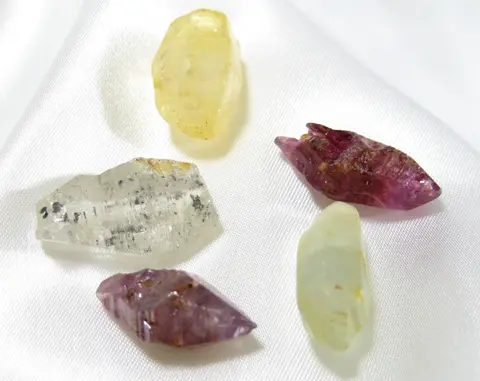
Corundum is crystalline aluminum oxide, the second hardest natural mineral after diamond. Red gem corundum is ruby and every other color is sapphire; the color comes from trace chromium (red), iron and titanium (blue), or iron alone (yellow and green).
Hardness 9: scratches glass, quartz and topaz with ease; only diamond and moissanite scratch it.
Heavy for a gem (SG about 4.0), clearly heavier than quartz, beryl or glass of the same size.
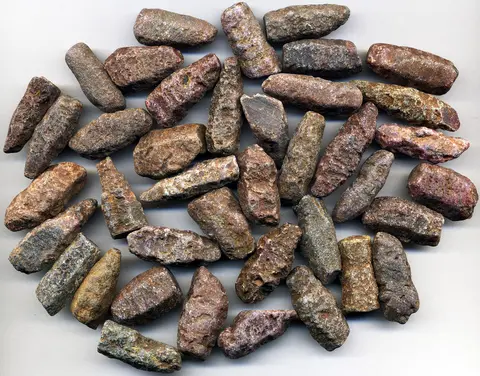
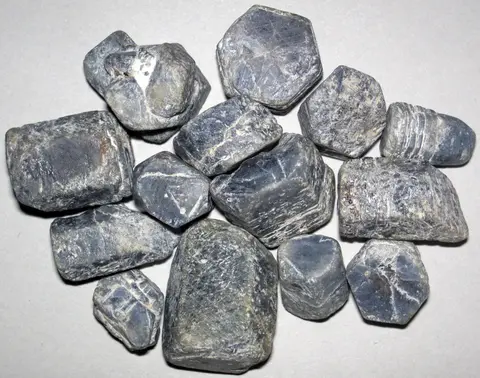
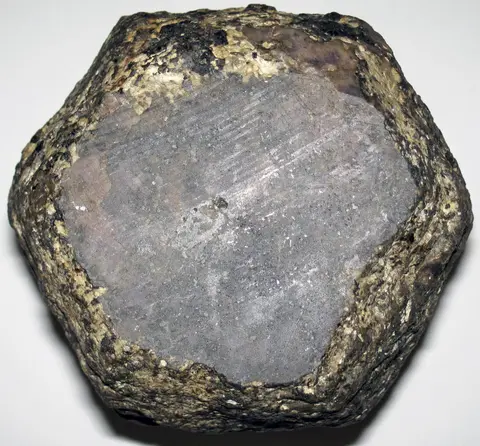
Rough crystals are barrel shaped or tapering six-sided bipyramids, often with flat ends and horizontal striations.
Hexagonal color zoning: straight, angled bands of color that follow the crystal shape, visible with a loupe.
Fine needle inclusions (rutile silk) crossing at 60 degree angles; dense silk gives star stones.
Vitreous to subadamantine luster; no cleavage, but rough often breaks along flat parting planes.
Ruby glows red under longwave UV; most blue sapphire is inert.
Madagascar sapphire is sapphire from Madagascar, a major source since the late 1990s producing blue, pink, padparadscha, yellow and other colors. Same mineral; many Madagascar blues resemble Sri Lankan or even Kashmir stones and need a lab to separate.
Australian sapphire
Australian sapphire is basalt related sapphire from Queensland and New South Wales, typically dark blue, green, yellow and parti colored. Iron rich, so often darker and inkier than metamorphic sapphire; also the main source of parti sapphire.
Where corundum comes from
Mogok, Myanmar
Benchmark source for ruby in marble, plus fine blue sapphire and spinel.
Ratnapura and Elahera, Sri Lanka
Gem gravels yielding blue, yellow, pink, padparadscha and white sapphire, and much heat treated geuda material.
Padar, Kashmir, India
Velvety blue sapphire mined mostly in the 1880s; still the reference for top blue.
Ilakaka, Andranondambo and Didy, Madagascar
Major modern source of sapphire in every color and of ruby.
Montepuez, Mozambique
The largest modern ruby supply since 2009, from amphibole rich rocks.
Chanthaburi, Thailand, and Pailin, Cambodia
Basalt related ruby and dark blue sapphire; Chanthaburi is now the main treatment and trading hub.
Montana, USA
Yogo Gulch, Rock Creek, the Missouri River and Dry Cottonwood Creek produce blue, teal and fancy sapphire.
Queensland and New South Wales, Australia
Dark blue, green, yellow and parti sapphire from basalt fields.
Umba Valley and Winza, Tanzania
Fancy and color change sapphire from Umba, ruby from Winza.
Flame fusion (Verneuil) synthetic ruby and sapphire
Very common
Curved color banding (striae) instead of straight hexagonal zoning
Round gas bubbles
Too clean and evenly colored at a low price
Often used in old jewelry and class rings
Flux grown and hydrothermal synthetics
Common
Wispy fingerprint like flux inclusions
Platinum platelets
Needs a gem lab for certain separation
Lead glass filled ruby (composite ruby)
Very common
Blue or orange flashes in fractures when tilted
Gas bubbles trapped in cracks
Uneven surface luster where glass reaches the surface
Garnet topped and sapphire doublets
Occasional
Red ring around the girdle when placed table down on white paper
Luster change at a seam near the girdle
Beryllium diffused sapphire
Common
Orange or yellow surface layer that follows the cut
Lab detection with LA-ICP-MS
Red and blue glass
Common
Bubbles and swirls
Does not scratch quartz
Light in hand
Trade names using 'ruby' or 'sapphire' for other stones
Occasional
Balas ruby is spinel
Cape ruby is garnet
Siberian ruby is tourmaline
Water sapphire is iolite
Is my corundum real? Tests you can do at home
Scratch test on a quartz crystal
Press the girdle edge of a loose stone or a rough corner gently against a quartz point, not the other way round.
Real
Corundum bites into quartz easily.
Fake or lookalike
Glass skids off; garnet and tourmaline barely mark it.
Can leave a small mark.
Specific gravity by water displacement
Use a scale reading to 0.01 g: weigh the stone dry, then weigh the displaced water and divide. Works best above 2 carats.
Real
About 4.0.
Fake or lookalike
Glass 2.3 to 4.5 depending on lead; spinel 3.6; tourmaline 3.06; YAG and CZ much higher.
UV torch
In darkness, shine a 365 nm longwave UV torch on the stone.
Real
Most ruby glows red; low iron pink sapphire glows orange red.
Fake or lookalike
Red garnet and most red glass stay dark. Synthetic ruby glows strongly too, so this does not rule out lab grown.
Loupe for color zoning and inclusions
Look through the side with a 10x loupe against a white background.
Real
Straight, angled color bands and silk needles.
Fake or lookalike
Curved bands and round bubbles point to flame fusion synthetic or glass.
Red ring for doublets
Place the stone face down on white paper and look straight down through the back.
Real
No ring.
Fake or lookalike
A red halo around the girdle shows a garnet topped doublet.
Thermal diamond tester for colorless stones
Touch the tester tip to the table.
Real
White sapphire reads as not diamond.
Fake or lookalike
Diamond and moissanite read as diamond, so use with a loupe check for doubling.
A stone that passes these tests is consistent with natural corundum, not proven. For valuable pieces, a gem lab report settles treatment and origin.
Treatments
Heat treatment (almost always)
Improves color and clarity, dissolves silk; accepted in the trade, but unheated stones carry a strong premium. Lab: altered silk, discoid stress fractures around inclusions, chalky blue SW fluorescence in some blue sapphire.
Lead glass filling (common)
Turns opaque, cracked low grade ruby into transparent looking stones; value drops to a small part of an untreated ruby and the glass is damaged by heat and acids. Blue flash in fractures, gas bubbles in glass, at home with a loupe.
Beryllium diffusion (common)
Creates yellow, orange and padparadscha colors from pale stones; much lower value than natural color. Lab chemistry; sometimes a colored rim visible when immersed.
Titanium surface diffusion (occasional)
Thin blue skin on pale sapphire; repolishing removes color. Blue concentrated on facet junctions when immersed.
Heating with flux to repair fractures (common)
Heating with flux partly heals fractures in ruby; accepted but reduces value against untreated. Lab: glassy residues in healed fissures.
Dyeing and oiling (occasional)
Mostly on low grade opaque ruby beads and Indian star ruby; lowers value. Color in cracks, acetone swab.
What moves the price of corundum
Variety and color. Saturated pure red ruby, velvety royal to cornflower blue sapphire and padparadscha rank highest; gray, brown and very dark stones lowest.
Treatment. No heat stones are worth far more than heated ones; glass filled and diffused stones are worth least.
Size. Value climbs steeply with carat weight; fine stones over a few carats are scarce.
Clarity. Eye clean stones lead, though light silk is accepted and can soften color.
Cut. Windowed, overly deep or lopsided native cuts lower value.
Lab report. A report from a major lab stating natural, origin and treatment supports value for important stones.
Questions collectors ask about corundum
What is the rarest color sapphire?
Padparadscha, a delicate mix of pink and orange, is generally regarded as the rarest sapphire color, with natural color stones mainly from Sri Lanka and Madagascar. Fine untreated red (ruby) is also very rare.
Is painite rarer than ruby?
Yes, by a wide margin. Painite was known from only a handful of crystals for decades, and even after newer finds in Myanmar gem quality painite remains far scarcer than ruby.
Is spinel more expensive than sapphire?
Usually not for comparable blue stones, but top red, hot pink and cobalt blue spinel can match or pass mid quality sapphire. Fine sapphire still leads at the highest grades.
Is tourmaline more expensive than sapphire?
Most tourmaline sells for less than sapphire of similar size and quality. Copper bearing Paraiba tourmaline is the exception and can exceed fine sapphire.
Sources
Prices: 613 current listings from Dakota Matrix Minerals, FossilEra, iRocks (The Arkenstone), The Natural Sapphire Company, The Gem Shop, Throwin Stones, seen 2026-11-20 to 2026-11-20. How we collect prices.