What ruby is worth
Show 12 of the listings behind these numbers
These are dealer asking prices: what shops list ruby for, not what it sells for and not an appraisal. Selling to a dealer usually brings well below retail, because the dealer has to resell it at a margin.
How to identify ruby
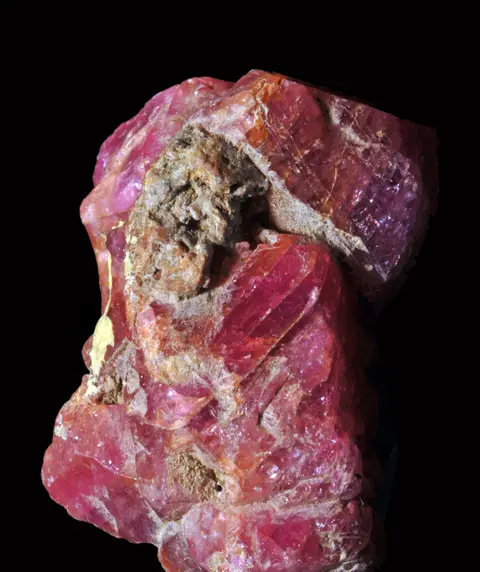
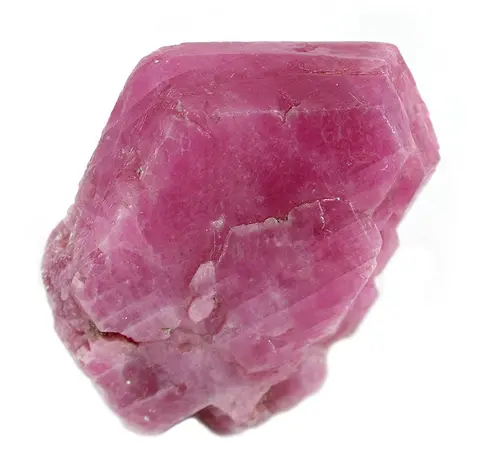
Ruby is red corundum colored by chromium. Trade labs draw the line between ruby and pink sapphire by saturation, and that boundary varies between labs and markets.
The red variety of corundum; chromium gives the color and a red glow under UV, and it is the most valuable corundum per carat in fine qualities. See corundum value for the species as a whole.
- Red to purplish or orangy red, with straight color zoning and silk under a loupe.
- Glows red under a longwave UV torch, strongly in low iron stones.
- Dichroic: purplish red and orangy red in different directions.
- Scratches quartz and garnet; SG about 4.0.
Where ruby comes from
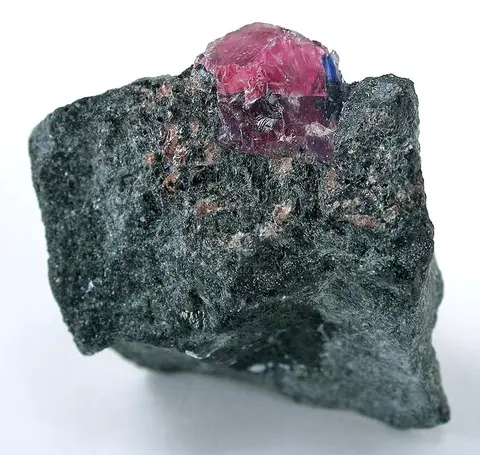
- Mogok and Mong Hsu, Myanmar
- Classic marble hosted rubies; Mong Hsu material is routinely heated.
- Montepuez, Mozambique
- Largest current supply.
- Chanthaburi, Thailand, and Pailin, Cambodia
- Darker, iron rich basalt rubies.
- Luc Yen, Vietnam, and Jegdalek, Afghanistan
- Marble hosted ruby, often pinkish red.
- Winza, Tanzania, and Kenya
- African sources of fine to commercial ruby.
- Madagascar and Greenland
- Newer and smaller sources.
Ruby lookalikes
Spinel is singly refractive with no dichroism; many historic 'rubies', including the Black Prince's Ruby, are spinel.
red spinel vs ruby
Garnet is dark red, singly refractive and stays dark under a UV torch.
- SG 3.6 to 4.3
- Hardness 6.5 to 7.5
Rubellite is lighter and shows obvious doubling and often liquid filled fractures.
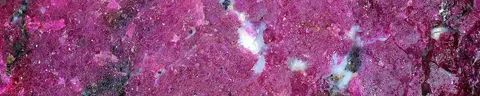
Opaque ruby crystals in green zoisite; real ruby, but carving grade.
- Green zoisite matrix with black hornblende
Also mistaken for ruby: garnet, almandine garnet, spinel, painite.
Fake, dyed and treated ruby
Lead glass filled ruby
Very common
- Blue and orange flash in cracks
- Gas bubbles in fractures
- Very cheap for a large clean looking stone
Synthetic ruby (flame fusion, flux, hydrothermal)
Very common
- Curved striae and bubbles in flame fusion
- Flux fingerprints
- Lab confirmation needed for flux and hydrothermal
Garnet topped doublet
Occasional
- Red ring test
- Seam at the girdle
Red glass
Common
- Bubbles
- Low weight
- No dichroism
Dyed low grade ruby or quench crackled quartz
Common
- Red concentrated in a web of cracks
- Acetone swab turns pink
- Quartz is light (SG 2.65)
Is my ruby real? Tests you can do at home
-
UV torch
Shine a 365 nm torch in the dark.
- Real
- Red glow (weaker in iron rich Thai stones).
- Fake or lookalike
- Garnet and most glass stay dark; synthetic ruby also glows.
-
Loupe for glass filling
Tilt the stone under a single light with a 10x loupe and watch the fractures.
- Real
- Fractures look white or reflective.
- Fake or lookalike
- Blue or orange flash and bubbles mean lead glass filling.
-
Red ring for doublets
Place table down on white paper and look through the back.
- Real
- No ring.
- Fake or lookalike
- Red halo at the girdle.
-
Specific gravity
Weigh dry and in water on a 0.01 g scale.
- Real
- About 4.0.
- Fake or lookalike
- Spinel 3.6, tourmaline 3.06, glass varies.
A stone that passes these tests is consistent with natural ruby, not proven. For valuable pieces, a gem lab report settles treatment and origin.
Treatments
- Heat (almost always)
- Removes purple or blue tones and silk; unheated fine ruby carries a large premium. Lab.
- Heat with flux (fracture repair) (common)
- Partly heals fractures; accepted but reduces value. Lab: residues in healed fissures.
- Lead glass filling (common)
- Composite ruby, a fraction of the value of untreated ruby, damaged by heat and lemon juice. Flash effect and bubbles with a loupe.
What moves the price of ruby
- Color. Pure, vivid red to slightly purplish red with strong fluorescence ranks highest; brownish or very dark red lower.
- Treatment. No heat, then heat only, then flux healed; glass filled at the bottom.
- Origin. Burma (Mogok) carries the highest premium; Mozambique fine stones are close behind in demand.
- Size. Fine ruby over a few carats is very rare.
- Clarity. Ruby is expected to be included; eye clean fine stones are exceptional.
Questions collectors ask about ruby
- How can you tell a real ruby?
- Check that it scratches quartz, feels heavy (SG about 4.0), glows red under a UV torch and shows straight color zoning with a loupe. Glass filled rubies show blue flashes in cracks, and only a gem lab can reliably separate natural from synthetic.
- What is the rarest color of ruby?
- The most prized and rarest is a pure, saturated red with strong red fluorescence, sold in the trade as pigeon's blood, classically from Mogok, Myanmar.
- What stone is mistaken for a ruby?
- Red spinel is the classic one; the Black Prince's Ruby in the British crown is a spinel. Red garnet, rubellite tourmaline and red glass are also often mistaken for ruby.
- Is garnet worth more than ruby?
- Red garnet sells for far less than ruby of comparable size and quality. Only rare garnets such as fine demantoid approach ruby values.
- What is the value of a ruby gemstone?
- Ruby value depends on color, treatment (no heat versus heated versus glass filled), origin, size and clarity, and spans a very wide range. See the price table above for current observations.
Sources
Prices: 16 current listings from FossilEra, iRocks (The Arkenstone), The Gem Shop, Throwin Stones, seen 2026-11-20 to 2026-11-20. How we collect prices.