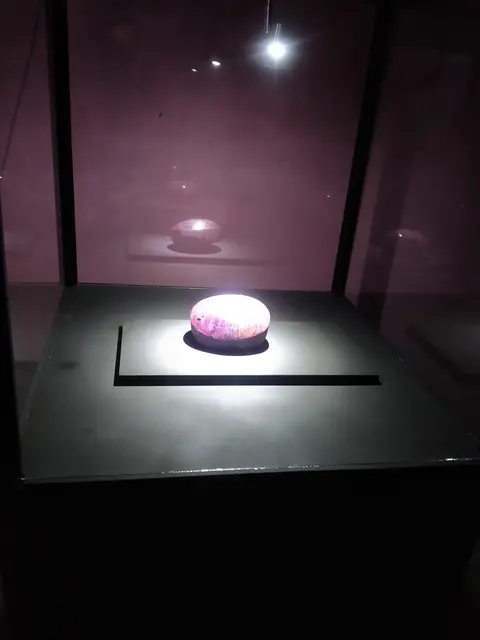
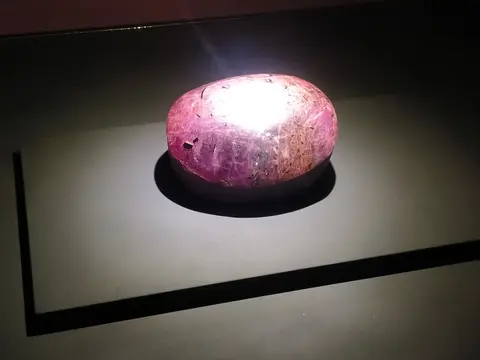
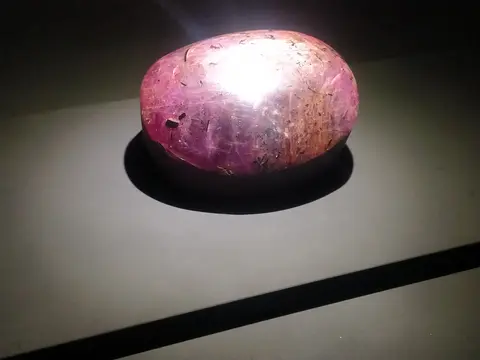
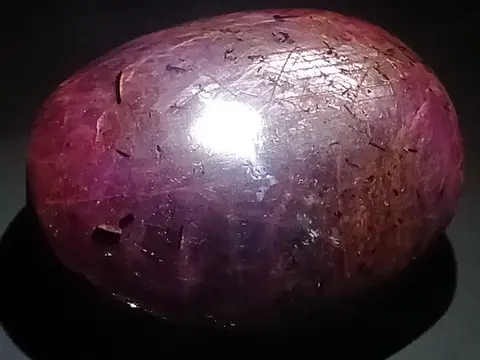
What star ruby is worth
Not enough data. We have not yet seen 5 or more current dealer listings for star ruby in any one form, so we show no range rather than guess.
These are dealer asking prices: what shops list star ruby for, not what it sells for and not an appraisal. Selling to a dealer usually brings well below retail, because the dealer has to resell it at a margin.
How to identify star ruby
Translucent to opaque ruby with dense silk; valued on star quality and red body color rather than transparency. See corundum value for the species as a whole.
- Six-rayed star that moves as the light moves.
- Natural stars often slightly wavy or off center.
- Body color red to purplish or brownish red.
- Glows red under UV like faceted ruby.
Where star ruby comes from
- Myanmar
- Fine translucent red star rubies.
- Sri Lanka
- Pinkish to purplish red star stones.
- Vietnam
- Luc Yen star rubies.
- India
- Opaque, often dyed or filled commercial star ruby.
Star ruby lookalikes
Usually a four-rayed star on a purplish brown body.
Spinel rarely shows a star and is singly refractive.
Fake, dyed and treated star ruby
Linde and other synthetic star ruby
Common
- Perfect, sharp star
- Uniform, slightly see through red body
- Curved striae and bubbles
Dyed or glass filled Indian star ruby
Very common
- Red concentrated in cracks
- Acetone swab picks up color
- Glassy fill in surface pits
Is my star ruby real? Tests you can do at home
-
Acetone swab
Rub the back with a nail polish remover swab.
- Real
- Swab stays clean.
- Fake or lookalike
- Dyed stones stain the swab red.
-
Star check under a penlight
Move a single light across the dome.
- Real
- Slightly uneven star with visible silk.
- Fake or lookalike
- Perfect, crisp star suggests synthetic.
-
Loupe the base
Look at the back and sides with a 10x loupe.
- Real
- Straight zoning, silk.
- Fake or lookalike
- Curved bands, bubbles, glass in cracks.
A stone that passes these tests is consistent with natural star ruby, not proven. For valuable pieces, a gem lab report settles treatment and origin.
Treatments
- Dyeing and glass filling (common)
- Common on Indian material; low value. Acetone swab, loupe.
- Diffusion stars (occasional)
- Artificial star; low value. Lab.
What moves the price of star ruby
- Star quality. Sharp, centered, complete arms.
- Body color. Translucent saturated red ranks far above brownish or opaque stones.
- Treatment. Undyed, unfilled stones carry a large premium.
- Origin. Burmese star rubies lead.