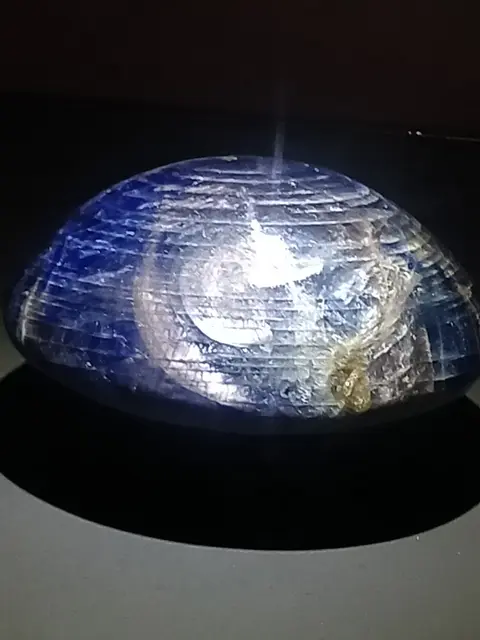
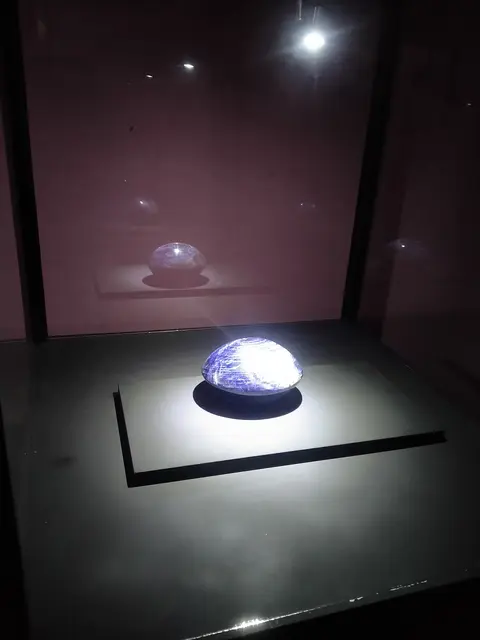
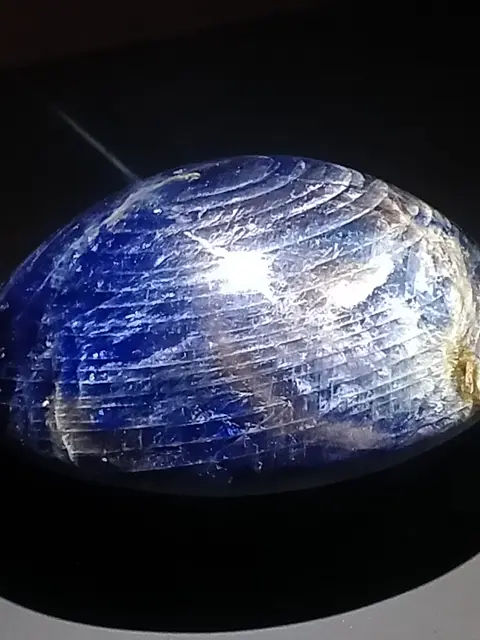
Eye of God Star Sapphire Front View. Photo: TheMaharlikan, CC0, via Wikimedia Commons.
The Eye of God Star Sapphire 13,214 Carats in Museum Display. Photo: TheMaharlikan, CC0, via Wikimedia Commons.
Eye of God Star Sapphire 13,214 carats the worlds largest Sapphire with asterism. Photo: TheMaharlikan, CC0, via Wikimedia Commons.
What star sapphire is worth
Not enough data. We have not yet seen 5 or more current dealer listings for star sapphire in any one form, so we show no range rather than guess.
These are dealer asking prices: what shops list star sapphire for, not what it sells for and not an appraisal. Selling to a dealer usually brings well below retail, because the dealer has to resell it at a margin.
How to identify star sapphire
Translucent to opaque sapphire with dense silk; valued for star sharpness and body color rather than transparency. See corundum value for the species as a whole.
Six-rayed star that glides across the dome as the light moves.
Natural stars are often slightly off center with uneven arms and visible silk.
Body color usually grayish blue to blue; also black, purple, pink and white.
Back is often left rough or unpolished to save weight.
Some older Linde stones have a small L on the back
Diffusion induced stars
Occasional
Star sits in a thin surface layer
Star too sharp for a heavily included stone
Lab test needed
Glass with an engraved or reflective star
Occasional
Star does not move with the light
Light weight
Is my star sapphire real? Tests you can do at home
Star sharpness and color check
View under a single penlight and move it across the dome.
Real
Star slightly uneven, body shows color zoning and silk patches.
Fake or lookalike
Ruler straight, perfect star on an even, opaque body suggests synthetic.
Loupe for curved bands and bubbles
Examine the side and base with a 10x loupe.
Real
Straight zoning and silk.
Fake or lookalike
Curved striae and round bubbles point to synthetic.
Specific gravity
Weigh dry and in water on a 0.01 g scale.
Real
About 4.0.
Fake or lookalike
Glass is lighter; star diopside 3.3.
A stone that passes these tests is consistent with natural star sapphire, not proven. For valuable pieces, a gem lab report settles treatment and origin.
Treatments
Heat (rare)
Heating dissolves silk and weakens stars, so most star sapphires are unheated. Lab.
Diffusion (occasional)
Adds an artificial star; low value. Lab.
What moves the price of star sapphire
Star quality. Sharp, centered, complete arms reaching the base.
Body color. Saturated blue ranks well above gray.
Translucency. Semi translucent stones with a glowing body beat dull opaque ones.
Size and proportions. Larger stones with balanced domes and not overly heavy bases rank higher.
Natural versus synthetic. Synthetic star stones are worth little.
Questions collectors ask about star sapphire
How can I tell if a star sapphire is real?
Natural stars are usually slightly uneven with visible silk and color zoning, while synthetics show a perfect, sharp star on an even body with curved banding or bubbles under a loupe. Check weight (SG about 4.0) and get a lab report for valuable stones.
What is the price of a natural star sapphire?
It depends on star sharpness and centering, body color, translucency and size; strong blue stones with sharp stars lead, gray and black stones are far more affordable. See the price table above.