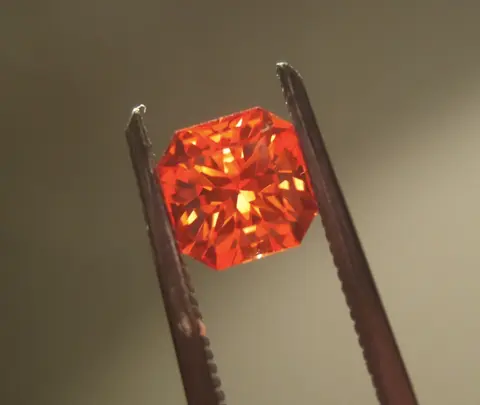
What padparadscha sapphire is worth
Not enough data. We have not yet seen 5 or more current dealer listings for padparadscha sapphire in any one form, so we show no range rather than guess.
These are dealer asking prices: what shops list padparadscha sapphire for, not what it sells for and not an appraisal. Selling to a dealer usually brings well below retail, because the dealer has to resell it at a margin.
How to identify padparadscha sapphire
Defined by a narrow pinkish orange to orangy pink color range; labs only use the name for stones within that range, and it is the scarcest sapphire color. See corundum value for the species as a whole.
- Pink and orange together in moderate to light tone, often described as salmon or sunset.
- Often glows orange under a longwave UV torch.
- Straight color zoning, often with pink and orange zones visible under a loupe.
- Heavy and hard like all corundum.
Where padparadscha sapphire comes from
- Sri Lanka
- Classic source and the origin of the name.
- Madagascar
- Significant modern supply, often more pink.
- Tanzania
- Umba and Tunduru produce pinkish orange sapphires.
Padparadscha sapphire lookalikes
Morganite is much lighter and pale.
padparadscha sapphire vs morganite
Sunstone is much lighter and often shows copper schiller.
Malaya garnet is singly refractive and shows no dichroism.
Spinel is singly refractive.
Also mistaken for padparadscha sapphire: imperial topaz.
Fake, dyed and treated padparadscha sapphire
Beryllium diffused 'padparadscha'
Very common
- Orange color concentrated at the surface around a pink core
- Very saturated and cheap
- Lab test needed for certainty
Synthetic padparadscha colored sapphire
Common
- Curved bands and bubbles
- Flawless and even
Pink or orange sapphire labeled padparadscha
Common
- Lacks one of the two colors
- No lab report naming the color
Is my padparadscha sapphire real? Tests you can do at home
-
Immersion look
Place the stone in a glass of water over white paper and look from the side.
- Real
- Color through the body with straight zoning.
- Fake or lookalike
- Orange skin around a pale or pink core suggests diffusion.
-
Loupe for curved bands
View with a 10x loupe.
- Real
- Straight zoning, natural inclusions.
- Fake or lookalike
- Curved bands and bubbles.
-
Sun fade check
Compare color before and after a few days in a bright window.
- Real
- Stable color; some natural padparadschas from color centers can fade too, so this needs a lab to interpret.
- Fake or lookalike
- Irradiated or unstable stones fade noticeably.
A stone that passes these tests is consistent with natural padparadscha sapphire, not proven. For valuable pieces, a gem lab report settles treatment and origin.
Treatments
- Heat (common)
- Adjusts pink and orange balance; accepted, but unheated stones are favored. Lab.
- Beryllium diffusion (common)
- Creates padparadscha color from pale pink stones; low value. Lab chemistry.
What moves the price of padparadscha sapphire
- Color balance. An even mix of pink and orange in a soft, glowing tone; lab confirmation of the name matters.
- Treatment. Unheated and not diffused, confirmed by a lab, carries a large premium.
- Origin. Sri Lankan origin is preferred.
- Color stability. Stones that fade in light lose value.
- Size and clarity. Clean stones over 2 carats are rare.
Questions collectors ask about padparadscha sapphire
- Why is a padparadscha sapphire engagement ring considered rare?
- The color window is narrow, natural stones come mainly from Sri Lanka and Madagascar, and many on the market are diffused or heated, so untreated stones with a lab confirmed padparadscha color are scarce.