What painite is worth
Not enough data. We have not yet seen 5 or more current dealer listings for painite in any one form, so we show no range rather than guess.
These are dealer asking prices: what shops list painite for, not what it sells for and not an appraisal. Selling to a dealer usually brings well below retail, because the dealer has to resell it at a margin.
How to identify painite
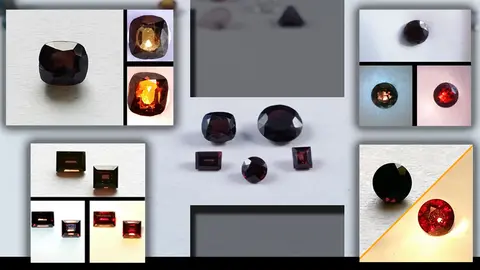
- Brownish red, orange-red to dark red color, often with a brown tone.
- Elongated six-sided prisms, frequently with a pointed or flat end, mostly small and opaque to translucent.
- Strong pleochroism: ruby red to pale brownish orange as the stone is turned.
- Hardness 8 and SG about 4.0, close to ruby.
- High birefringence (about 0.028), so back facets often appear doubled through a loupe in clean faceted stones.
- Comes almost entirely from the Mogok area of Myanmar, usually with ruby and spinel from the same gravels.
Where painite comes from
- Mogok, Mandalay Region, Myanmar
- Type locality, where the first crystal was identified in the 1950s by gem dealer Arthur C. D. Pain.
- Kyaukpyatthat area, near Mogok, Myanmar
- Source of the larger finds after 2004 that made painite available to collectors, mostly as opaque crystals.
Painite lookalikes
Ruby is purer red with lower birefringence (0.008), so facet doubling is not visible; painite is usually browner and shows doubling.
- Ruby RI 1.76 to 1.77
- Ruby SG 4.0, almost the same
- Ruby hardness 9
- Ruby fluoresces red under longwave UV
painite vs ruby
Spinel is singly refractive, with no pleochroism and no facet doubling.
- Spinel SG about 3.6
- Spinel crystals are octahedrons, not hexagonal prisms
Garnet is singly refractive and shows no pleochroism.
- Garnet crystals are rounded dodecahedrons
- SG varies from about 3.6 to 4.3
painite vs garnet
Zircon is heavier (SG 4.6 to 4.7) and shows much stronger fire and doubling.
- Zircon has an adamantine luster
- Zircon facet edges wear easily
Fake, dyed and treated painite
Garnet, spinel, zircon or brownish ruby sold as painite
Common
- No lab report naming painite
- Singly refractive (garnet, spinel)
- Sold cheaply or in quantity, which does not match the scarcity of clean painite
Red-brown glass labeled painite
Occasional
- Bubbles and swirls
- SG about 2.5 to 3
- No pleochroism
Is my painite real? Tests you can do at home
-
Pleochroism with polarized sunglasses
Rotate one lens of polarized sunglasses over the stone in bright light.
- Real
- Obvious change from red to pale brownish orange.
- Fake or lookalike
- Garnet, spinel and glass show no change.
-
Loupe check for facet doubling
Look through the table at the back facet edges with a 10x loupe, turning the stone.
- Real
- Back facet edges appear doubled in many directions.
- Fake or lookalike
- Ruby, spinel, garnet and glass show single, sharp edges.
-
Specific gravity
Weigh in air and in water on a 0.01 g scale and divide (stones under a carat give unreliable results).
- Real
- About 4.0.
- Fake or lookalike
- Spinel 3.6, glass 2.5 to 3, zircon 4.7; ruby is also 4.0, so this does not separate ruby.
A stone that passes these tests is consistent with natural painite, not proven. For valuable pieces, a gem lab report settles treatment and origin.
What moves the price of painite
- Transparency. Facet-grade transparent painite is far rarer and more valuable than opaque crystals.
- Lab identification. A report from a recognized gem lab confirming painite is essential for value.
- Size. Clean faceted stones are usually small; larger ones are exceptional.
- Color. Redder stones with less brown are preferred.
- Crystal quality. Sharp, terminated crystals bring more than broken or waterworn pieces.
Questions collectors ask about painite
- How rare is painite gem?
- Very rare as a gem. Only a handful of crystals were known for decades after its 1950s discovery, and although finds near Mogok since the mid 2000s produced many crystals, most are opaque and clean faceted stones remain scarce.
- Where is painite found?
- Painite is found in the Mogok area of Myanmar, mainly in gravels near Kyaukpyatthat. No other locality has produced gem painite in quantity.
- Is painite rarer than ruby?
- Yes. Ruby is mined in many countries, while gem painite comes from one small region of Myanmar, and transparent painite is much scarcer than fine ruby.
- How much is painite gem worth?
- Transparency, size, color and a lab report confirming the species decide value, with opaque crystals priced far below clean faceted stones. See the price table above for observed ranges.