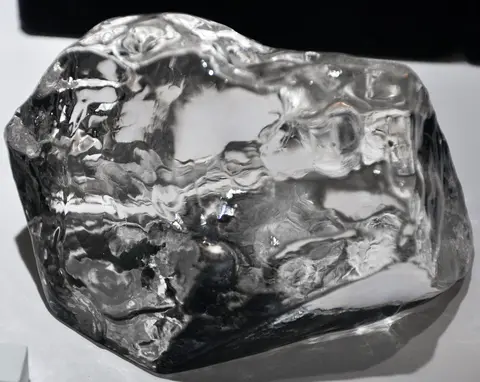
Diamond is pure carbon crystallized in a cubic structure deep in the Earth's mantle and brought up in kimberlite and lamproite eruptions. It is the hardest natural material and has very high brilliance and fire when cut.
Prices checked . Page updated .
Cullinan Diamond (replica) (Premier Kimberlite Pipe, Precambrian; Premier Mine, South Africa) 1 (17872546950). Photo: James St. John, CC BY 2.0, via Wikimedia Commons.
What diamond is worth
Not enough data. We have not yet seen 5 or more current dealer listings for diamond in any one form, so we show no range rather than guess.
Crater of Diamonds State Park, Murfreesboro, Pike Co., Arkansas, USA
$2,200
These are dealer asking prices: what shops list diamond for, not what it sells for and not an appraisal. Selling to a dealer usually brings well below retail, because the dealer has to resell it at a margin.
How to identify diamond
Hardness 10: nothing but another diamond scratches it, and polished facet edges stay razor sharp
Very high brilliance with a balance of white light and moderate rainbow fire
Single refraction: facet edges seen through the table never look doubled
Breath fog on the surface clears almost instantly because diamond conducts heat so well
Rough crystals are octahedra, dodecahedra or rounded shapes with a greasy, adamantine luster and triangular growth marks (trigons)
Often shows small natural inclusions: dark crystals, feathers or pinpoints under a 10x loupe
Grease clings to it and water beads up on a clean surface
Passes a basic diamond tester but flags on a moissanite tester
Strong rainbow flashes
Needle-like inclusions running in one direction
Lab-grown diamond sold as natural
Occasional
Passes every home test
Girdle inscription such as LG or a lab-grown report number
Only a gem lab with spectroscopy can confirm natural origin
Glass and rhinestones
Common
Soft, worn facet edges
Bubbles
Foil backing in costume jewelry
Fogs and stays fogged
Herkimer diamonds and other trade names for quartz
Very common
Six-sided quartz crystal shape
Light weight
Low brilliance once compared side by side
Coated diamonds and simulants
Occasional
Color sits only at the surface
Scratches or worn spots in the coating at facet junctions
Is my diamond real? Tests you can do at home
Fog test
Clean the stone, breathe on it like fogging a mirror, and count how long the fog stays.
Real
Fog disappears almost immediately.
Fake or lookalike
Glass, CZ and many simulants stay fogged for a few seconds. Moissanite also clears fast, so this rules out only some fakes.
Loupe check for doubling and edges
With a 10x loupe, look through the side of the stone at the back facets, then check the facet edges.
Real
Single, sharp facet edges; no doubling.
Fake or lookalike
Moissanite and zircon show doubled back facets; CZ and glass show rounded or chipped edges.
Combined diamond and moissanite tester
Use a handheld multi tester that checks thermal and electrical conductivity, touching the probe to a clean facet.
Real
Reads diamond.
Fake or lookalike
CZ, glass, sapphire and topaz fail; moissanite is flagged separately. Lab-grown diamond still reads as diamond.
Weight compared with size
For a loose round stone, measure its diameter and weigh it on a carat scale, then compare with standard diamond size charts.
Real
Weight matches diamond tables (for example about 6.5 mm for a 1 carat round).
Fake or lookalike
CZ of the same size weighs much more; moissanite slightly less.
Read-through test for loose round brilliants
Place a loose round stone table down on printed text.
Real
A well-cut diamond does not let you read the text.
Fake or lookalike
Glass, quartz, topaz and sapphire often show readable text. Only valid for standard round brilliants.
Mount stamp check
Look inside the ring or setting with a loupe.
Real
Gold or platinum stamps such as 14K, 18K or PT950 are typical for diamonds.
Fake or lookalike
Stamps such as CZ, or 925 in silver settings, strongly suggest a simulant.
A stone that passes these tests is consistent with natural diamond, not proven. For valuable pieces, a gem lab report settles treatment and origin.
Treatments
Laser drilling (common)
Burns tiny channels to reach and bleach dark inclusions, improving apparent clarity; lowers value compared with an untreated stone of the same look. Fine straight tunnels from the surface visible with a loupe; noted on lab reports.
Fracture filling (occasional)
Glass-like filler hides surface-reaching cracks; filled stones sell well below untreated ones and the filler can be damaged by heat or ultrasonic cleaning. Flash effect: blue, orange or pink flashes along cracks when tilting the stone under a loupe.
HPHT treatment (occasional)
High pressure and heat can turn brown diamonds colorless or change them to yellow, green, pink or blue. Gem lab spectroscopy only.
Irradiation and annealing (common)
Creates fancy colors such as blue, green, yellow, pink and black; treated colors sell for far less than natural ones. Gem lab only; some show color zoning at the culet.
Coating (occasional)
Thin films add color or mask a yellow tint; coatings can wear off. Loupe for scratched or patchy coating; lab confirmation.
What moves the price of diamond
Natural vs lab-grown. Natural diamonds and lab-grown diamonds are separate markets; lab-grown sells far lower.
Carat weight. Value rises steeply with size, with jumps at round weights such as half and one carat.
Color. For white diamonds, D to F colorless is top; for fancy colors, saturation and hue decide value.
Clarity. Fewer and smaller inclusions raise value; eye-clean stones are the practical threshold.
Cut quality. Well-proportioned stones with excellent cut grades command more than poorly cut ones.
Treatment. Untreated stones sell well above treated ones of similar appearance.
Grading report. A report from a major lab such as GIA adds confidence and liquidity.
Fluorescence. Strong blue fluorescence can lower the value of near-colorless stones.
Shape. Round brilliants generally bring more than fancy shapes of the same weight.
Care and safety
Diamond can chip along its cleavage if knocked hard. Clean with warm water, mild soap and a soft brush. Avoid ultrasonic and steam cleaning for fracture-filled or heavily included stones.
Questions collectors ask about diamond
Can you tell if a diamond is real with a flashlight?
No. A flashlight shows sparkle and fire, but cubic zirconia and moissanite sparkle as much or more. Use a combined diamond and moissanite tester, a loupe check for doubling, or a lab report.
How do I check if my diamond is real at home?
Check the setting stamp, look at facet edges and back facets with a 10x loupe for wear or doubling, do the fog test, and use a multi tester that flags moissanite. Lab-grown diamonds pass all home tests, so only a gem lab can confirm natural origin.
Do fake diamonds sparkle like real diamonds?
Many do, and some sparkle more. Cubic zirconia and moissanite show stronger rainbow fire, while a diamond shows a balance of bright white light and moderate fire.
Is the Herkimer diamond a real diamond?
No. Herkimer diamonds are naturally double-terminated quartz crystals from Herkimer County, New York; the name refers to their clarity and natural facets.
Can you find diamonds in geodes?
No. Diamonds form deep in the mantle and reach the surface in kimberlite and lamproite; the sparkling crystals in geodes are quartz, calcite or similar minerals.
What is the rarest color of diamond?
Red is generally considered the rarest, with very few pure red diamonds known. Strong natural blue, green and pink diamonds are also very rare.
Sources
Prices: 4 current listings from iRocks (The Arkenstone), Trade Roots, seen 2026-11-20 to 2026-11-20. How we collect prices.