RockValues

Brown diamond value and identification

Brown diamonds are the most common colored diamonds, colored by lattice distortion and nitrogen-related defects. They are marketed under names such as champagne, cognac and chocolate.

A variety of diamond. Prices checked .
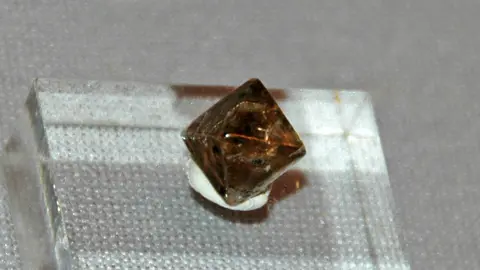
Brown diamond: Diamond (AK1 Pipe, Argyle Lamproite, Precambrian; Argyle Mine, Western Australia) (18021603662)
Diamond (AK1 Pipe, Argyle Lamproite, Precambrian; Argyle Mine, Western Australia) (18021603662). Photo: James St. John, CC BY 2.0, via Wikimedia Commons.
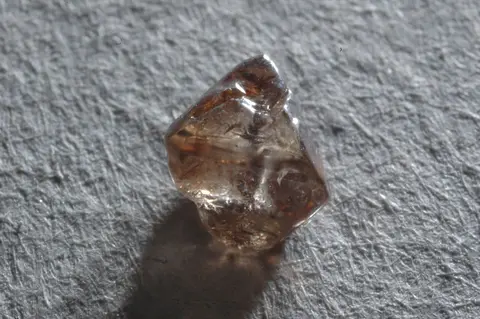
Brown diamond: Uncut-diamond
Uncut-diamond. Photo: Shieldforyoureyes Dave Fischer, CC BY-SA 3.0, via Wikimedia Commons.
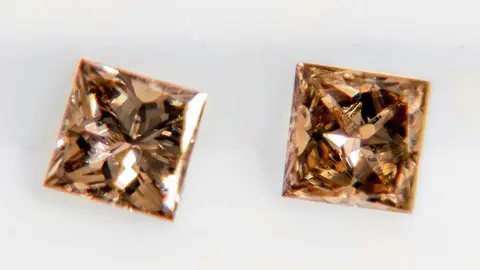
Brown diamond: Two princess cut coffee diamonds 2
Two princess cut coffee diamonds 2. Photo: W.carter, CC BY-SA 4.0, via Wikimedia Commons.

What brown diamond is worth

Not enough data. We have not yet seen 5 or more current dealer listings for brown diamond in any one form, so we show no range rather than guess.

These are dealer asking prices: what shops list brown diamond for, not what it sells for and not an appraisal. Selling to a dealer usually brings well below retail, because the dealer has to resell it at a margin.

How to identify brown diamond

Far more common than other fancy colors, so brown diamonds generally sell for less than colorless or other colored diamonds of the same size. Chocolate Diamonds is a jewelry brand's trademark, not a separate type. See diamond value for the species as a whole.

  • Light champagne to deep cognac and dark chocolate brown
  • Same diamond hardness, brilliance and single refraction
  • Often with brown graining visible under a loupe
  • Common in small sizes in pavé and cluster jewelry

Other diamond varieties

Where brown diamond comes from

Argyle mine, Western Australia
Produced huge volumes of brown diamonds and promoted the champagne and cognac names.
Most diamond mines
Brown is a common color worldwide.

Brown diamond lookalikes

Brown zircon

Zircon shows doubled back facets and chipped facet edges.

  • RI 1.92 to 2.01
  • SG about 4.6 to 4.7

Brown cubic zirconia

CZ is heavier and fails a thermal tester.

  • SG 5.6 to 6.0

Fake, dyed and treated brown diamond

  • Brown CZ sold under chocolate or cognac names

    Common

    • Fails a thermal tester
    • Heavy for size
    • Worn facet edges
  • Lab-grown brown diamonds

    Occasional

    • Passes home tests
    • Lab report or inscription

Is my brown diamond real? Tests you can do at home

  1. Multi tester

    Use a combined diamond and moissanite tester on a clean facet.

    Real
    Reads diamond.
    Fake or lookalike
    Smoky quartz, zircon and CZ fail.
  2. Loupe for doubling

    Look through the side at back facets at 10x.

    Real
    No doubling.
    Fake or lookalike
    Zircon and moissanite double.

A stone that passes these tests is consistent with natural brown diamond, not proven. For valuable pieces, a gem lab report settles treatment and origin.

Treatments

HPHT (occasional)
Brown type IIa diamonds can be turned colorless, and others turned yellow or green. These stones are sold as colorless or fancy and must be disclosed. Gem lab spectroscopy.
Irradiation (occasional)
Used to change brown stones to other fancy colors. Gem lab.

What moves the price of brown diamond

  1. Color depth and tone. Even, warm cognac and pinkish-brown tones are preferred over dull grayish browns.
  2. Carat weight. Larger stones bring more, though browns remain the most affordable natural diamond color.
  3. Clarity. Eye-clean stones sell better.
  4. Branding. Branded jewelry carries a retail premium that does not carry over to resale.

Sources

Prices: no current dealer listings yet. How we collect prices.