What topaz is worth
Show 12 of the listings behind these numbers
These are dealer asking prices: what shops list topaz for, not what it sells for and not an appraisal. Selling to a dealer usually brings well below retail, because the dealer has to resell it at a margin.
How to identify topaz
Topaz is an aluminum silicate mineral containing fluorine and hydroxyl, hardness 8, that forms in granite pegmatites and gas cavities in rhyolite. Natural topaz is mostly colorless, pale blue, golden brown or sherry colored; the bright blues on the market are treated.
- Heavy for a transparent gem: SG about 3.5, so a topaz feels noticeably weightier than quartz or beryl of the same size.
- Hardness 8: scratches quartz and glass easily.
- One perfect cleavage across the crystal, so broken crystals show a flat, mirror-like end and cut stones can show cleavage cracks parallel to the table.
- Crystals are prisms with a lozenge (diamond-shaped) cross section and vertical striations, ending in wedge or pyramid faces.
- Glassy luster and a slippery, smooth feel on crystal faces.
- Weak to moderate dichroism, stronger in imperial and pink stones.
Topaz varieties
Precious topaz
Precious topaz is an old trade term used to distinguish genuine topaz, especially golden to sherry imperial-type topaz, from citrine sold as 'topaz'. It is not a separate variety but a label for true topaz in golden and orange colors, as opposed to quartz sold under topaz names.
Utah topaz
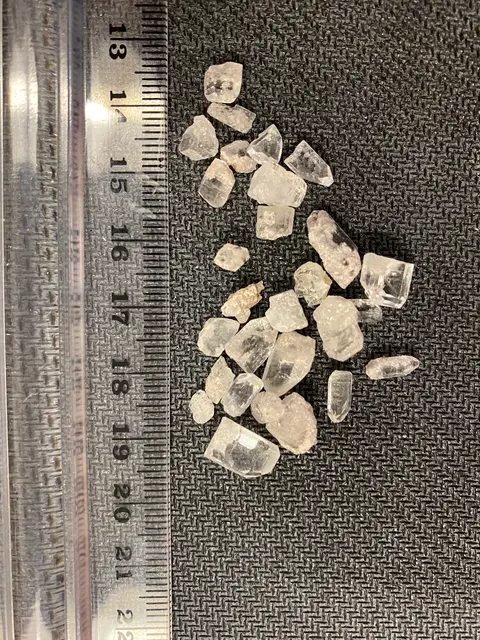
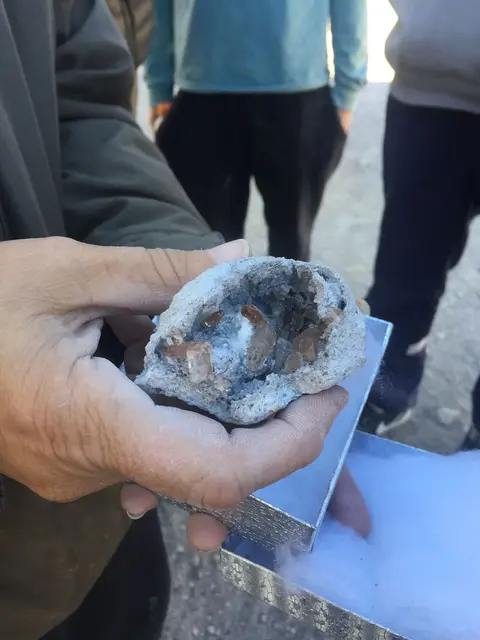
Utah topaz is sherry to golden brown topaz from rhyolite cavities in the Thomas Range (Topaz Mountain), Utah, often collected by the public. Its sherry color is unstable and fades to colorless after weeks to months of sunlight, so specimens are stored away from light.
Where topaz comes from
- Ouro Preto, Minas Gerais, Brazil
- The classic and main source of imperial topaz in golden orange to pinkish orange.
- Teofilo Otoni and other pegmatites, Minas Gerais, Brazil
- Large volumes of colorless and pale blue topaz used for treated blue.
- Katlang, Mardan, Pakistan
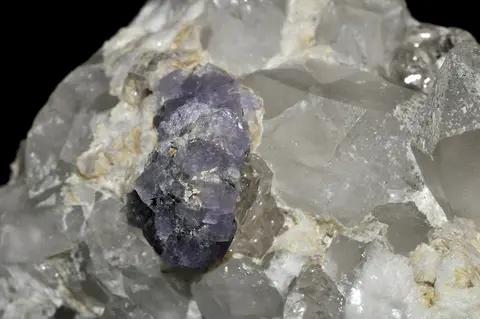
- Natural pink to violet topaz crystals in calcite.
- Thomas Range (Topaz Mountain), Utah, USA
- Sharp sherry crystals in rhyolite that fade to colorless in sunlight.
- Murzinka and Ilmen Mountains, Urals, Russia
- Historic source of blue and sherry crystals.
- Volyn, Ukraine
- Giant crystals, some weighing many kilograms, from pegmatite pockets.
- San Luis Potosi, Mexico
- Sherry crystals in rhyolite.
- Nigeria, Sri Lanka and Madagascar
- Colorless and pale blue cutting rough.
Topaz lookalikes
Aquamarine is much lighter (SG about 2.7 against 3.53), which shows clearly in a water displacement test.
- Aquamarine has no useful cleavage
- Treated blue topaz is often a more vivid blue than aquamarine of similar price
- Aquamarine RI 1.57 to 1.58
aquamarine vs topaz
Citrine is lighter (SG 2.65) and has no cleavage.
- Quartz hardness 7, topaz 8
- Citrine crystals end in a six-sided point
citrine vs topaz
Sapphire is heavier (SG 4.0) and harder (9), with a higher RI (1.76).
- Sapphire often shows color zoning and silk
- Topaz is scratched by sapphire
topaz vs sapphire
Zircon shows strong doubling of back facets and much more fire.
- Zircon SG 4.6 to 4.7
- Zircon facet edges chip and wear easily
blue zircon vs topaz
Diamond has far stronger sparkle and fire and passes a thermal diamond tester; white topaz does not.
- Almost identical SG (3.52), so weight does not help
- Diamond hardness 10
Also mistaken for topaz: quartz, tourmaline, phenakite, jeremejevite, danburite, euclase.
Fake, dyed and treated topaz
Irradiated and heated blue topaz
Very common
- Nearly all bright blue topaz on the market is treated colorless topaz
- Even, saturated sky, Swiss or London blue in large clean sizes
- Not a fake species, but rarely disclosed in casual sales
Coated 'mystic' and color-coated topaz
Very common
- Rainbow or uniform color sits on the pavilion surface
- Scratches and worn facet edges show colorless topaz underneath
Glass sold as topaz
Common
- Too light (SG about 2.5)
- Bubbles and swirls
- Soft, rounded facet edges
Citrine or smoky quartz sold as 'topaz', 'gold topaz' or 'Madeira topaz'
Common
- Much lighter than topaz
- Old trade names are still used on vintage jewelry and in some markets
Synthetic spinel or cubic zirconia sold as topaz
Occasional
- CZ is far heavier (about 5.8) with strong fire
- Spinel shows no dichroism
Is my topaz real? Tests you can do at home
-
Specific gravity by water displacement
Weigh the loose stone on a 0.01 g scale, then weigh it suspended in a cup of water, and divide dry weight by the weight lost.
- Real
- Topaz gives 3.49 to 3.57.
- Fake or lookalike
- Quartz and citrine 2.65, aquamarine 2.7, glass about 2.5, cubic zirconia about 5.8.
-
Scratch test on glass
Press a sharp crystal edge or unset rough firmly across a glass plate.
- Real
- Topaz bites into glass easily.
- Fake or lookalike
- Glass fakes skid or scratch only weakly.
Can leave a small mark.
-
Loupe check for cleavage and coatings
Examine the stone with a 10x loupe, paying attention to the pavilion facets and any internal flat cracks.
- Real
- Flat cleavage cracks parallel to the base are typical; color goes through the whole stone.
- Fake or lookalike
- Coated stones show scratches with colorless material beneath; glass shows bubbles.
-
Crystal shape check
On rough, look at the cross section and the end of the crystal.
- Real
- Lozenge-shaped cross section, vertical striations, flat cleavage or wedge-shaped ends.
- Fake or lookalike
- Quartz has a hexagonal section and pointed end; glass has no crystal faces.
A stone that passes these tests is consistent with natural topaz, not proven. For valuable pieces, a gem lab report settles treatment and origin.
Treatments
- Irradiation and heating to blue (almost always)
- Turns colorless topaz sky, Swiss or London blue; stable and so common that blue topaz is inexpensive. Not reliably detectable outside a lab, but any vivid blue topaz should be assumed treated.
- Heating of imperial topaz to pink (common)
- Turns orange chromium-bearing topaz pink; heated pink is accepted but natural pink brings more. Lab examination.
- Surface coating (common)
- Thin films add rainbow (mystic) or other colors; the coating can wear off and the stone has little value beyond the setting. Worn facet edges and scratches show colorless topaz under a loupe.
What moves the price of topaz
- Variety and color origin. Natural imperial, pink and red topaz are far more valuable than treated blue or white topaz.
- Color saturation. Deep, even orange to pinkish orange imperial topaz brings the most; pale golden stones less.
- Size. Large treated blue is cheap at any size, but large natural imperial stones are scarce.
- Clarity. Topaz is usually eye clean, so visible inclusions or cleavage cracks lower value.
- Cut. Well-proportioned stones with good brilliance sell better; elongated cuts follow the crystal shape in imperial topaz.
- Specimen quality. Sharp, undamaged crystals on matrix from Katlang, Utah or Ouro Preto are valued as specimens.
Questions collectors ask about topaz
- Are topaz stones expensive?
- Most are not. Treated blue and white topaz are among the least expensive transparent gems, while natural imperial, pink and red topaz are rare and priced much higher. The price table above shows ranges by variety.
- How can you tell if topaz is real?
- Measure specific gravity: topaz is about 3.5, much heavier than glass, quartz or aquamarine. It also scratches glass easily and often shows flat cleavage cracks under a loupe.
- Which type of topaz is the most expensive?
- Natural red to pinkish red and pink topaz, followed by deep orange imperial topaz from Ouro Preto. Treated blue and colorless topaz are the least expensive.
- What is the rarest color of topaz?
- Natural red and strongly saturated natural pink are the rarest topaz colors. Most pink topaz on the market is heated imperial topaz or coated colorless topaz.
- Sapphire vs topaz: how do you tell them apart?
- Sapphire is harder (9 against 8), heavier (SG 4.0 against 3.5) and has a higher refractive index. Blue topaz is usually a lighter, more electric blue and is far less expensive.
Sources
Prices: 16 current listings from Dakota Matrix Minerals, FossilEra, iRocks (The Arkenstone), seen 2026-11-20 to 2026-11-20. How we collect prices.