What danburite is worth
Not enough data. We have not yet seen 5 or more current dealer listings for danburite in any one form, so we show no range rather than guess.
Show 1 of the listings behind these numbers
These are dealer asking prices: what shops list danburite for, not what it sells for and not an appraisal. Selling to a dealer usually brings well below retail, because the dealer has to resell it at a margin.
How to identify danburite
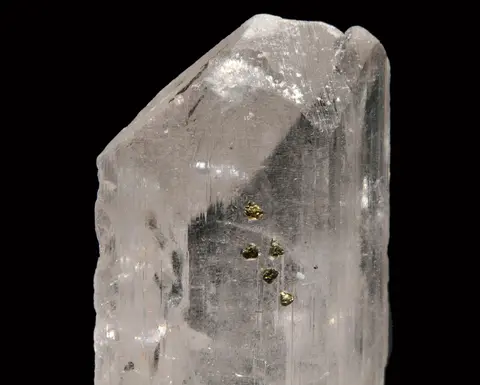
- Prismatic crystals with a diamond-shaped (rhombic) cross section and lengthwise striations.
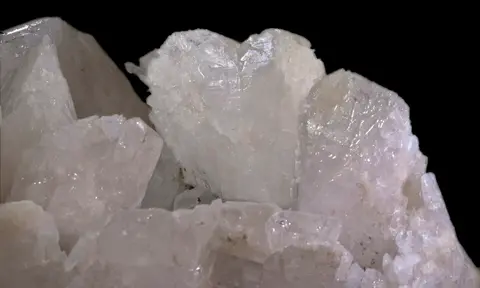
- Terminations are chisel or wedge shaped, not the six-sided pyramid points of quartz.
- Glassy to slightly greasy luster; usually colorless, white, pale pink, pale yellow or brownish.
- Hardness 7 to 7.5: scratches glass easily.
- Noticeably heavier than quartz of the same size (specific gravity about 3.0).
- Many crystals fluoresce sky blue under longwave UV.
Where danburite comes from
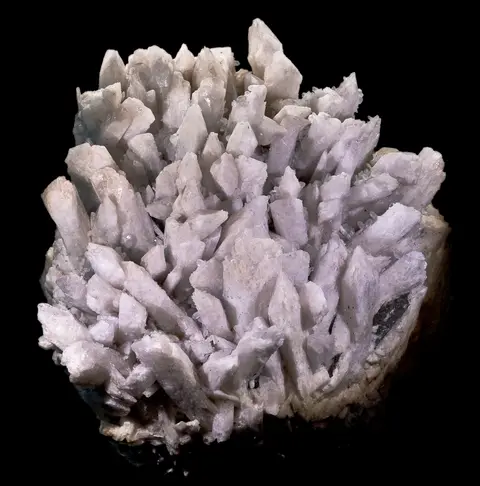
- Charcas, San Luis Potosí, Mexico
- The main specimen source: large, sharp colorless to pale pink crystals and clusters.
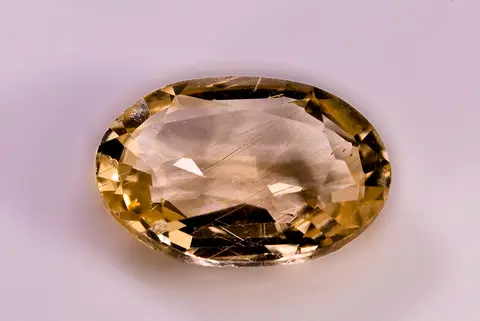
- Mogok, Myanmar
- Yellow gem-quality crystals cut into faceted stones.
- Dalnegorsk, Primorsky Krai, Russia
- Colorless crystals with other borosilicates from the skarn deposits.
- Tanzania and Madagascar
- Yellow to colorless gem rough for faceting.
- Danbury, Connecticut, USA
- Type locality, now built over; of historical interest only.
Danburite lookalikes
Quartz crystals have a six-sided cross section with pyramid points; danburite prisms are diamond shaped in cross section with wedge-shaped tips.
- Quartz specific gravity 2.65 versus danburite about 3.0
- Quartz striations run across the prism, danburite striations run lengthwise
- Quartz rarely fluoresces
Topaz has perfect cleavage across the prism and is heavier (specific gravity about 3.5).
- Topaz hardness 8
- RI 1.61 to 1.64
Kunzite shows strong pleochroism (deeper pink down the length) and perfect cleavage; pink danburite has weak pleochroism and poor cleavage.
- Kunzite specific gravity about 3.18
- Kunzite hardness 6.5 to 7
- Kunzite fades in strong light
danburite vs kunzite
Apatite is softer (5) and does not scratch glass.
- Hexagonal crystals
- Specific gravity about 3.2
Also mistaken for danburite: spodumene, phenakite, hambergite.
Fake, dyed and treated danburite
Quartz points sold as danburite
Occasional
- Six-sided cross section and pyramidal termination
- Lighter in hand (specific gravity 2.65)
- Horizontal striations on the prism
Glass faceted stones sold as danburite
Rare
- Round bubbles
- Rounded facet edges
- Does not scratch glass well
Is my danburite real? Tests you can do at home
-
Crystal shape check
Look at the end of the crystal and its cross section.
- Real
- Diamond-shaped cross section and wedge or chisel-like termination with lengthwise striations.
- Fake or lookalike
- Quartz shows six sides and a pyramid point with horizontal striations.
-
Specific gravity with a kitchen scale
Weigh the crystal dry, then the water it displaces when suspended in a cup on the scale; divide.
- Real
- About 3.0.
- Fake or lookalike
- Quartz 2.65; topaz about 3.5.
-
UV torch
Shine a longwave UV flashlight on the crystal in a dark room.
- Real
- Many danburites glow light blue.
- Fake or lookalike
- Quartz and glass usually stay dark. No glow does not rule out danburite.
-
Scratch against glass
Drag a crystal edge across a glass plate on an unseen spot.
- Real
- Scratches glass easily.
- Fake or lookalike
- Apatite and glass imitations do not scratch glass well.
Can leave a small mark.
A stone that passes these tests is consistent with natural danburite, not proven. For valuable pieces, a gem lab report settles treatment and origin.
What moves the price of danburite
- Crystal quality. Sharp, transparent, undamaged crystals and clusters are worth the most as specimens.
- Color. Saturated yellow faceted stones and pink crystals sell above colorless material.
- Size and clarity. Larger clean faceted stones are uncommon and command more.
- Locality. Charcas, Mexico, specimens and Burmese yellow gems are well known; classic or documented material adds value.
- Cut quality. Well-cut stones show the brightness that makes danburite attractive.
- Damage. Chipped terminations and edges reduce specimen value.
Sources
Prices: 1 current listings from iRocks (The Arkenstone), seen 2026-11-20 to 2026-11-20. How we collect prices.